Key takeaways
What this article covers, in order:
- Where Mumbai businesses usually lose time on bookkeeping
- What AI bookkeeping actually automates in an Indian setup
- GST accuracy matters more than raw speed
- A realistic Mumbai workflow: from bill image to filed return
- An illustrative, invented scenario shows the gain more honestly
- What to look for if you are moving from spreadsheets or Tally
India’s small businesses in Mumbai can automate much of data entry by using AI bookkeeping to capture purchase bills, read bank statements, prepare GST-ready entries, and reconcile invoices against receipts instead of typing everything into spreadsheets or Tally. The real gain is not “AI” by itself; it is cleaner books for GST, faster month-end closure, fewer duplicate entries, and less scrambling before filing on the GST Portal run through GSTN under the Central Goods and Services Tax Act, 2017 and related state GST laws.
Where Mumbai businesses usually lose time on bookkeeping
For many Mumbai shops, agencies, distributors, consultants, and online sellers, bookkeeping is still a patchwork of Excel files, accountant follow-ups on WhatsApp, bank statement downloads, and backfilled entries near return time. The work looks small in isolation: typing supplier bills, checking GSTINs, splitting CGST and SGST or IGST, updating stock, matching customer receipts from UPI, NEFT, RTGS, or IMPS, and then trying to make the books agree with GSTR-1 and GSTR-3B.
That manual flow creates three predictable problems:
- the same transaction gets typed more than once
- GST treatment is applied inconsistently
- month-end reports do not match what is filed
In Mumbai, where many owners move between store, warehouse, and customer meetings, bookkeeping often happens late at night or in batches. That is exactly where automation helps: not by replacing judgement, but by reducing repetitive entry.
What AI bookkeeping actually automates in an Indian setup
In India, bookkeeping automation is useful when it handles the documents and compliance context businesses already deal with. That usually means:
- reading supplier bills from PDFs or phone photos
- turning those bills into purchase entries
- importing bank activity from an uploaded statement instead of keying each line manually
- matching receipts and payments against invoices or bills
- applying place-of-supply logic so the right tax heads are used
- keeping sales, purchases, ITC tracking, and reports aligned
For example, when a purchase invoice arrives as a PDF, OCR can pull the supplier name, invoice number, taxable value, and GST amounts for review. When a monthly bank statement is uploaded, AI can suggest matches between credits and open customer invoices, or between debits and supplier payments, rather than forcing someone to reconcile line by line.
If the business also raises GST invoices from the same system, the books become much cleaner because sales entries do not need to be re-created from scratch later. HelloBooks fits this workflow by combining GST invoicing with OCR for purchase bills and bank statement upload with AI reconciliation, so invoices, expenses, and receipts sit in one set of books instead of scattered files.
GST accuracy matters more than raw speed
A lot of “automation” articles focus on time saved. In India, the bigger issue is often accuracy under GST.
When sales and purchase data are entered manually, common errors include:
- wrong GSTIN copied from an old invoice
- charging IGST on a local sale, or CGST and SGST on an inter-state sale
- using the wrong HSN or SAC
- missing reverse charge treatment where applicable under GST law NEEDS EXPERT REVIEW
- claiming input tax credit from bills that do not line up with GSTR-2B
These are not just bookkeeping mistakes. They affect returns filed on the GST Portal and can create notices, reversals, or rework. Current return rules, advisories, and operational details are published by CBIC and GSTN on their official portals; businesses should check those sources or ask a qualified professional before relying on any practice point.
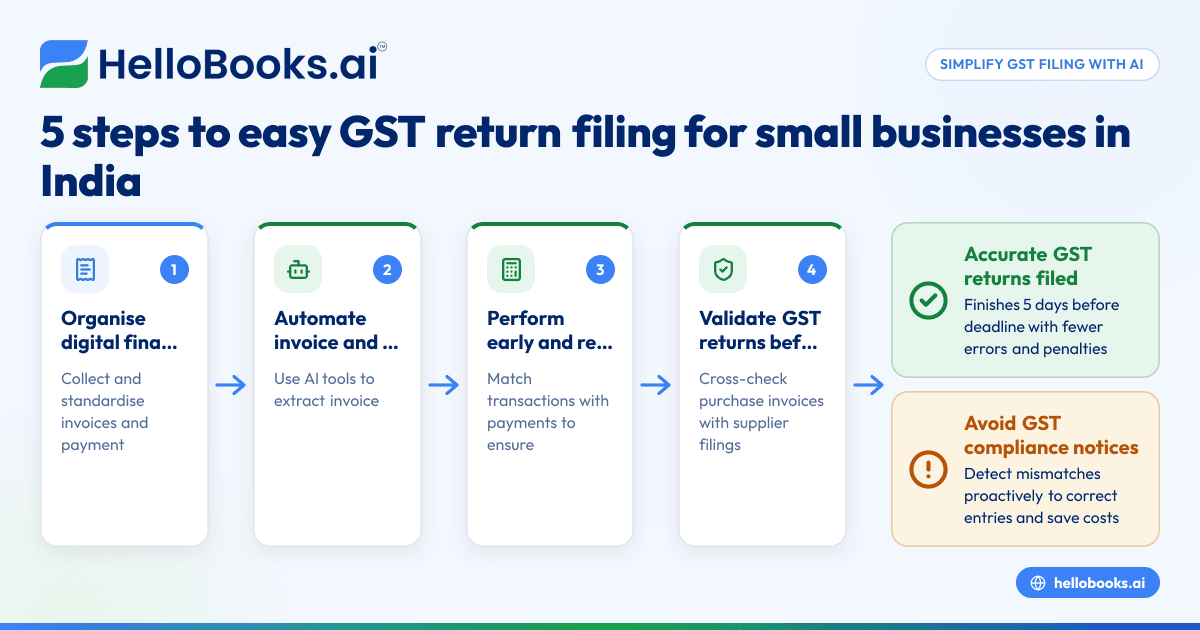
Software helps most when it reduces these errors at source. If a system determines the place of supply and applies the tax-head split before the invoice is saved, there is less fixing later. If purchase bills are tracked against GSTR-2A or GSTR-2B before GSTR-3B is prepared, the business can spot missing supplier uploads earlier.
HelloBooks is useful here because the same records that support invoices can also flow into GSTR-1 and GSTR-3B filing, while purchase-side matching helps with ITC tracking. That matters more than flashy automation claims: clean data in, fewer surprises out.
A realistic Mumbai workflow: from bill image to filed return
Consider a small wholesaler in Andheri or Bhiwandi supplying goods across Maharashtra and to buyers in Gujarat. The owner receives supplier invoices by email and sometimes as paper copies with the goods. Customer payments come through UPI, NEFT, and occasional cash deposits, while dispatches may require an e-way bill depending on the movement and the rules published by CBIC and the e-way bill system.
Without automation, someone might:
- type purchase bills into a ledger
- type sales into another file
- update inventory separately
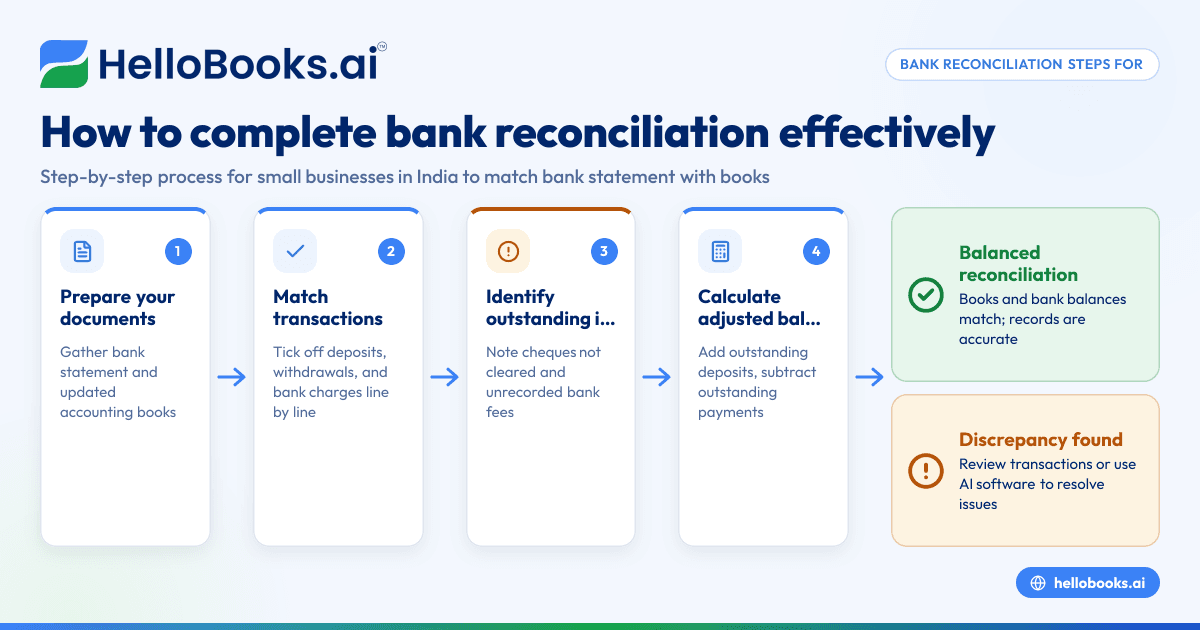
- download a bank statement and manually tick receipts
- prepare GST workings in Excel
- re-enter figures into the GST Portal
With a more integrated setup, the process changes:
- purchase bills are captured from image or PDF and reviewed
- sales invoices are created with the right GST split and GSTIN details
- stock updates as purchases and sales are recorded
- bank statements are uploaded and matched against open invoices and bills
- GSTR-2A or 2B reconciliation highlights supplier mismatches
- GSTR-1 and GSTR-3B are prepared from the books already maintained
That is where AI bookkeeping becomes practical rather than aspirational. HelloBooks also supports inventory, so a trading business is not maintaining stock in one tool and accounts in another, and it can generate e-way bill data from invoice records when movement documentation is needed through an e-way bill workflow.
An illustrative, invented scenario shows the gain more honestly
Take an invented Mumbai business with monthly sales of ₹12 lakh and around 180 purchase bills. These figures are illustrative and invented, and they leave out industry-specific complications, credit notes, payroll entries, depreciation, and complex contract terms.
If one staff member spends about 3 minutes typing each purchase bill, that is roughly 540 minutes just on bill entry. If another 6 hours a month goes into matching bank statement lines to invoices and supplier payments, and another 4 hours goes into checking GST splits and return workings, the manual process can easily cross 19 hours in a month.
In a software-led setup, OCR may prefill many purchase fields for review instead of full manual entry. Uploaded bank statements can suggest likely matches for customer receipts. Sales invoices already contain the GST treatment used for reporting. Even if the team still reviews everything carefully, the work may shift from repetitive typing toward exception-checking.
The point is not that every business will save the same hours. The point is that the highest-friction tasks in Mumbai bookkeeping are repetitive and structured, which makes them suitable for automation.
What to look for if you are moving from spreadsheets or Tally
Many Mumbai businesses are not starting from zero. They already have years of entries in Tally, accountant-built ledgers, and habits shaped around year-end finalisation under the Income-tax Act, 1961 and company-law reporting where relevant under the Companies Act, 2013 overseen by the MCA.
So the question is not just “Can AI read my bills?” It is also:
- can I migrate without breaking my books?
- will my CA still be able to review what matters?
- can multiple users work across billing, purchases, and accounts?
- can I maintain more than one GSTIN if I operate in multiple states?
This is where a generic bookkeeping app often falls short in India. A local workflow needs GST-first records, tax-head logic, and enough continuity with existing systems. HelloBooks supports Tally migration and a connector, which can make testing a new workflow less disruptive for businesses that have old masters, stock items, and ledger structures they cannot rebuild overnight. If you are comparing options, accounting software for small business, accounting software in India, and even a Tally alternative lens are more useful than just asking whether a product has “AI.”
The bank statement is often the fastest place to start
Owners often think automation must begin with a full software replacement. In practice, the easiest win is usually bank reconciliation.
Why? Because the bank statement already contains the trail of what happened: customer receipts, supplier payments, rent, card settlements, and transfers. Once the statement is uploaded, software can suggest matches against open invoices and bills, flag unmatched transactions, and reduce the need to retype narration into the books.
That is particularly helpful for Mumbai businesses with many low-value receipts through UPI or frequent transfer traffic through NEFT and IMPS. The volume creates fatigue, and fatigue creates errors.
What matters here is to keep expectations realistic. AI reconciliation is not the same as blind posting. It should propose likely matches, surface exceptions, and let a human confirm. Businesses still need controls over cash transactions, partner drawings, suspense entries, and unusual receipts.
HelloBooks is built around uploaded bank statements for India rather than promising a magical hands-off process, which is a healthier way to automate bookkeeping: import, suggest, confirm, and report.
Purchase bills, ITC tracking, and supplier discipline
For GST-registered businesses, the purchase side is where bookkeeping and tax compliance really meet.
A bill is not just an expense record. It can affect:
- vendor outstanding balances
- stock valuation
- TDS accounting in some cases under the Income-tax Act, 1961
- reverse charge treatment in some cases under GST law NEEDS EXPERT REVIEW
- input tax credit tracking against GSTR-2A or GSTR-2B
That is why simply storing PDFs in a folder does not solve the problem. The bill has to become a structured accounting entry.
OCR helps by extracting the repetitive fields, but the stronger advantage is what happens next: bills can be tied to supplier ledgers, taxes can be checked, and ITC visibility becomes easier before filing. HelloBooks supports OCR for purchase bills and tracks reconciliation against GSTR-2A or 2B, which is far more relevant for an Indian business than generic receipt scanning alone.
If a supplier’s GSTIN looks doubtful or an invoice format seems incomplete, free validation tools can help at a basic level before deeper review. HelloBooks provides India-specific utilities such as a GSTIN validator, HSN code search, and a GST reconciliation checker.
Mobile entry matters when the owner is rarely at the desk
A Mumbai proprietor may approve purchases from the market, check dispatches from a godown, and chase collections while commuting. If bookkeeping only happens on an office desktop, delay becomes normal.
Mobile access changes that. A bill can be captured when it arrives. An invoice can be raised at the point of sale or after a service visit. An expense can be recorded before the paper slip disappears. A follow-up question about the books can happen quickly instead of waiting for the accountant’s next call.
That is why a practical India setup should not separate the bookkeeping engine from day-to-day business movement. HelloBooks’ mobile app on iOS and Android helps owners and staff record invoices and expenses without waiting to get back to the office, and Noor on WhatsApp in Hindi, English, or Hinglish can suit teams that already coordinate work there.
Compliance still needs judgement, not just software
Automation reduces clerical effort. It does not remove legal responsibility.
Businesses still need to verify:
- whether an invoice is valid for GST purposes under the CGST Rules and related law
- whether e-invoicing applies to them under notifications and advisories published by CBIC and the GST system, including IRN and signed QR requirements where applicable
- whether e-way bill generation is required for a movement, based on the law and current official guidance
- whether TDS or TCS treatment is relevant for a transaction under the Income-tax Act, 1961 or GST law as applicable
- whether records handling aligns with broader legal obligations, including data handling practices under India’s DPDP framework NEEDS EXPERT REVIEW
So the best use of AI bookkeeping software is to make the books cleaner, faster, and more reviewable. It should leave fewer loose ends for the owner, accountant, or CA to resolve.
If your business is in Mumbai and the problem is too much typing, late reconciliations, and GST work rebuilt every month from scratch, start with the part causing the most rework: invoices, purchase-bill capture, or bank statement reconciliation. Then make sure those records feed directly into reporting and GST filing instead of becoming one more disconnected tool. For a closer look at the India workflow, see HelloBooks India, book a demo, or review pricing.