
Key takeaways
What this article covers, in order:
- Before you start
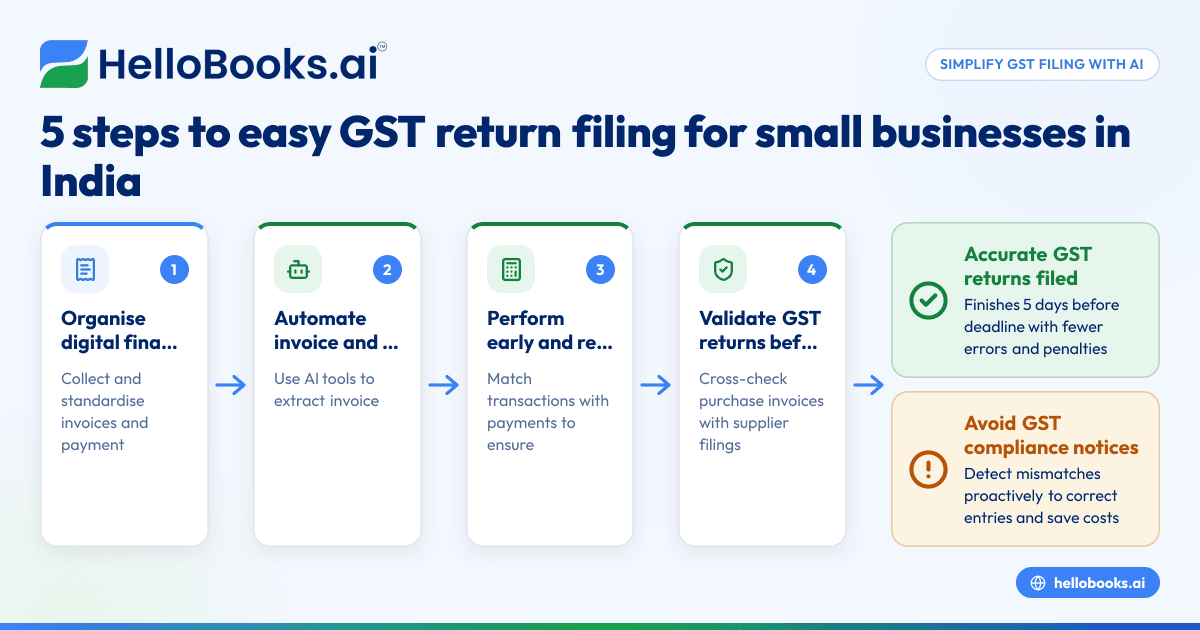
- Step 1: How do I organise my financial data digitally?
- Step 2: How to automate invoice and expense capture effectively?
- Step 3: Why should I perform bank reconciliation early and regularly?
- How does AI GST return software simplify filing GST returns?
- Step 4: How to validate your GST returns before filing?
How AI Accounting Software Simplifies GST Return Filing Process for Small Businesses in India
This guide is for small business owners, finance leads, and accountants in India who want to reduce the time and errors in the GST return filing process. By the end, you will know how to streamline GST filings using AI GST return software and avoid common pitfalls.
Before you start
- Have your business's GST registration details handy (GSTIN, legal name).
- Maintain your purchase and sales invoices digitally.
- Access your bank statements for bank reconciliation.
- Choose suitable AI-powered accounting software that supports GST filing.
Step 1: How do I organise my financial data digitally?
Accurate GST return filing starts with organised, digital financial records. Collect all sales and purchase invoices, expense bills, and payment data in one place. This makes it easier to classify transactions under GST heads like CGST, SGST, or IGST.
Why: Manual data entry increases errors and wastes time. Electronic records ensure you can use AI GST return software effectively for automation. Digitised data allows the software to scan, categorise, and aggregate information quickly, preparing your returns with minimal human intervention.
Common mistake: Relying on paper invoices or scattered spreadsheets that cannot be integrated with accounting systems. Many businesses still have bills saved in folders on desktops or shared via WhatsApp in unstructured formats, making automation difficult.
Tip: Standardise invoice formats and encourage suppliers to send GST-compliant invoices electronically or via email. You can also store invoices in organised cloud folders tagged by month or vendor for easy retrieval.
Step 2: How to automate invoice and expense capture effectively?
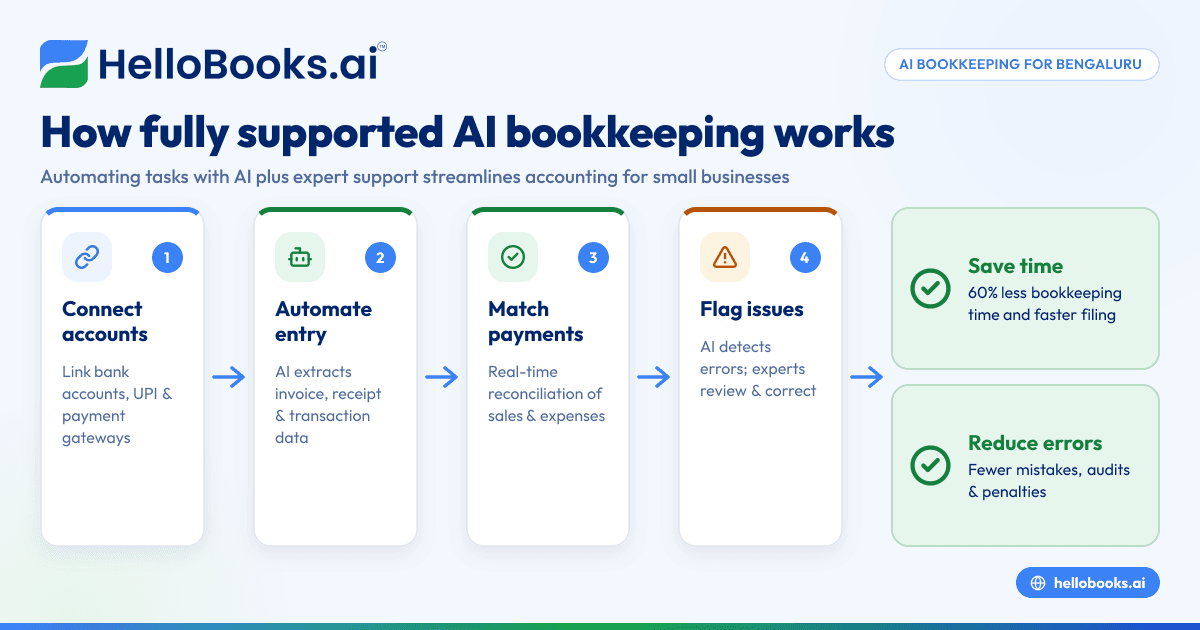
Deploy AI-powered invoice software or expense management software to automatically extract invoice details. These tools scan images or PDFs and capture vendor names, invoice numbers, dates, taxable amounts, and GST components.
Why: This speeds up data entry and reduces mistakes, especially for businesses receiving large volumes of invoices or bills from IndiaMART or JustDial leads. Automation reduces the workload of your finance team and helps keep records up to date in real time.
Common mistake: Entering invoice data manually and missing GST components or wrongly inputting tax rates. Manual entry can cause mismatches leading to GST compliance notices. Also, many businesses fail to record the reverse charge mechanism correctly for certain purchases.
Tip: Set up automated reminders to your vendors to share GST-compliant invoices timely and digitally, which your AI software can capture immediately.
Step 3: Why should I perform bank reconciliation early and regularly?
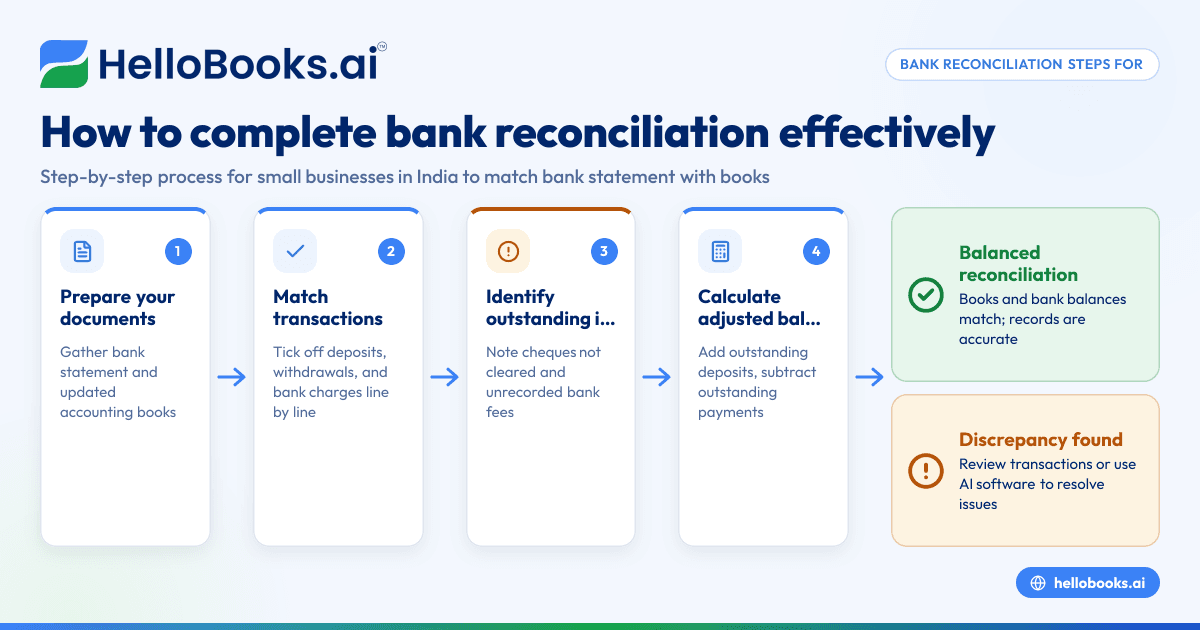
Reconcile your bank transactions against your recorded receipts and payments using bank reconciliation software. This can be automated with AI to flag mismatches, missing invoices, or unaccounted transactions.
Why: GST returns require correct taxable turnover reporting. Bank reconciliation ensures your sales, expenses and revenue numbers match actual cash flows, avoiding discrepancies between your GST filings and actual payments or collections.
Common mistake: Delaying reconciliation until GST filing deadlines, which causes a scramble and errors. Late reconciliation risks missing sales made on credit or expenses paid digitally but not yet recorded in books.
Tip: Schedule weekly or bi-weekly reconciliations instead of monthly to keep your books fresh and minimise errors during GST filing season.
How does AI GST return software simplify filing GST returns?
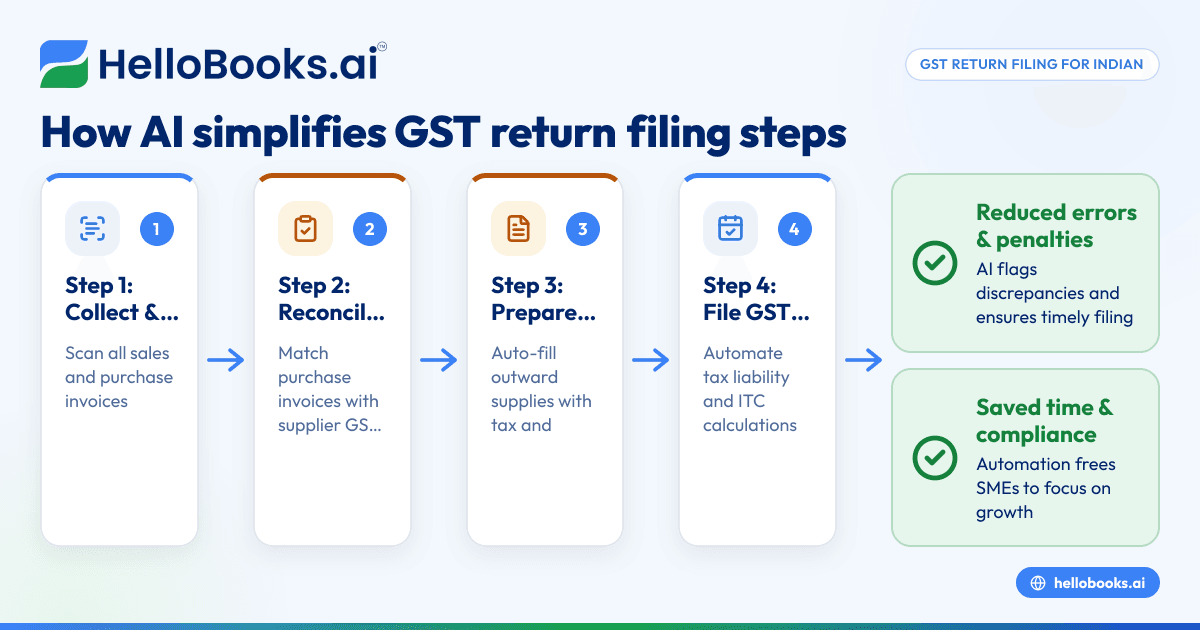
AI GST return software automates data aggregation, error checking, and prepares GST returns in formats prescribed by the GST portal (e.g., GSTR-1, GSTR-3B). It reduces manual data entry and detects mismatches with supplier invoices for correction.
The software pulls together all taxable sales, purchase invoices, and input tax credit details, then populates the return forms. It cross-verifies supplier GST return data (where available) and alerts you of mismatches or missing invoices, so corrections can be made proactively. Businesses can submit returns faster and with fewer errors, lowering penalties and stress during filings. Behind this, role-based dashboards, automated reminders, and e-invoicing integration make compliance smoother for small businesses operating in Mumbai, Bengaluru, Pune, and other Indian cities.
Step 4: How to validate your GST returns before filing?
Before submitting your GST returns, the AI accounting software cross-verifies your purchase invoices against supplier filings and flags inconsistencies. It highlights missing or mismatched entries so you can correct them in time.
Why: Validation prevents GST notices and penalties for mismatches after filing—saving money and effort. The GST portal constantly matches your GSTR-2A or 2B data with your filings, and mismatches trigger notices.
Common mistake: Filing returns without matching purchase data with suppliers’ filings, inviting future scrutiny. Some businesses file returns hastily without performing validation, leading to rejected returns or demands for documentation from tax authorities.
Tip: Run validation reports a few days before the GST filing deadline. This buffer allows you to reach out to suppliers for reconciliations or correct your entries without penalty.
Step 5: How to file your GST returns online efficiently?
Most AI accounting software connects directly with the GST portal using APIs or generates return files ready for upload. Some solutions allow you to file multiple returns (monthly GSTR-3B, quarterly GSTR-1) in a few clicks from a dashboard.
Why: This saves time and ensures neat, error-free forms, reducing chances of filing rejections. The built-in data checks align with GST portal validations, preventing entry errors during filing.
Common mistake: Manually preparing return forms leads to transcription errors and delays compliance. Using manual offline utilities or copying data from spreadsheets adds avoidable risks and wastes time.
Tip: Choose software offering end-to-end GST return filing support including e-invoicing integration, automated payment of GST liabilities, and status tracking.
A worked example: Filing GSTR-3B with AI accounting software
Imagine a Pune-based small apparel business making ₹25 lakh in sales and purchasing ₹15 lakh worth of inputs monthly. They receive about 150 purchase bills each month and issue around 200 sales invoices, often with varying GST rates (5%, 12%, 18%).
Here’s how the process unfolds:
- Invoice capture The finance team uploads purchase bills received digitally or by WhatsApp into AI expense management software. The AI scans each invoice, extracts vendor details, invoice number, GSTIN, date, taxable amounts and GST components (CGST, SGST, IGST). It classifies expenses by category automatically.
- Bank reconciliation Concurrently, the bank reconciliation tool imports statements from their leading bank accounts and matches incoming payments against sales invoices. It flags 10 payments recorded in bank but missing sales invoice entries, which finance promptly investigates and resolves.
- GST data aggregation The AI aggregates all GST-relevant invoices — sales and purchases — consolidates total values under correct GST heads, and prepares draft GSTR-3B file with taxable turnover, input tax credit, and GST liability computed.
- Validation The software compares purchase invoices against suppliers’ filings available from GST portal data. It finds 5 mismatched purchase bills with suppliers not filing the corresponding invoices yet. The finance lead contacts suppliers for correction and updates entries accordingly.
- Return filing After final validation, the AI accounting software uploads the approved GSTR-3B via API to GST portal directly from the dashboard. Filing completes 5 days before the 20th of the next month deadline.
- Reporting & reminders Automated alerts remind staff about e-way bill generation for outbound shipments over ₹50,000, and track GST payment schedules. Monthly reports help management monitor GST compliance costs and cash flow.
This example shows how AI software replaces manual task duplication, reduces human error, and streamlines compliance — saving the Pune business time and costly mistakes.
What common challenges does AI GST return filing solve?
AI GST return filing automates tedious processes, reducing errors and saving time. It handles mismatches, speeds reconciliation, and ensures compliance with GST laws efficiently.
By automating data entry, it cuts manual errors and typos. It quickly matches supplier invoices and bank transactions to identify missing or incorrect entries. Automating checks also keeps GST filings accurate, minimizing penalties and compliance risks. Managing different GST rates and e-invoices becomes easier, keeping you ahead of deadlines. For small businesses in India, this technology transforms GST return filing from a burden into a straightforward task.
How do I get started with AI GST return filing software?
Begin by choosing AI accounting software designed for Indian GST compliance. Upload your digital invoices and bank statements to start automatic data extraction and reconciliation. Set up validation reports and reminders for timely filing.
Select a solution that offers integration with the GST portal and supports e-invoicing. Many software options provide dashboards to monitor your GST filing status and alerts for pending tasks. This will reduce your filing stress and improve accuracy.
Explore different AI accounting software plans on hellobooks.ai’s pricing page, and you can also book a demo to see how automation fits your business workflow and budgets.
By adopting AI tools for GST return filing, you simplify the process, maintain accurate records, and ensure timely compliance with GST laws in India. Your next step is to organise your invoices digitally and explore AI solutions that fit your needs and budget.
Get started with the GST return filing process today and focus more on growing your business. Book a demo at /book-a-demo or find the right plan at /pricing to experience hassle-free GST filing powered by AI.
Related reading
- accounting software for small business
- How HelloBooks AI Automates GST Return Filing for Small Businesses in India
- How Small Businesses in Dadra and Nagar Haveli Can Simplify GST Return Filing Using AI Bookkeeping
Read next
This article covers one part of a bigger topic. For the complete picture, read our guide to fully supported.