
Key takeaways
What this article covers, in order:
- The data entry mistakes Indian SMEs actually run into
- Where AI helps most in an Indian bookkeeping workflow
- GST classification errors are especially expensive to clean up later
- Purchase bills, OCR and GSTR-2B checks reduce the “side spreadsheet” problem
- Bank statement upload is often the fastest win
- Inventory and multi-branch operations create hidden entry errors
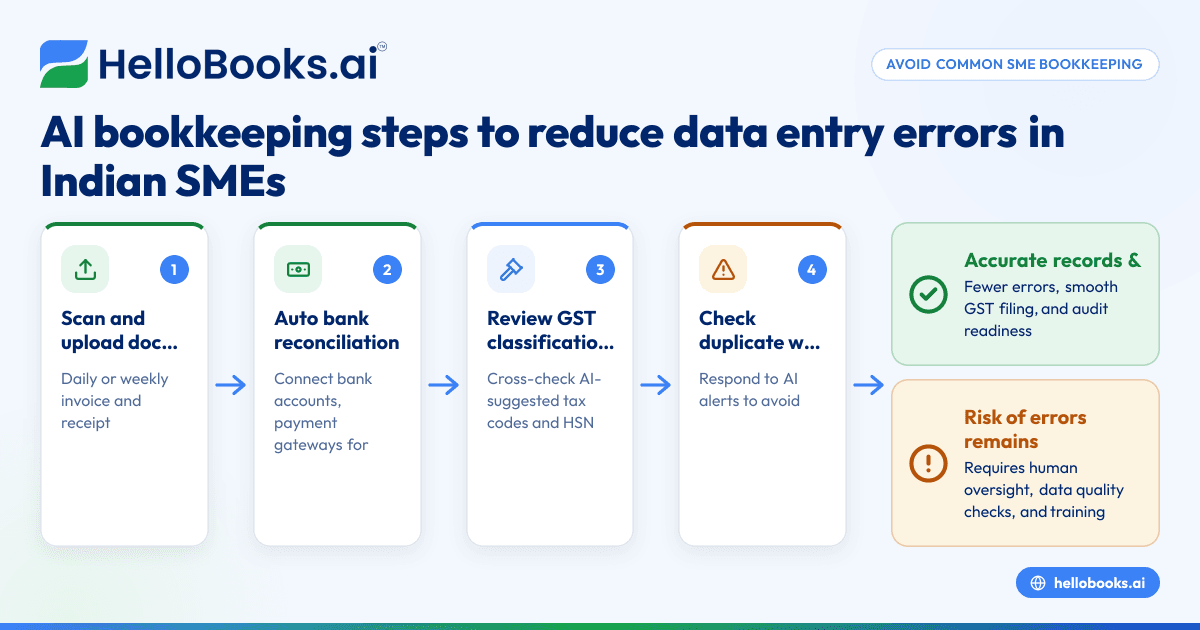
India’s SMEs can cut many day-to-day data entry mistakes by using AI bookkeeping for the repetitive parts: reading purchase bills, preparing GST invoices, matching uploaded bank statement lines to receipts, and reconciling books against GST data before filing. It helps most with repeatable errors such as duplicate entries, wrong GST head splits, missed collections, and manual typing mistakes. But AI is not a substitute for review: under the Central Goods and Services Tax Act, 2017 and related rules administered by CBIC through GSTN and the GST portal, the registered person remains responsible for what gets filed.
The data entry mistakes Indian SMEs actually run into
In India, bookkeeping errors are rarely abstract. They usually happen in familiar places: a rupee figure keyed in with one zero too many, a supplier bill entered twice, a UPI receipt not matched to the right invoice, an interstate sale posted with CGST and SGST instead of IGST, or an expense left sitting in WhatsApp photos until month-end.
For many SMEs, the problem starts with fragmented records. Sales may be raised in one tool, purchases arrive as PDFs or paper bills, collections come through UPI, NEFT, RTGS or IMPS, and the accountant later retypes everything into Tally or a spreadsheet. Every re-entry creates another chance for a mismatch.
The most common Indian error patterns include:
- invoice details copied wrongly from a customer GSTIN or old invoice
- incorrect place of supply, leading to the wrong CGST/SGST or IGST split
- purchase bills entered with the wrong supplier name or invoice number
- duplicate expense entries when the same bill comes by email and paper
- receipts appearing in the bank statement but never linked back to receivables
- inventory quantities updated late, so stock and accounts disagree
- input tax credit tracked in a side sheet instead of against GSTR-2A/2B data
These mistakes hurt beyond compliance. A wrong ledger can distort receivables, stock, margins and cash planning. For a business working in lakh and crore terms, even a small posting habit can snowball into month-end confusion.
Where AI helps most in an Indian bookkeeping workflow
AI bookkeeping works best when it removes repeated typing, not when it is expected to “understand” every transaction without context. In practice, Indian SMEs benefit most when software captures information once and reuses it across books, GST work and reports.
If a supplier sends a PDF or photo bill, OCR can pull out the invoice number, date, taxable value and GST fields instead of making someone type them line by line. If the owner uploads a bank statement, the system can suggest matches between bank entries and invoices or expenses, reducing manual reconciliation. If a sale is created with the customer’s GSTIN and state details, the invoice can apply the correct tax head split based on place of supply logic rather than guesswork.
That matters because Indian compliance is joined up. The same underlying entries influence invoices, GST returns, stock, debtors and financial reports. When one entry is wrong, several outputs become wrong together.
This is where HelloBooks is useful in a specifically Indian sense: it can create GST invoices with the right place-of-supply treatment, help generate e-invoices with IRN and signed QR where applicable, let you upload a bank statement for AI reconciliation, read purchase bills through OCR, and file GSTR-1 and GSTR-3B from the recorded transactions. That reduces repeated typing across the GST portal workflow instead of merely shifting data entry to a different screen.
If you want to see how that fits into day-to-day invoicing, smart invoicing and AI bookkeeping are the closest starting points.
GST classification errors are especially expensive to clean up later
A generic bookkeeping article often misses this, but in India the most painful “data entry” issue is often a tax-classification issue.
Under the GST framework administered by CBIC on GSTN, the invoice is not just a commercial document; it drives return reporting, e-invoice data where applicable, and often e-way bill details too. A simple mistake in state selection, GSTIN, HSN/SAC, or place of supply can cascade.
For example, a seller may copy a prior invoice and forget that this customer’s branch is in another state. The result is a local tax split when IGST should have applied, or the reverse. Or a purchase bill may be recorded without enough detail to reconcile properly against GSTR-2B later. The correction then takes time across books, returns and customer communication.
The current legal requirements for invoice contents, return filing and e-invoicing applicability are published under the Central Goods and Services Tax Act, 2017, the CGST Rules, notifications and advisories issued by CBIC and GSTN on the GST portal. Because those rules change over time, any current threshold, format requirement or due date should be checked there or with a qualified professional.
Software can reduce these errors by making the tax treatment flow from the transaction details already present. In HelloBooks, that means GST invoicing tied to customer GSTIN and place of supply, e-invoicing with IRN and signed QR where relevant, and direct GSTR-1 and GSTR-3B filing so you are not exporting and retyping the same numbers elsewhere. For transport-heavy businesses, generating the e-way bill from invoice data also avoids entering consignment details twice.
Purchase bills, OCR and GSTR-2B checks reduce the “side spreadsheet” problem
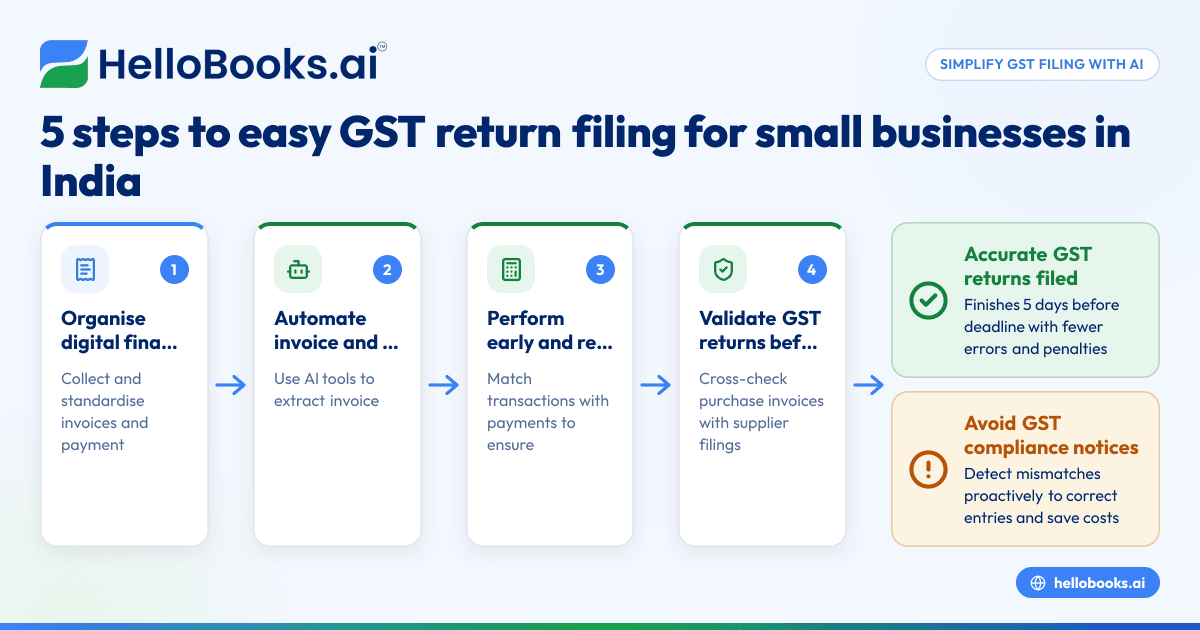
A lot of SME bookkeeping trouble in India comes from purchases, not sales. Supplier bills may arrive by paper, email, WhatsApp image or PDF. Someone then manually enters them, maybe abbreviates the supplier name differently, skips the invoice number, or records tax amounts into the wrong field. Later, while preparing GSTR-3B, the team checks another spreadsheet to see which invoices appear in GSTR-2B.
This side-spreadsheet habit creates hidden risk. A purchase may be in books but not in GSTR-2B. Or it may appear in GSTR-2B but not have been booked correctly. Either way, the clean-up happens under pressure.
AI does not solve the legal judgment about eligibility by itself, but it can reduce clerical mistakes in getting the source document into the books. OCR on purchase bills captures the repeated fields faster and more consistently. Then reconciliation against GSTR-2A/2B helps surface missing or mismatched supplier invoices before return preparation.
That is particularly relevant in India because input tax credit tracking depends on matching and timing under the GST law and CBIC/GSTN system, not just on whether a PDF exists in your inbox. The operative conditions and current procedural guidance are published in the law, rules, circulars and GST portal materials, so any claim decision still needs accounting review.
HelloBooks is strongest here when purchase OCR and GSTR-2A/2B reconciliation sit in the same workflow as GSTR-3B preparation. The point is not “AI for its own sake”; the point is fewer re-entries and fewer unreconciled bills.
You can also use the free GST reconciliation checker, GSTIN validator or HSN code search to catch obvious data problems before they spread.
Bank statement upload is often the fastest win
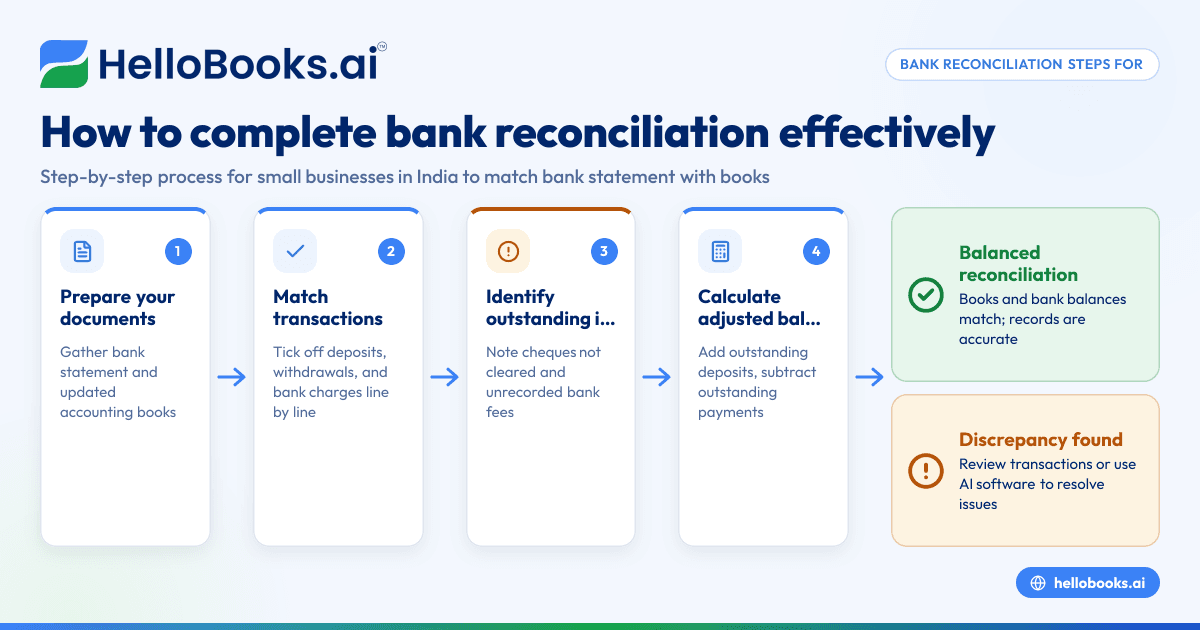
Many Indian business owners assume bookkeeping automation begins with tax, but the quickest improvement is often bank reconciliation. When receipts come through a mix of UPI, NEFT, RTGS and IMPS, the books can drift fast if collections are recorded late or against the wrong party.
Uploading the monthly bank statement and letting software suggest matches does two things:
- it reduces line-by-line typing of receipts and payments
- it exposes gaps, such as a bank credit with no invoice match or a payment booked twice
This matters for cash flow as much as compliance. If a ₹ amount is sitting unmatched, debtors ageing may be wrong. If a supplier payment is posted to the wrong bill, outstanding payable reports become unreliable.
An illustrative and invented scenario makes the point. Suppose a Jaipur distributor uploads a monthly bank statement showing 240 credit and debit lines. The numbers here are invented purely to explain the workflow and leave out charges, reversals, cheque timing differences and professional review. If the software auto-suggests matches for 180 of those lines based on amount, date and party, the accountant only investigates the balance instead of typing all 240. The gain is not that the machine is always right; it is that the human spends time on exceptions rather than repetition.
HelloBooks supports this Indian workflow through bank statement upload and AI reconciliation rather than live feeds, which suits businesses that still receive statements from multiple banks and accounts in different formats. From there, the matched entries feed through to reports and GST work more consistently. For that use case, bank reconciliation software is the relevant path.
Inventory and multi-branch operations create hidden entry errors
Data entry mistakes are not only about tax amounts. In trading, retail, distribution and light manufacturing, stock and accounting often diverge because quantities are updated in one place and values in another. A sale is booked, but inventory is not reduced. A purchase is entered as an expense instead of stock. A branch transfer is noted in a message but not recorded properly.
Once that happens, gross margin and closing stock become suspect. Under the Companies Act, 2013 and the Income-tax Act, 1961, as applicable to the entity and context, reliable books and supporting records matter for financial reporting and assessment. For incorporated entities, MCA governance expectations sit alongside tax and GST obligations; for all businesses, poor records raise avoidable friction with accountants and auditors.
This is another area where one-entry workflows help. If sales, purchases and stock movement update together, there is less room for the classic mismatch between a godown register, Tally export and GST summary.
HelloBooks is relevant where inventory management and financial reports come from the same transactions used for invoicing and return preparation. Businesses operating more than one GST registration can also work across multiple GSTINs in one account, which helps when the same team handles branches in different states with different place-of-supply outcomes.
For businesses moving away from fragmented tools or partial Tally setups, inventory, accounting software India and the Tally alternative pages are more useful than generic automation claims.
AI reduces manual work, but the legal responsibility stays with the business
This caveat matters. AI bookkeeping lowers the chance of clerical errors; it does not transfer responsibility under Indian law.
If an invoice is wrong, or GSTR-1 and GSTR-3B are filed with inconsistent figures, the taxpayer may still have to explain and correct it. The governing framework comes from the Central Goods and Services Tax Act, 2017, corresponding state GST laws, rules, notifications and GSTN portal processes. For direct taxes, the Income-tax Act, 1961 and Income Tax Department guidance apply. For company records, the Companies Act, 2013 and MCA rules matter. Data handling obligations may also intersect with the Digital Personal Data Protection Act, 2023 depending on the facts. Current compliance figures, filing windows and procedural updates should always be checked on the relevant official portal or with an expert.
A sensible approach is:
- automate capture of repetitive fields
- review exceptions and tax-sensitive classifications
- reconcile sales, purchases and bank entries monthly, not only at year-end
- keep source documents accessible
- involve your CA or accountant where legal interpretation is needed
That is why the best software setups in India are collaborative. The owner can raise invoices from phone or desktop, the accountant can review ledgers and reconciliation, and the CA can look at GST outputs before filing. HelloBooks supports that practical setup with unlimited users, mobile access on iOS and Android, and even Noor on WhatsApp in Hindi, English or Hinglish for basic bookkeeping help in the channels many owners already use.
What to look for if you want fewer entry mistakes, not just more automation
If your real problem is avoidable data entry error, evaluate software against the places errors happen in your business, not against generic “AI” language.
For an Indian SME, the useful checklist is more operational than futuristic:
- Can invoices be raised with the right GST treatment from customer details?
- Can e-invoice and IRN data flow from the sale record where applicable?
- Can purchase bills be captured from PDFs and photos without retyping?
- Can uploaded bank statements be reconciled against invoices and expenses?
- Can GSTR-1 and GSTR-3B be prepared from the same underlying books?
- Can GSTR-2A/2B mismatches be spotted before filing?
- Can stock, receivables and reports update from the same entries?
- Can the system handle TDS, TCS or reverse charge situations where relevant?
If the answer to those is yes, you are not just buying automation. You are reducing the number of times the same information gets touched by human hands.
If you want to explore HelloBooks in that context, the most relevant pages are GST return filing software, e-invoicing software and accounting software for small business. For pricing, use /in/pricing. If you want a hands-on walkthrough, book a demo.
The bottom line is simple: in India, AI bookkeeping helps SMEs avoid common data entry mistakes when it is used to eliminate duplicate typing across invoices, purchases, bank reconciliation and GST work. It is most valuable where it fits Indian workflows—GSTINs, e-invoice, e-way bill, GSTR-1, GSTR-3B, bank statement uploads, Tally migration and stock-linked accounting—while leaving final review to a human who understands the business and the law.