
Key takeaways
What this article covers, in order:
- What AI bookkeeping looks like for a Sitapur business
- Where manual bookkeeping usually breaks down in Sitapur
- How AI reduces bookkeeping effort without replacing judgement
- GST compliance improves when sales and purchase data are recorded once
- Sitapur businesses can benefit even if they are not very large
- An invented illustration of how the time savings can show up
India’s small businesses in Sitapur can use AI bookkeeping to reduce manual data entry, keep GST records cleaner, reconcile uploaded bank statements faster, and get more reliable numbers for cash flow and compliance. In practice, that means less time switching between Excel, Tally, the GST portal and paper bills, and more time seeing which invoices are unpaid, which purchase entries are missing, and whether sales, stock and tax figures actually agree.
What AI bookkeeping looks like for a Sitapur business
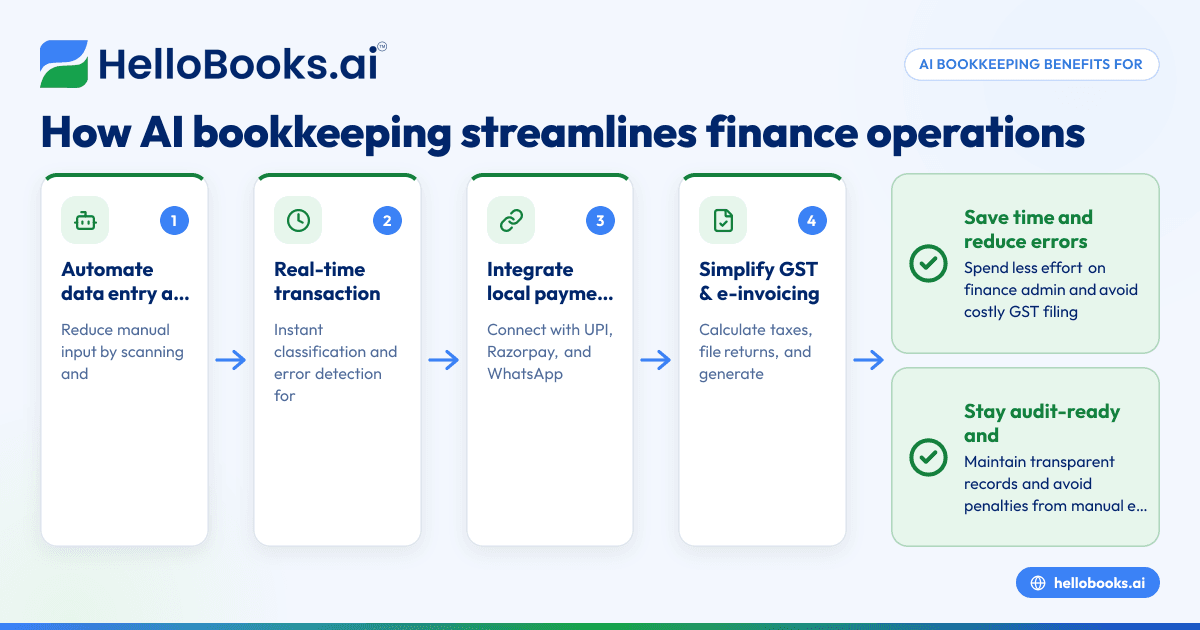
For many businesses in Sitapur, bookkeeping is not a separate back-office function. The owner, a family member, or one accountant may handle sales invoices, supplier bills, UPI receipts, NEFT credits, cash expenses, GST working and stock checks together. That is exactly where AI bookkeeping helps most: it takes repetitive finance work that usually lives across WhatsApp messages, PDFs, paper bills, Excel files and Tally entries, and brings it into one system.
Instead of typing every sale and purchase manually, a business can create GST invoices, capture supplier bills through OCR, upload a bank statement for AI reconciliation in India, and keep inventory moving with each transaction. The result is not “magic accounting”; it is cleaner bookkeeping with fewer duplicate entries and fewer missed transactions.
For a trader, distributor or service business in Sitapur, the real benefit is continuity. If the same records drive invoicing, stock, receivables and GST return preparation, there is less mismatch later when GSTR-1 and GSTR-3B need to be filed on the GST portal operated through GSTN under the Central Goods and Services Tax Act, 2017, the Integrated Goods and Services Tax Act, 2017, and related GST law administered by CBIC. Current return requirements, notifications and advisories are published on the GST portal and CBIC website.
Where manual bookkeeping usually breaks down in Sitapur
Small businesses here often face a familiar pattern:
- invoices are made in one place and payments are tracked somewhere else
- purchase bills arrive as paper slips or phone photos
- UPI, IMPS, NEFT and RTGS receipts pile up in the bank statement
- stock is maintained separately from sales entries
- GST working is done at month-end under pressure
- the CA receives incomplete data and has to ask for the same documents again
That creates friction in day-to-day work. A sale may be billed, but not followed up for collection. A supplier invoice may be paid, but never entered. A bank charge or TDS deduction may sit unexplained. A local sale within Uttar Pradesh may be recorded with the wrong tax head split, or an out-of-state sale may need IGST but get entered incorrectly. Under Indian GST law, the place of supply and the tax head matter because they affect whether CGST and SGST or IGST applies; the governing framework sits under the GST Acts and related rules, with official guidance and updates published by CBIC and on the GST portal.
AI bookkeeping helps because it catches the operational reality of Indian businesses: data does not arrive neatly. It arrives from bank statements, PDFs, bill photos, accountant follow-ups and customer GSTIN details.
How AI reduces bookkeeping effort without replacing judgement
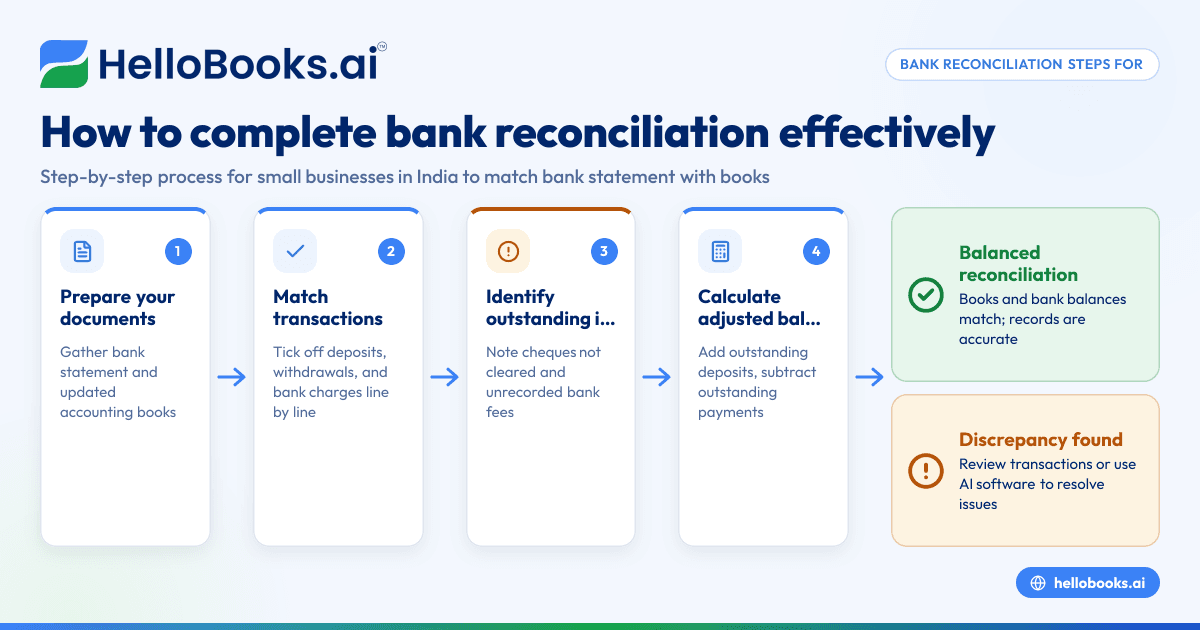
A useful way to think about AI bookkeeping is that it automates the first pass of accounting work, while the owner or accountant still reviews the important bits.
If you upload a monthly bank statement, the software can match receipts and payments against invoices and bills instead of forcing someone to retype every line. If you scan purchase bills, OCR can pull key details into the books faster. If you create invoices in the same system, customer balances and ageing reports stay current.
That matters in Sitapur because many businesses still rely on a Tally-and-spreadsheet combination. There is nothing wrong with that setup, but it often means sales, GST, receivables and stock are only partly connected. A system with a Tally migration path and connector lets a business move gradually instead of changing everything overnight.
AI also helps identify bookkeeping issues that are easy to miss manually, such as:
- likely duplicate expenses
- receipt amounts that do not match invoice amounts
- supplier bills entered without tax details
- purchase entries that may affect input tax credit tracking
- customer ledgers that look settled in Excel but remain unpaid in the books
The important point is accuracy through workflow, not through slogans. Better books happen when invoices, bills, bank entries and GST data are recorded once and reused consistently.
GST compliance improves when sales and purchase data are recorded once
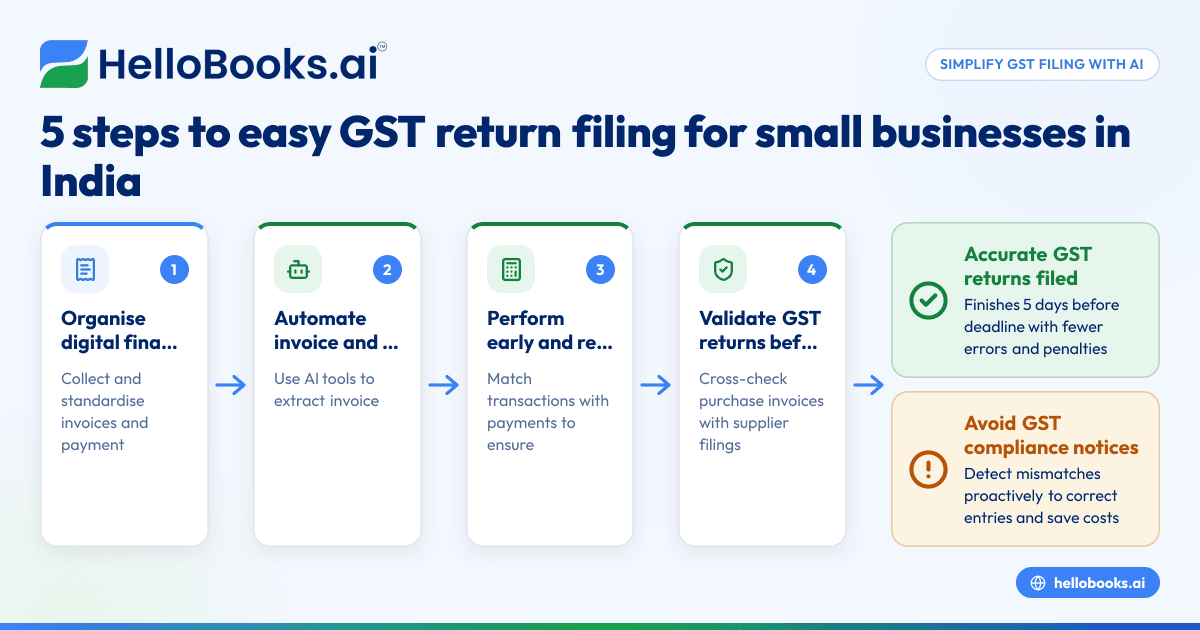
For Indian small businesses, bookkeeping quality and GST compliance are closely linked. If invoices are created outside the books and bills are entered later from memory, return preparation becomes a cleanup exercise. If the bookkeeping system already carries the GST invoice details, HSN or SAC, customer GSTIN, and place-of-supply logic, the monthly or quarterly compliance work becomes easier to review.
That is where software that supports smart invoicing and GST return filing is directly useful. A business can raise GST invoices with the correct place-of-supply and tax head split, then use the same invoice data to prepare and directly file GSTR-1 and GSTR-3B. For businesses covered by India’s e-invoicing framework under GST law, e-invoicing with IRN and signed QR reduces separate portal work; the current applicability criteria and technical schema are notified under GST law by CBIC and published on the GST portal and NIC/GSTN resources, so any current threshold or date should be checked there.
Purchase-side accuracy matters too. GSTR-2A/2B reconciliation and ITC tracking help a business compare supplier reporting with its own books before claiming credit in GSTR-3B. The legal basis for input tax credit sits under the CGST Act, 2017 and related rules, with current conditions and advisories published by CBIC and the GST portal.
If your business moves goods, the same accounting flow can extend into e-way bill software, reducing duplicate typing from invoice to logistics document. The e-way bill system also sits within the GST compliance framework, with current rules and notifications published on the official portal and CBIC sources.
Sitapur businesses can benefit even if they are not very large
AI bookkeeping is not only for a company doing crores in turnover. A small wholesaler, retailer, workshop, clinic, service provider or food business can benefit because the pain comes from process gaps, not only from size.
Consider a Sitapur business that has one GSTIN today but plans to add another registration in a different state later. A system that can handle multi-GSTIN operations prevents a second round of fragmented bookkeeping. Or take a business where the owner is often away from the desk. A mobile app on iOS and Android means invoices, expenses and approvals do not have to wait until evening.
Language and communication style matter too. Many owners are comfortable discussing finance in Hindi or Hinglish, often over WhatsApp. Support through Noor on WhatsApp in Hindi, English and Hinglish fits how many Indian businesses actually ask bookkeeping questions day to day.
This local fit matters more than generic “AI” branding. Sitapur businesses need software that understands GSTIN-based invoicing, e-invoice requirements, e-way bill workflows, TDS/TCS and reverse charge handling, and uploaded Indian bank statements. Those are India-specific finance tasks, not global templates.
An invented illustration of how the time savings can show up
To make this concrete, take an illustrative and invented Sitapur electrical goods trader with monthly sales of ₹12 lakh and purchases of ₹8 lakh. These figures are purely illustrative and invented; they leave out many realities such as credit notes, stock valuation methods, freight treatment, advances, bad debts, and industry-specific GST issues.
Suppose the business raises around 180 invoices in a month, receives money through UPI, NEFT and bank transfer, and collects about 95 supplier bills as PDFs and paper copies. In a manual process, one person may spend several days entering invoices, checking GSTINs, typing purchase bills, updating stock, and matching the uploaded bank statement line by line.
With AI bookkeeping, the same business could create invoices inside the accounting system, pull bill details through OCR, reconcile the uploaded bank statement against customer receipts and supplier payments, and keep inventory updated from the same entries. By the time GSTR-1 and GSTR-3B are reviewed, the books are already closer to the return figures because the source transactions were recorded in one place.
The gain is not that every accounting question disappears. The gain is that the accountant’s time shifts from data entry to review: checking exceptions, tax treatment, ITC mismatches, reverse charge cases, and whether any TDS or TCS entries need correction under the Income-tax Act, 1961 and applicable GST provisions. Current TDS/TCS rules, rates, thresholds and forms are published by the Income Tax Department and in the Act, rules and related notifications; they should be verified there.
Better bookkeeping also improves cash flow and stock visibility
Owners usually start looking for bookkeeping software because of GST stress, but the everyday value often shows up first in cash flow.
When invoices, receipts and ledgers stay updated, receivables ageing becomes useful instead of decorative. You can see which customer in Sitapur, Lucknow or another state has not paid, whether a part-payment needs follow-up, and whether a discount was recorded correctly. Financial reports become more trustworthy because they come from the same entries used for invoicing and purchase recording.
Inventory matters just as much for traders and product businesses. If stock is updated only at physical counting time, margins become guesswork. Inventory management tied to sales and purchases gives a running view of fast-moving and slow-moving items. That is especially helpful when working capital is tight and every rupee of blocked stock matters.
Businesses moving off Tally or using it alongside a newer system often want continuity. A Tally alternative or a solution with a connector can help them modernise without losing historical habits overnight. If you are assessing options generally, accounting software India and accounting software for small business comparisons are more useful than generic global bookkeeping advice.
What to check before choosing software for your Sitapur setup
The right software depends on how your business actually runs, not on a long feature checklist.
First, check whether it handles Indian GST workflows properly: GST invoicing, place-of-supply logic, CGST/SGST versus IGST split, e-invoicing where applicable, and direct filing for GSTR-1 and GSTR-3B. If goods movement is part of your business, e-way bill generation should fit naturally into the same workflow.
Second, check how it captures incoming records. In many small businesses, the hard part is not sales invoicing but purchase bookkeeping. OCR for purchase bills, bank statement upload with AI reconciliation in India, and ITC tracking against GSTR-2A/2B make a practical difference.
Third, check whether it supports your operating style. If the owner uses phone-first workflows, the mobile app matters. If the business works across more than one registration, multi-GSTIN support matters. If the owner and staff prefer Hindi or Hinglish, day-to-day help over WhatsApp may matter more than a polished but distant dashboard.
Fourth, check migration comfort. If your accountant still needs Tally continuity, a connector is more realistic than a forced switch.
HelloBooks is most useful in this context when it helps a Sitapur business keep invoicing, purchases, reconciliation, inventory and GST filing connected. You can explore its India setup at HelloBooks India, try relevant free India tools, GST calculator, and GST reconciliation checker, or review fit and onboarding from the pricing page and book a demo.
Compliance and data responsibility still need human review
AI bookkeeping does not remove legal responsibility. Under the GST laws administered by CBIC and run through the GST portal/GSTN, and under the Income-tax Act, 1961 administered by the Income Tax Department, the business remains responsible for the correctness of its records and filings. Company law obligations, where applicable, arise under the Companies Act, 2013 and MCA compliance framework; current filing rules and forms are published by MCA. Payment and banking practices in India also sit within systems overseen by RBI, while personal data handling should be reviewed against the Digital Personal Data Protection Act, 2023, based on your actual data flows and advice from counsel if needed.
So the best use of AI bookkeeping is not blind automation. It is disciplined bookkeeping with faster capture, better matching, clearer reports and fewer avoidable GST errors.
For a Sitapur small business, that can be enough to change finance operations materially: fewer late-night reconciliations, less dependence on scattered spreadsheets, cleaner GST working, better stock visibility, and a more reliable view of what the business is actually earning in rupees each month.