
Key takeaways
What this article covers, in order:
- Set up the books around how an Indian factory actually operates
- Raw materials, WIP and finished goods are not bookkeeping detail
- GST touches manufacturing entries far earlier than the return filing stage
- The entries Indian manufacturers most often misclassify
- Production accounting should still work when sales happen across states
- Bank reconciliation is part of manufacturing control, not just finance hygiene
India manufacturing accounting starts with three things done correctly: separate raw materials, work in progress and finished goods; record GST on purchases and sales based on place of supply; and make sure production, stock and tax returns come from the same underlying entries. If your books treat factory costs like generic expenses, you will quote in ₹, sell across states, generate an e-invoice or e-way bill, and only discover the true margin after dispatch.
Set up the books around how an Indian factory actually operates
A manufacturer in India does not just need a profit and loss statement. You need books that reflect how goods move: purchase of inputs, issue to production, labour and overhead absorption, completion into finished goods, sale, dispatch, receipt collection through UPI, NEFT, RTGS or IMPS, and then GST reporting on the GST portal.
That means your chart of accounts should separate inventory and production stages clearly. In practice, many small factories coming from spreadsheets or Tally-style habits collapse too much into a few ledgers, and that causes three problems:
- stock is visible only at year end,
- WIP is guessed instead of measured,
- GST and financial reports stop agreeing.
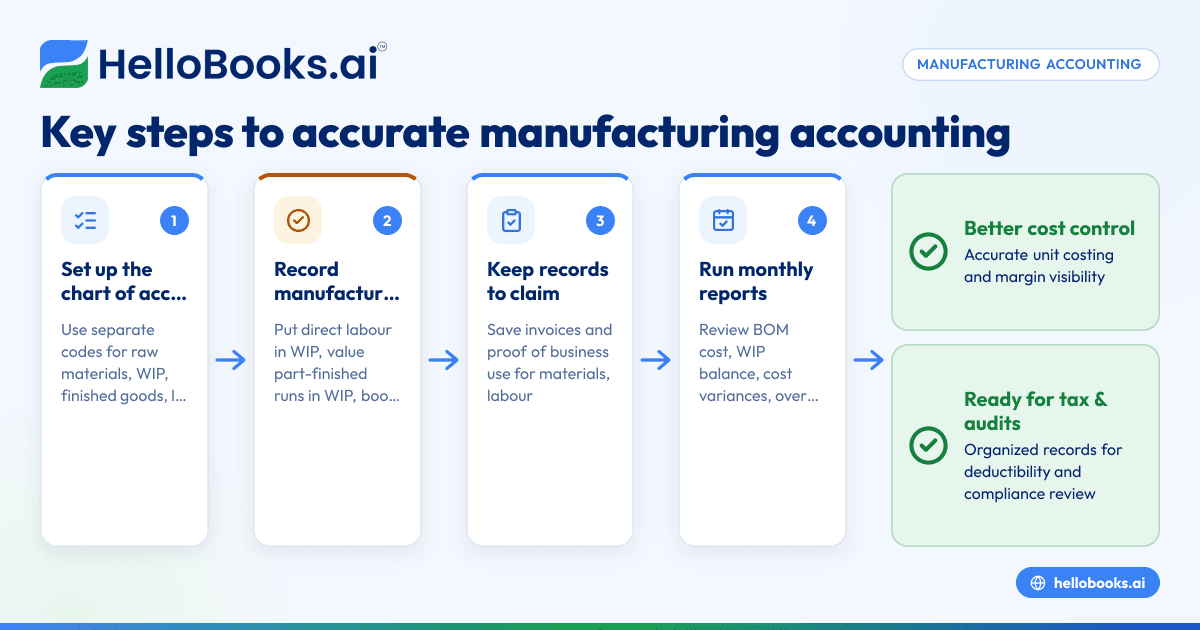
At minimum, most manufacturers need distinct ledgers for raw materials, packing materials, work in progress, finished goods, scrap, direct labour, factory overhead, input GST, output GST and freight. If you sell from one state and buy from another, the tax head split between CGST, SGST and IGST should follow the place-of-supply rules under the Central Goods and Services Tax Act, 2017 and the Integrated Goods and Services Tax Act, 2017, administered by CBIC through GSTN and published on the GST portal. Current rates and classification guidance should always be checked in CBIC notifications, GST rate schedules and GSTN portal help content, because those are the official sources.
For day-to-day work, this is where software matters. A system that creates GST invoices with the correct tax split, keeps inventory moving with each purchase and sale, and turns those same entries into financial reports is far more useful than one that leaves stock in a separate register.
Raw materials, WIP and finished goods are not bookkeeping detail
For manufacturing, these three balances tell you whether your margin is real.
Raw materials are what you have bought and not yet consumed. Work in progress is what has entered production but is not yet saleable. Finished goods are completed units ready for sale. If these are blurred together, you cannot answer basic questions such as:
- what did this production run actually cost,
- how much capital is stuck in semi-finished stock,
- whether a price rise is needed before the next quotation.
In Indian practice, WIP often gets missed at month-end because the owner is focused on dispatches, GST invoicing and collections. But if a production run is half complete on the closing date, leaving all its material in raw materials understates consumption and distorts gross profit.
An illustrative and invented case makes this clearer. Suppose a unit in Pune has raw material issues of ₹2,40,000, direct factory wages of ₹80,000 and allocable factory overhead of ₹60,000 for a batch that is only partly complete at month-end. If only ₹1,20,000 is treated as finished goods and the balance is not moved into WIP, the monthly gross margin report will look stronger than reality. These figures are illustrative and invented, and they leave out valuation policy choices, abnormal loss treatment and the requirements of your accounting framework, so they NEED EXPERT REVIEW.
The point is not the exact journal. The point is that month-end stock stages must be explicit. Good manufacturing books let you see inventory movement continuously instead of reconstructing it from a physical count and a notebook.
GST touches manufacturing entries far earlier than the return filing stage
Many businesses treat GST as something to think about only at GSTR-1 and GSTR-3B time. For manufacturers, that is too late.
GST affects:
- how purchase bills are captured,
- whether input tax credit appears in GSTR-2B,
- whether a sale is intra-state or inter-state,
- whether the invoice needs an IRN and signed QR under the e-invoice system,
- whether movement of goods needs an e-way bill,
- whether reverse charge or TDS/TCS handling is relevant on a transaction.
The legal basis sits under the CGST Act, 2017, the IGST Act, 2017 and related rules, with CBIC as the regulator and GSTN operating the system rails used by the GST portal. The current thresholds, document requirements and procedural updates are published through CBIC notifications, advisories on GSTN and the e-invoice/e-way bill system documentation. Do not rely on a stale blog post for a live operational decision.
For a manufacturer, the practical issue is that GST data quality begins at invoice and bill entry. If the customer GSTIN is wrong, the place of supply is wrong, or the HSN is inconsistent, the return will inherit that error. The same goes for purchase bills: if supplier invoices are entered late or badly, input tax credit review becomes reactive.
That is why it helps when purchase bills can be captured from a PDF or photo using OCR, then checked against GSTR-2A/2B for ITC tracking before you file GSTR-3B. On the sales side, if the invoice itself carries the right CGST/SGST or IGST split and, where applicable, the IRN and signed QR are generated as part of the invoicing flow, you remove a lot of month-end friction. When the books are ready, filing GSTR-1 and GSTR-3B directly from the same records is safer than rebuilding figures in a spreadsheet.
The entries Indian manufacturers most often misclassify
The recurring errors are usually ordinary, not exotic.
Factory wages booked as admin expense
Direct labour should normally flow into production cost, not disappear into office payroll. If factory wages are parked in an overhead bucket with no link to output, unit economics become unreliable.
Semi-finished stock left in purchases or raw materials
This is the classic WIP problem. Material has been issued, labour applied, but month-end books still show it as untouched raw stock.
Scrap hidden inside cost of goods sold
Scrap and rework need visibility. If losses are buried inside a broad COGS line, you lose a control signal that could point to a machine issue, process drift or supplier quality problem.
Freight and ancillary costs posted with no inventory logic
Inbound freight, loading and similar costs may affect inventory valuation depending on your accounting policy and framework. The treatment should be agreed with your accountant under the applicable standards and retained consistently. The Companies Act, 2013 and MCA reporting environment matter for companies, while tax treatment may also intersect with the Income-tax Act, 1961. The precise rule for your case should be taken from the governing standard, law and current guidance, not from a generic template.
Wrong tax head on interstate sales
Charging CGST and SGST on a transaction that should carry IGST, or the reverse, creates avoidable correction work. A system that determines tax head split from the customer GSTIN and place of supply reduces this risk at source.
Production accounting should still work when sales happen across states
A manufacturer in India often buys in one state, produces in another, and sells nationwide. That creates practical bookkeeping pressure beyond pure production costing.
You may have:
- multiple GSTINs,
- branch stock transfers,
- separate godowns,
- e-way bill generation on dispatch,
- e-invoicing for eligible entities,
- collection patterns split between bank transfer and UPI.
If you manage more than one registration, books should not be mixed casually. Each GSTIN has its own compliance trail on the GST portal, even if management wants consolidated reporting. The useful setup is one that keeps each GSTIN clean while still giving group-level inventory and financial visibility.
This is where a system with multi-GSTIN support helps a manufacturer more than generic accounting software does. You can keep state-wise invoicing, tax heads and filing separated, but still review combined receivables, inventory and P&L. If you are moving from Tally, a migration path or connector matters because factories rarely stop operations to rebuild their books from zero. See Tally alternative or HelloBooks vs Tally if you are comparing workflows.
Bank reconciliation is part of manufacturing control, not just finance hygiene
Owners often think inventory is the manufacturing control and bank reconciliation is the accountant’s cleanup job. In practice, the two are connected.
A factory may issue invoices, dispatch goods with an e-way bill, and then receive collections in fragments: one payment by UPI, another by NEFT, a balance adjustment later, maybe a deduction for shortage or quality dispute. If those receipts are not matched back to invoices quickly, your debtor ageing becomes fiction. And when receivables are wrong, production planning suffers because the purchase team does not know what cash is actually free for raw materials.
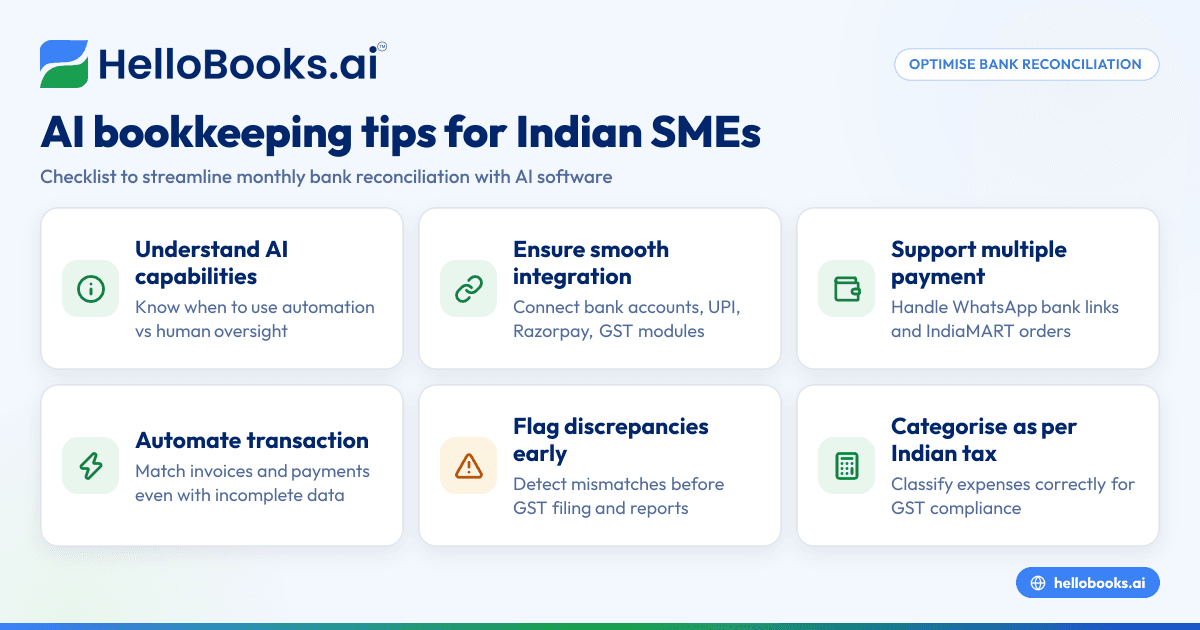
Uploading a bank statement and using AI reconciliation to match receipts and payments against invoices, expenses and ledger entries is especially useful in India because transaction volumes can be high and references can be inconsistent. It is not glamorous, but it shortens the distance between dispatch, collection and decision-making. Manufacturers evaluating this should look at bank reconciliation software and broader accounting software India options.
What to review every month if you manufacture in India
A monthly close for a manufacturer should answer operational questions, not just produce compliance numbers.
Review at least these:
- raw material consumption versus purchase and stock issue,
- WIP carried forward with a basis you can explain,
- finished goods valuation,
- scrap and rework trends,
- sales by item or product family,
- receivables ageing,
- supplier bills pending capture,
- GSTR-2B match position before ITC claim decisions,
- bank reconciliation status,
- GST liability as it appears from recorded invoices.
If you are the owner and not a full-time finance person, mobile access matters more than brochures admit. The ability to check invoices, expenses, stock or reports from an iOS or Android app can keep month-end moving when you are on the factory floor or travelling. And in India, support over WhatsApp is often more realistic than expecting users to log into a help desk. That is why conversational help in Hindi, English or Hinglish can remove friction for small teams.
For quick checks, free tools are also useful before data even enters the books. A GSTIN can be checked with a GSTIN validator, HSN references can be reviewed with HSN code search, and invoice field sanity can be checked with a GST invoice validator.
Choosing software for a factory: what actually matters
Manufacturers sometimes buy accounting software on the strength of a general ledger demo and only later discover that stock, tax and dispatch live in separate places. For India, the shortlist should be filtered by whether the software can handle the transaction chain end to end.
Look for these capabilities in context, not in isolation:
A sale should create a GST-compliant invoice, apply the correct place-of-supply logic, support e-invoicing where required, and feed the return figures later without re-entry. A dispatch should be able to flow into e-way bill generation without typing consignment details twice. Purchase bills should be captured quickly, ideally from OCR, and then checked against GSTR-2A/2B so ITC decisions are based on what suppliers have actually reported. Inventory should move as purchases and sales are recorded, so your closing stock is not a year-end surprise. Financial reports should come from the same books, not from a second spreadsheet universe.
If you are comparing options, start with smart invoicing, e-invoicing software, e-way bill software, and the broader accounting software for small business. If you need commercial details, use /in/pricing rather than relying on copied price references.
A final word on law, tax and records
Manufacturing accounting in India sits at the overlap of commercial reality and legal compliance. GST treatment follows the GST laws and rules under CBIC and the GSTN-operated portal ecosystem. Income-tax deductibility and TDS questions arise under the Income-tax Act, 1961 and guidance from the Income Tax Department. Company reporting may bring in the Companies Act, 2013 and MCA requirements. Data handling practices increasingly need attention under the Digital Personal Data Protection Act, 2023 in India, especially when documents and customer records move through digital systems.
So keep two habits.
First, build books that reflect production honestly: raw material, WIP, finished goods, scrap, collections and tax. Second, verify live numbers such as rates, thresholds, due dates and procedural changes only from the current official sources: CBIC notifications, GST portal and GSTN advisories, MCA publications, and Income Tax Department materials.
If the books are structured properly, manufacturing decisions become faster and GST filing becomes calmer. If they are not, the same error shows up everywhere: in stock, in margin, in cash flow and on the return.