
Key takeaways
What this article covers, in order:
- What does it mean to use fully supported AI bookkeeping software for bank reconciliation?
- How does fully supported AI streamline month-end reconciliation?
- What challenges do small businesses face in bank reconciliation without AI?
- How can I ensure a smooth transition to fully supported AI bookkeeping software?
- Common gaps in bank reconciliation teams often miss
- Related reading
Streamlining monthly bank reconciliation is a vital task for small businesses in India aiming to maintain precise financial records and ensure compliance with GST and other regulations. Using fully supported AI bookkeeping software can transform this traditionally time-consuming process into a more efficient, error-free routine. This checklist guides you through optimising bank reconciliation with AI, focusing on what really matters to Indian SMEs.
What does it mean to use fully supported AI bookkeeping software for bank reconciliation?
Fully supported AI bookkeeping software automates routine tasks like transaction matching and categorisation while integrating smoothly with banks and GST filing. It combines machine learning with human oversight to handle exceptions and ensure accuracy.
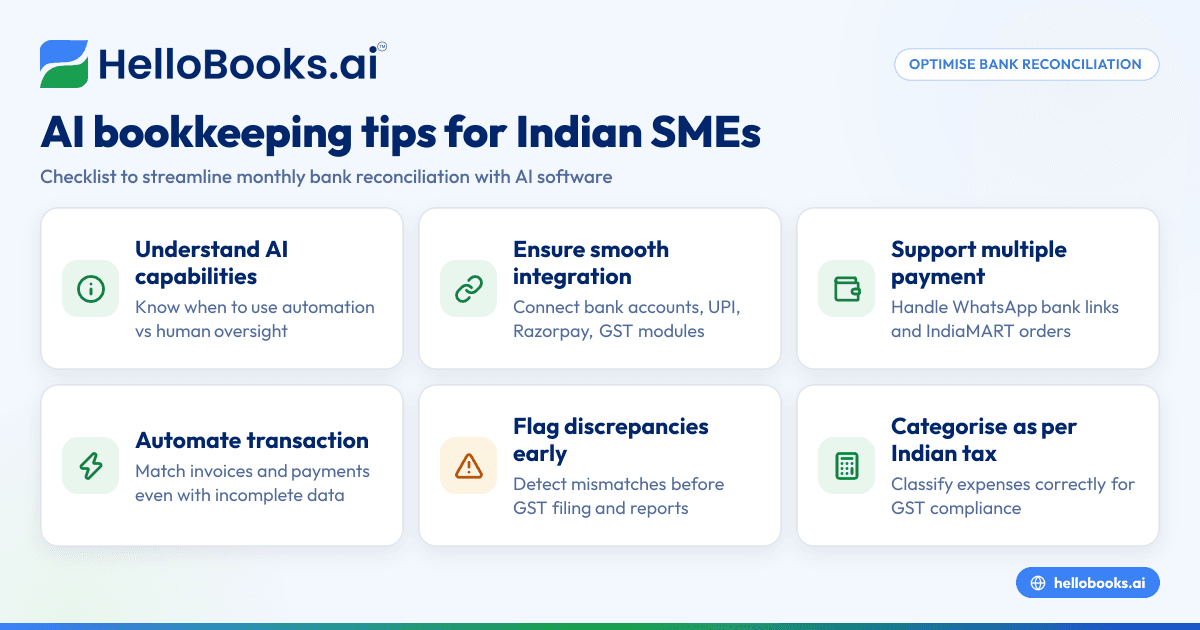
- [ ] Understand the capabilities and limits of AI in your bookkeeping software so you know when to rely on automation and when human oversight is necessary.
Most AI bookkeeping tools today, including those tailored to Indian SMEs, use machine learning to automate transaction matching, categorisation, and error detection, but exceptions and contextual adjustments need human verification.
- [ ] Ensure your software integrates smoothly with your bank accounts, payment platforms like UPI or Razorpay, and GST filing modules to allow seamless data flow.
Direct bank connections reduce manual data entry and errors. AI fully supported software can regularly pull transaction data, so reconciliation can be near real-time rather than a month-end chore.
- [ ] Check that the software supports multiple bank accounts and payment methods common in India, including payments received via WhatsApp bank links or IndiaMART orders.
Many small businesses juggle several accounts and receive payments in various forms. AI software that adapts to this complexity prevents reconciliation headaches.
How does fully supported AI streamline month-end reconciliation?
Fully supported AI bookkeeping software automates matching transactions, flags discrepancies early, and categorises expenses as per Indian tax laws. This drastically cuts time spent and improves compliance.
- [ ] Automate transaction matching between bank statements and your internal bookkeeping records effortlessly.
AI algorithms identify corresponding invoices, payments, and expenses even when descriptions differ or are incomplete, saving hours of manual cross-checking.
- [ ] Use AI to flag discrepancies instantly so you can investigate mismatches early, reducing errors before filing GST returns or drafting financial reports.
Small delays or incorrect matches can cascade into compliance risks or incorrect financial decisions. AI tools alert you quickly.
- [ ] Leverage AI’s ability to categorize expenses and income accurately according to Indian tax rules, helping prepare ready-made reports for accountants and GST filings.
Classification mistakes can cause costly filing errors and missed input tax credits. Fully supported AI software updates regularly with the latest GST rates and rules.
What challenges do small businesses face in bank reconciliation without AI?
Manual reconciliation remains time-consuming, error-prone, and complex, especially with multiple payment channels and GST requirements in cities like Mumbai and Bengaluru.
- [ ] Manual reconciliation consumes valuable time each month which could be redirected towards growing the business.
Small teams in cities like Mumbai or Pune often struggle due to limited accounting resources and multiple payment channels.
- [ ] Data entry errors and missed transactions lead to inaccurate books, affecting tax calculations and financial planning.
Spreadsheets and Tally users frequently face these issues, increasing the risk of penalties.
- [ ] Difficulty correlating bank transactions with invoices, especially when payment descriptions differ from internal records.
This discrepancy appears frequently with payments coming through platforms like Razorpay or UPI due to inconsistent narration fields.
How can I ensure a smooth transition to fully supported AI bookkeeping software?
Choosing the right software and supporting your team during onboarding is key to success and compliance with evolving Indian regulations.
- [ ] Choose software that offers onboarding support and responsive customer service to address India-specific needs such as GST compliance and e-invoicing.
Implementation matters more than just features. Your provider should help you integrate existing records and set up bank feeds correctly.
- [ ] Train your team to review AI suggestions carefully before final approval; remember, AI assists but does not fully replace human judgment.
Periodic audits of reconciled data help maintain accuracy and trust in automation over time.
- [ ] Regularly update your software to benefit from ongoing improvements in AI capabilities and regulatory changes.
Indian GST rates and e-invoicing thresholds can change, and software updates ensure compliance and relevance.
Common gaps in bank reconciliation teams often miss
- [ ] Ignoring small unmatched transactions that cumulatively distort accounts and GST filings.
Rounding off these errors affects accurate input tax credit and tax liabilities, leading to compliance risk.
- [ ] Neglecting to reconcile credit card or EMI payments taken through instalment runs, which have different processing dates.
These require special handling to avoid mismatches between sales and bank records.
- [ ] Overlooking adjustments for returned payments or cancelled orders occurring mid-month.
Without accurate adjustments, your bookkeeping and financial position reports are faulty.
Incorporating an AI fully supported bookkeeping solution tailored for Indian SMEs helps reduce errors, speeds up monthly bank reconciliation, and ensures your accounts stay audit-ready. The technology handles routine matching and categorisation while your team focuses on reviewing exceptions and strategic finance activities.
Considering how much time and effort traditional reconciliation requires, especially with GST compliance, adopting AI bookkeeping software like HelloBooks can be a game-changer. Learn more by exploring our accounting software for small business or see how we compare in our pricing. Ready to experience smoother reconciliation first-hand? You can book a demo today to see the software in action.
Related reading
- How AI Bookkeeping Can Help Small Businesses Manage Bank Reconciliation in India with Caveats
- How Small Businesses in Arunachal Pradesh Can Streamline Bank Reconciliation with AI Software
Read next
This article covers one part of a bigger topic. For the complete picture, read our guide to fully supported.