
Key takeaways
What this article covers, in order:
- The supported payment gateways template with caveats
- How do I choose a payment gateway supported by AI and what caveats should I expect?
- What payment methods should my Indian small business focus on?
- How to fill in the supported payment gateways template with caveats
- What are the common caveats when using AI-supported payment gateways in India?
- Example: Supported payment gateways with caveats for a Bengaluru-based retail SME
Small businesses in India often face challenges choosing the right payment gateway. They want solutions that integrate smoothly with their accounting, offer ease in GST compliance, and cater to local payment preferences like UPI and wallets. This guide helps you understand the supported payment gateways with caveats you should know before selecting one for your business.
The supported payment gateways template with caveats
| Payment Gateway | Popular in (cities/regions) | Payment Modes Supported | Integration Ease with Accounting | GST Compliance Support | Key Caveats |
|---|---|---|---|---|---|
| Razorpay | Pan-India, strong in Bengaluru, Mumbai | UPI, Card, Netbanking, Wallets | Medium (API + plugins) | Supports GST invoicing & e-invoicing | Settlement delay on weekends; higher MDR for AMEX cards |
| Paytm | Pan-India, Tier-2 cities | UPI, Wallet, Card | Easy (SDK + plugins) | Has GST invoice generation | Limited auto reconciliation; wallet refund delays |
| CCAvenue | Pan-India, urban centres | Cards, UPI, Netbanking | Complex (requires developer) | No direct GST invoicing support | Setup time longer; higher integration cost |
| Instamojo | Startups, small sellers, Pune, Bengaluru | UPI, Cards, Wallets | Very easy (plugins & dashboard) | Basic GST invoice features | Payment hold on high-volume accounts; limited multi-currency |
| Cashfree | Pan-India with focus on SMEs | UPI, Cards, Netbanking, Wallets | Good API support | GST invoice via partner apps | KYC verification delays; weekend settlements slower |
| PayU | Large & SME businesses, metros | UPI, Cards, Wallets | Good plugin support | GST invoice support for select plans | MDR rates fluctuate; delayed settlements during holidays |
How do I choose a payment gateway supported by AI and what caveats should I expect?
AI supported payment gateways speed up reconciliation and detect anomalies by automating transaction processing. Choose a gateway that fits your sales channels, integrates with your accounting software, and supports GST invoicing to streamline compliance.
Beyond automation, be aware of caveats like settlement delays and partial automation that may affect cash flow and bookkeeping accuracy.
AI-supported gateways use data-powered automation to reduce manual errors. Your choice depends on business size, payment methods, and compatibility with your accounting stack. Verify that the gateway automatically syncs transaction data with your accounting software in India and supports GST invoicing for smooth tax compliance. Note that some gateways may have weekend settlement delays, higher fees for certain card types, or limited auto reconciliation that require manual intervention.
What payment methods should my Indian small business focus on?
Most Indian customers prefer UPI, credit/debit cards, and mobile wallets like Paytm or PhonePe. UPI is fastest and cheapest, with zero MDR on many banks. Card payments are essential for larger invoicing but come with merchant discount rates (MDR). Mobile wallets help in tier-2 and tier-3 cities.
Your payment gateway must support multiple payment modes and integrate with your existing bookkeeping system. This integration is crucial to ensure GST compliance and avoid manual data entry errors.
How to fill in the supported payment gateways template with caveats
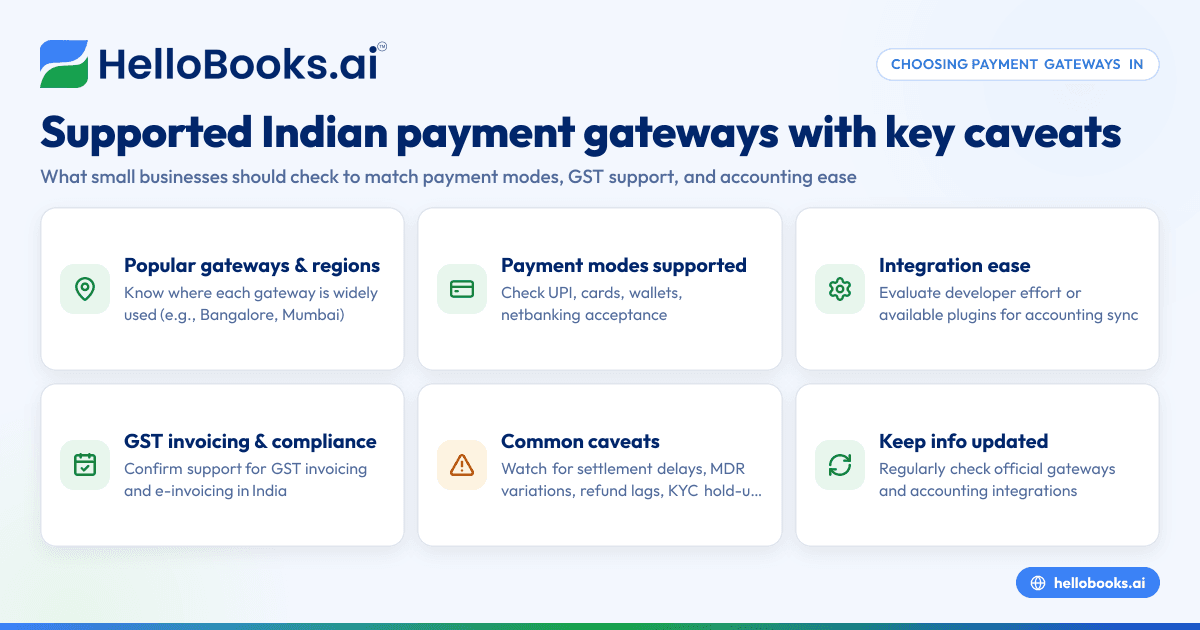
Start by listing the payment gateway name popular among Indian SMEs. Note the cities or regions it is widely used in. Specify the payment modes supported, such as UPI, cards, netbanking or wallets.
Describe how easy it is to integrate with your accounting system: whether it requires developer effort or offers ready plugins. Clarify if GST invoicing or e-invoicing is supported.
In key caveats, mention any payment holds, settlement cycle quirks, MDR rate variations, or reconciliation challenges to watch for.
This template helps you compare gateways on features and risk factors aligned with your bookkeeping and compliance needs.
What are the common caveats when using AI-supported payment gateways in India?
AI supported payment gateways ease transaction processing but aren’t flawless. Expect some delays in settlements, variable MDR rates, and occasional refund processing lags.
Other caveats include KYC delays and limited automatic GST reconciliation, which need manual follow-up to avoid compliance issues.
While AI can automate many tasks, settlement delays (especially over weekends and holidays) affect cash flow timing. Merchant discount rates vary widely depending on payment mode and card type. Refunds and chargebacks may take several days to reflect in your books. KYC verification can delay payout activation. Automation for GST reconciliation may be partial, so manual checks remain essential. Understanding these caveats helps you manage expectations and select the best AI supported payment gateway for your business.
Example: Supported payment gateways with caveats for a Bengaluru-based retail SME
| Payment Gateway | Popular in (cities/regions) | Payment Modes Supported | Integration Ease with Accounting | GST Compliance Support | Key Caveats |
|---|---|---|---|---|---|
| Razorpay | Bengaluru, Mumbai, Delhi | UPI, Cards, Wallets | Medium (good plugins, some API) | Supports GST invoicing & e-invoicing | Weekend settlements delayed; AMEX MDR 3-3.5% |
| Instamojo | Bengaluru, Pune | UPI, Cards, Wallets | Very easy via plugins & dashboard | Basic GST invoice tools | High-volume payment holds possible |
This SME needs a gateway with automation for accounting and GST but must watch out for settlement timing to avoid cash flow crunch during weekends. Instamojo’s hold policy requires careful volume management.
Using bank reconciliation software with automated imports lets this SME reduce manual errors while managing caveats effectively.
How do I keep my payment gateway information up to date?
Keep your payment gateway info current by checking official sites and update your records at least quarterly or when notified. Coordinate with your accounting software provider like HelloBooks to maintain smooth API integrations and GST compliance.
Payment gateways update features, MDR rates, and settlement terms frequently. Regularly reviewing official announcements ensures your bookkeeping and compliance stay aligned. Working closely with your AI bookkeeping or AI accounting software provider helps spot integration issues early. Monitor GST e-invoicing and invoice format changes so payment data stays compliant.
Choosing a well-supported, AI-empowered payment gateway lets your bookkeeping keep pace with sales growth without manual headaches. Learn more about how AI can integrate with your payment flows and reduce errors. To explore solutions tailored to Indian SMEs, you can book a demo or compare plans with HelloBooks today.
Related reading
- accounting software for small business
- How AI Bookkeeping Automates Data Entry for Small Businesses in India, Supported with Caveats
- What Small Businesses Should Know About AI Bookkeeping Accuracy, Supported with Caveats
Read next
This article covers one part of a bigger topic. For the complete picture, read our guide to supported with caveat.