Key takeaways
What this article covers, in order:
- Before you start
- Step 1: What exactly is bank reconciliation and why should I do it?
- Step 2: How do I perform bank reconciliation steps manually?
- Step 3: How can AI bank reconciliation software help my business?
- Step 4: What caveats should I keep in mind when using AI bookkeeping for reconciliation?
- Worked example: Reconciling May bank transactions for a Pune-based garment wholesaler
This guide is for small business owners and accountants in India who perform bank reconciliation manually or using outdated methods. By the end, you will understand practical bank reconciliation steps and how AI bookkeeping can simplify this process while highlighting important caveats to consider.
Before you start
- Access to your bank statements in digital format (CSV, OFX, or downloadable from your bank portal).
- Your accounting records ready, whether in spreadsheets, Tally, or any accounting software.
- A clear understanding of your business’s typical transactions and vendors.
- Basic familiarity with GST implications on bank transactions, especially for payments and receipts.
Step 1: What exactly is bank reconciliation and why should I do it?
Bank reconciliation is the process of matching the transactions recorded in your books with those appearing in your bank statement to verify accuracy. It ensures that your accounting records are up-to-date and correct, helps detect errors or fraud, and assists in cash flow management.
For example, you might have recorded a customer payment in your books, but it could be delayed or missing in your bank statement due to bank processing times or cheque clearance delays. If you do not reconcile regularly, you may overestimate your available cash, leading to overdrafts or missed payments.
A common mistake is to delay reconciliation, which results in a backlog of unmatched entries that can distort your business’s financial health. Especially around GST return filing deadlines, this can cause inaccuracies in reported turnovers or input tax credits.
Regular reconciliation helps you spot discrepancies early, reducing financial risk. It also supports smooth tax compliance since GST returns require accurate recording of payments and receipts. Furthermore, for businesses required to issue e-invoices and generate e-way bills, prompt reconciliation confirms the transaction flows are correctly recorded.
Step 2: How do I perform bank reconciliation steps manually?
Performing bank reconciliation manually involves careful comparison and verification between your bank statement and your accounting records. Here’s the detailed process:
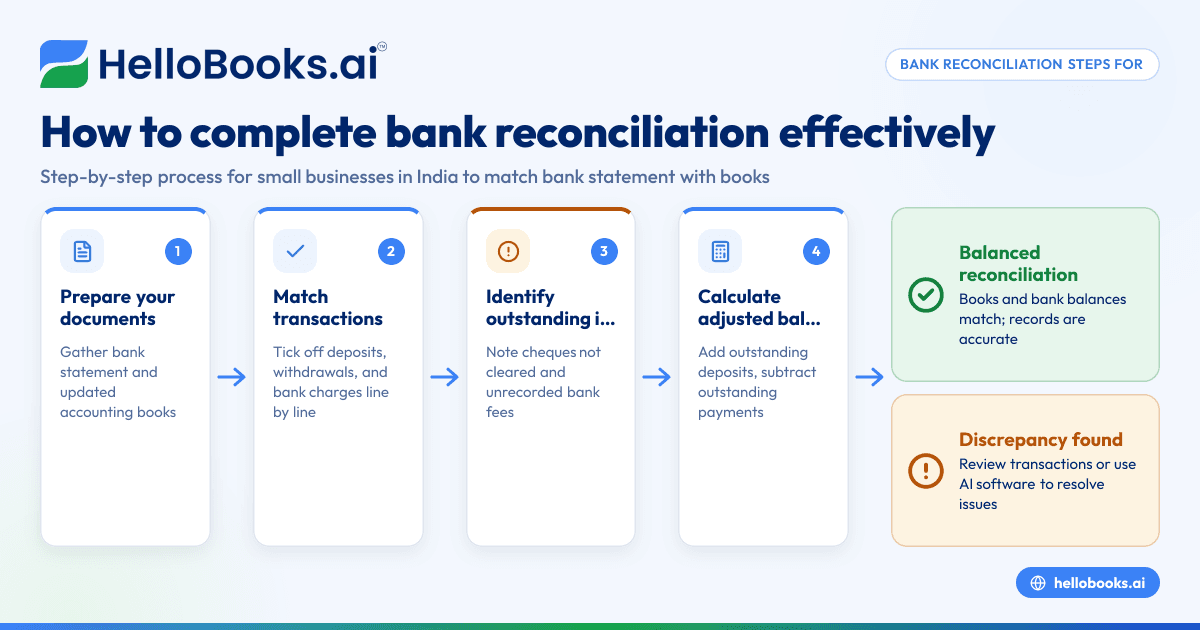
- Match Opening Balances: Start by confirming that the opening balance on your bank statement matches your cash book or ledger opening balance for the period. Any mismatch here can create confusion later.
- Tick off Matched Transactions: Next, sequentially compare each transaction on the bank statement (deposits and withdrawals) with your records. Tick off items that appear on both sides with the same amount and date (within a reasonable margin, for example, a difference of 1–2 days due to processing).
- Identify Unmatched Items: Note any deposits or payments present in your books but not yet cleared in the bank (e.g., recently issued cheques). Likewise, note bank transactions not recorded in your books, such as bank charges, interest income, or automated payments.
- Investigate Discrepancies: For each unmatched item, investigate why it’s missing. Perhaps you forgot to record a direct debit payment or a vendor might have returned funds that triggered a refund.
- Make Adjustments: Update your books to include missing bank charges or interest, and reach out to customers or suppliers when expected payments are missing.
- Calculate Adjusted Balances: After all adjustments, the closing balance in your books should agree with your bank statement’s closing balance.
A frequent error is overlooking bank fees or interest incomes, which might not be immediately recorded in your books but appear on the bank statement. In India, banks usually levy monthly maintenance charges or EMI payments might reflect on your accounts. Always check and record these timely.
Similarly, if you issue cheques, remember that clearance can take several days, depending on the bank and city. For example, a cheque issued in Bengaluru may clear quicker than one in a smaller town, so track these pending payments carefully.
Step 3: How can AI bank reconciliation software help my business?
AI bank reconciliation automates much of the manual work by using intelligent algorithms to match transactions quickly with high accuracy. Here’s why it helps:
- Automated Matching: The AI automatically pairs bank entries with invoices or payment records based on amounts, dates, vendor names, and payment modes like UPI or NEFT.
- Pattern Learning: Over time, the AI learns common transaction names, recurring payments, and customer details to improve matching accuracy.
- Flagging Exceptions: Instead of manually sifting through hundreds of transactions, the AI flags only those that need attention, such as unmatched payments or possible duplicates.
- Real-time Updates: Many AI bookkeeping systems can connect directly with bank APIs or allow easy upload of bank files, speeding up reconciliation.
For small businesses in Mumbai or Pune handling numerous orders from IndiaMART or JustDial leads and receiving payments through Razorpay or UPI, AI reconciliation can reduce days of bookkeeping work to hours or minutes.
However, AI tools rely heavily on good data quality and consistency. If your invoice numbering is inconsistent, vendor names are spelled differently, or records are incomplete, the AI may struggle to match transactions or give false positives.
Additionally, AI does not replace your judgement. It can’t verify if a vendor’s bank account is fraudulent or if GST has been correctly applied on a payment. Always review exceptions and keep your data clean.
Step 4: What caveats should I keep in mind when using AI bookkeeping for reconciliation?
AI bank reconciliation is powerful, but it needs good data and human oversight to be effective. Be wary of inconsistent invoicing, vendor name variations, or missing GST info that reduce AI accuracy. Also, manual checks are needed especially for large or unusual transactions. Keep your software updated for Indian tax changes to avoid compliance issues.
- Data Quality Is Crucial: AI accuracy depends on well-maintained records. Avoid using multiple invoice formats, inconsistent vendor names, or missing GST details.
- Nomenclature Differences: For example, “ABC Traders” in your books might appear as "ABC Tdrs" or “A.B.C Traders” in bank statements. AI can misclassify or fail to match such transactions.
- Regulatory Changes: Keep your AI software updated for Indian GST changes, such as amendments effective from FY 2023–24 or changes in e-invoicing requirements. An outdated rulebook can cause compliance slips.
- Manual Oversight for High-Value Transactions: AI can err in unusual cases — like refunds, advance payments, or split invoices. For example, if a ₹2,00,000 transaction is partially refunded, AI may not reconcile properly without your input.
- Data Privacy Compliance: With the new Data Protection law (DPDP Act 2023), ensure your AI bookkeeping provider follows personal data protection norms for financial data.
With these caveats in mind, adopting AI means pairing it with sound bookkeeping hygiene and human controls. Keep refining your transaction categories and vendor master data to improve AI accuracy over time.
Worked example: Reconciling May bank transactions for a Pune-based garment wholesaler
Let’s walk through a typical scenario to apply these principles.
- Your bank statement opening balance on 1/5/2023 is ₹5,00,000.
- Your books (in Tally) show an opening balance of ₹5,00,000 for the cash ledger — this confirms a clean starting point.
- On 10/5/2023, the bank shows a deposit of ₹1,20,000 labeled “Customer Payment from XYZ Fabrics.”
- You check that your sales ledger has recorded a payment for invoice #1234 from XYZ Fabrics on 8/5/2023 for ₹1,20,000.
- Both records show GST applied correctly at 5%, and the invoice was generated using your e-invoicing software.
- On 15/5/2023, you notice ₹500 bank charges deducted by the bank which are not yet in your accounting records.
- You immediately add this ₹500 as a bank expense in your ledger for accurate cash flow reporting.
- Your AI bookkeeping tool matches 95% of transactions automatically, but it flags a ₹5,000 receipt dated 20/5/2023 from “ABC Cloths” without a matching invoice.
- You investigate and find you forgot to enter invoice #5678 issued on 18/5/2023 to ABC Cloths.
- After updating the invoice data, the AI recompletes the match.
- Finally, your bank statement ends with ₹6,14,500 on 31/5/2023, and your books reconcile to the same figure after adjustments.
By following these steps and using AI tools, what might have taken a whole day becomes just a couple of hours, improving your business’s financial accuracy and GST readiness.
How often should small businesses in India do bank reconciliation?
At a minimum, monthly reconciliations align well with GST return filing deadlines and annual audit cycles. Most GST forms require accurate recording of payments and receipts to correctly claim input tax credit and file returns.
If your business has a high volume of daily transactions — such as an e-commerce seller in Bengaluru or a distributor in Mumbai — weekly reconciliation helps track cash flow closely and catch issues early.
For cash-intensive trades or firms dependent on multiple payment gateways (Razorpay, UPI), more frequent reconciliation underpins better financial control and faster error resolution.
What are common pitfalls in AI bank reconciliation that I should watch out for?
AI bank reconciliation speeds up your work but don’t blindly trust automation. Common issues include inconsistent data, ignoring AI alerts, and missing bank charges. Always cross-check flagged transactions and maintain clean, consistent data for best AI results.
Common pitfalls in AI bank reconciliation include trusting automation without manual review, inconsistent invoice formats or vendor details reducing accuracy, ignoring alerts on GST mismatches or failed payments, neglecting to record bank charges, and missing e-invoicing or e-way bill linkages that can cause GST compliance issues. Combining AI with careful bookkeeping and manual oversight is essential.
When you are ready to streamline your bank reconciliation process, consider AI solutions like those at HelloBooks. They combine AI with Indian tax norms to automate your bookkeeping, GST filing, expense management and more. You can book a demo to see how automated bank reconciliation fits your business or compare pricing plans that suit your scale.
Taking control of your bank reconciliation means more reliable financial records, faster tax compliance, and greater peace of mind for your business finances. Start with clear steps, empower yourself with AI, and watch your accounting efficiency improve.
Related reading
- AI bookkeeping
- How AI Bookkeeping Automates Data Entry for Small Businesses in India, Supported with Caveats
- How Small Businesses in Arunachal Pradesh Can Streamline Bank Reconciliation with AI Software
Read next
This article covers one part of a bigger topic. For the complete picture, read our guide to supported with caveat.