


Key takeaways
What this article covers, in order:
- Why this comes up / what goes wrong
- Step-by-step
- Example (fictional figures)
- Common mistakes
- Doing this in HelloBooks
- Frequently asked questions
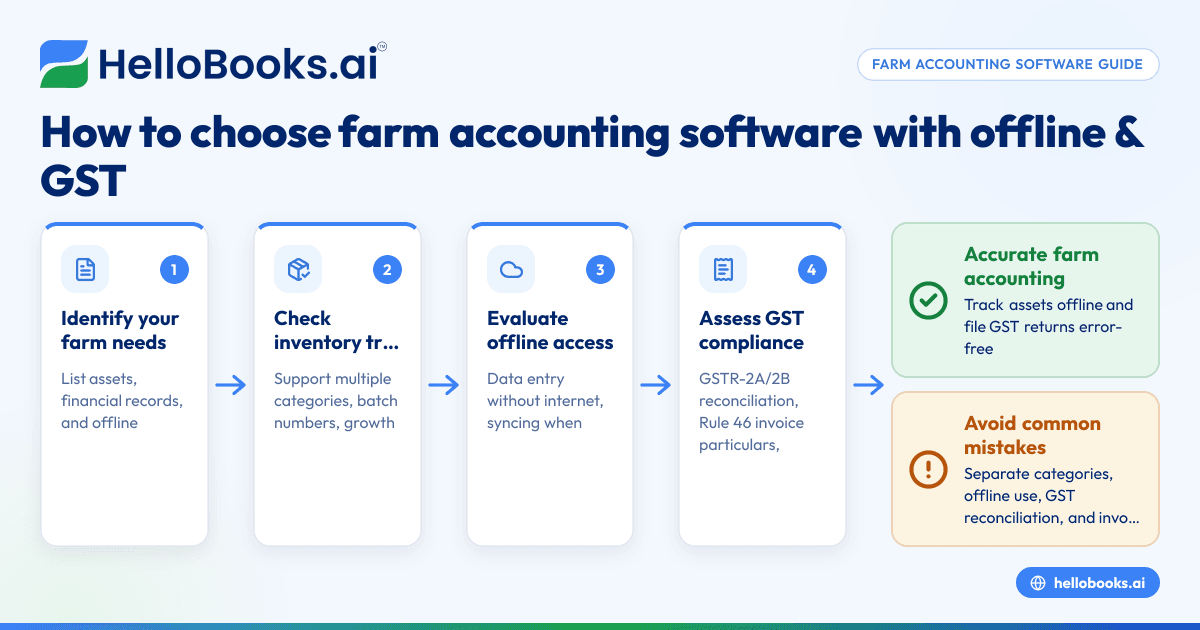
The top farm accounting software for tracking livestock, crops, and financial records with offline access combines inventory and financial management features suited to agriculture. It should support offline data entry, detailed tracking of farm assets, and GST compliance. This article covers how to choose such software, step-by-step selection criteria, a practical example, common mistakes, and how HelloBooks supports farm businesses with GST and financial reporting.
Why this comes up / what goes wrong
Farm business owners and accountants in India often manage diverse assets like livestock, crops, seeds, fertilisers, and machinery. Many still rely on spreadsheets, Tally, or manual books, making it difficult to track farm inventory and finances accurately, especially without continuous internet access in rural areas. Offline access becomes critical for daily data entry during field visits.
Additionally, reconciling GST invoices, filing returns like GSTR-1 and GSTR-3B, and tracking input tax credit (ITC) can be complex without integrated software. A commission agent at a grain mandi in Ludhiana or a seed and fertiliser dealer in Guntur needs farm-specific inventory tracking combined with financial reports and GST compliance tools.
Step-by-step
- Identify your farm business needs
- List assets to track: livestock, crop types, seed and fertiliser stock, machinery.
- Determine financial record needs: sales, purchases, expenses, GST filing.
- Check if offline data entry is essential due to poor internet.
- Check for inventory and asset tracking features
- Does the software support multiple inventory categories (livestock, crops)?
- Can you track quantities, batch numbers, expiry dates (for seeds/fertilisers)?
- Is there a way to record growth stages or health status for livestock/crops?
- Evaluate offline access capabilities
- Confirm if the software allows data entry and updates without internet.
- Check how data syncs when internet is available.
- Assess GST compliance support
- Look for automatic GSTR-2A/2B reconciliation to track ITC before filing GSTR-3B.
- Check if the software generates GST-compliant invoices with required particulars as per Rule 46 (supplier/recipient details, HSN/SAC codes, tax amounts, signatures).
- Verify support for multiple GSTINs if operating in more than one state.
- Examine financial reporting features
- Ensure monthly Profit & Loss statements and receivables ageing reports are available.
- Confirm reports are generated from the same data used for GST returns to avoid mismatches.
- Consider user access and scalability
- Check if multiple users can access the software simultaneously.
- Look for multi-GSTIN support if your farm business has registrations in different states.
- Compare pricing and plans
- Review pricing based on transaction volume and GSTINs.
- Consider free plans for basic needs or paid plans for advanced features.
- Read reviews and seek demos
- Test the software with your data.
- Ask for support responsiveness and training options.
For more on farm business accounting software, see Agricultural trading and agri businesses and accounting software in India.
Example (fictional figures)
A commission agent at a grain mandi in Ludhiana sells wheat and tracks livestock feed stock. On 15/09/2023, he records a wheat sale and livestock feed purchase:
- Wheat sold: 5,000 kg at ₹22 per kg
- Livestock feed purchased: 2,000 kg at ₹18 per kg + 5% GST
Calculations:
Wheat sale value = 5,000 × ₹22 = ₹1,10,000
Livestock feed purchase value = 2,000 × ₹18 = ₹36,000
GST on purchase = ₹36,000 × 5% = ₹1,800
Total purchase including GST = ₹36,000 + ₹1,800 = ₹37,800
The agent enters these in the software offline during market hours and syncs later. GST invoices generated include all Rule 46 particulars such as supplier and recipient GSTINs, HSN codes, and tax amounts. The software reconciles purchase invoices against GSTR-2B before filing GSTR-3B to ensure ITC claims are accurate.
Common mistakes
- Not tracking inventory categories separately
- Prevent by setting up distinct categories for livestock, crops, seeds, and fertilisers.
- Ignoring offline access needs
- Prevent by choosing software with reliable offline data entry and syncing.
- Skipping GST reconciliation before filing
- Prevent by using software that flags missing or mismatched supplier invoices in GSTR-2B.
- Using different data sources for GST and financial reports
- Prevent by selecting software where financial reports and GST returns come from the same entries.
- Failing to include all invoice particulars as per Rule 46
- Prevent by generating GST-compliant invoices with all mandatory details.
- Not reviewing multi-GSTIN compliance if operating in multiple states
- Prevent by using software that supports multiple GSTINs under one login.
For more on inventory, see inventory management.
Doing this in HelloBooks
HelloBooks offers GSTR-2A/2B reconciliation and ITC tracking, showing which supplier invoices are missing before you claim ITC in GSTR-3B. It provides monthly Profit & Loss and receivables ageing reports from the same entries used for GST, ensuring your books and returns agree. Multi-GSTIN support and unlimited users allow a trader with registrations in multiple states to file from a single login. Learn more about HelloBooks features and plans at HelloBooks for India.
Frequently asked questions
What features should farm accounting software have for livestock and crops?
Farm accounting software should track multiple inventory types like livestock, crops, seeds, and fertilisers with quantity and batch details. It should allow offline data entry, generate GST-compliant invoices, and provide financial reports linked to GST returns.
How does offline access benefit farm businesses?
Offline access lets farm owners and accountants enter data during fieldwork or in areas with poor internet. Data syncs when connectivity returns, ensuring records are up-to-date without delays.
Can farm accounting software handle GST compliance for multiple states?
Yes, software with multi-GSTIN support lets you manage GST registrations in different states from one login, simplifying filing GSTR-1 and GSTR-3B returns.
Why is GSTR-2B reconciliation important for farms?
GSTR-2B reconciliation flags missing or mismatched supplier invoices before filing GSTR-3B, helping avoid ITC claim errors and penalties.
Is HelloBooks suitable for small farm businesses?
HelloBooks supports GST invoicing, GSTR-2A/2B reconciliation, ITC tracking, and financial reporting, making it suitable for small to growing farm businesses needing integrated accounting.
Where can I find more information on accounting software for agriculture?
You can explore Agricultural trading and agri businesses and accounting software for small business for related solutions.
Key takeaways
- Choose farm accounting software that tracks livestock, crops, and inputs separately.
- Offline data entry is essential for rural farm operations with limited internet.
- GST compliance features like GSTR-2B reconciliation and multi-GSTIN support reduce filing errors.
- Financial reports should come from the same data as GST returns for accuracy.
- Avoid common mistakes by using integrated software with proper invoice generation.
- HelloBooks provides GST reconciliation, ITC tracking, financial reports, and multi-GSTIN access.
Start managing your farm's finances and GST compliance efficiently. Start on the Free plan (200 transactions a year, GSTR-1 and 3B filing for one GSTIN) with HelloBooks today.


