
Key takeaways
What this article covers, in order:
- Key takeaways
- Understanding quarterly estimated tax payments for freelancers in the United States
- What counts as quarterly estimated tax for freelancers?
- How do I calculate my quarterly estimated tax as a freelancer?
- How does AI bookkeeping help manage quarterly estimated taxes?
- What are the IRS rules and deadlines for quarterly estimated taxes?
Quarterly estimated tax payments are pre-payments of your federal income tax made four times a year. These payments help freelancers avoid surprises at tax time by spreading the tax burden throughout the year. Using AI bookkeeping can streamline this process, saving time and reducing the chance of penalties.
Key takeaways
- Freelancers in the U.S. typically need to pay estimated taxes quarterly to avoid IRS penalties.
- Estimated tax payments cover income tax and self-employment tax on freelance earnings.
- AI bookkeeping software helps automate income tracking, estimate tax calculations, and payment reminders.
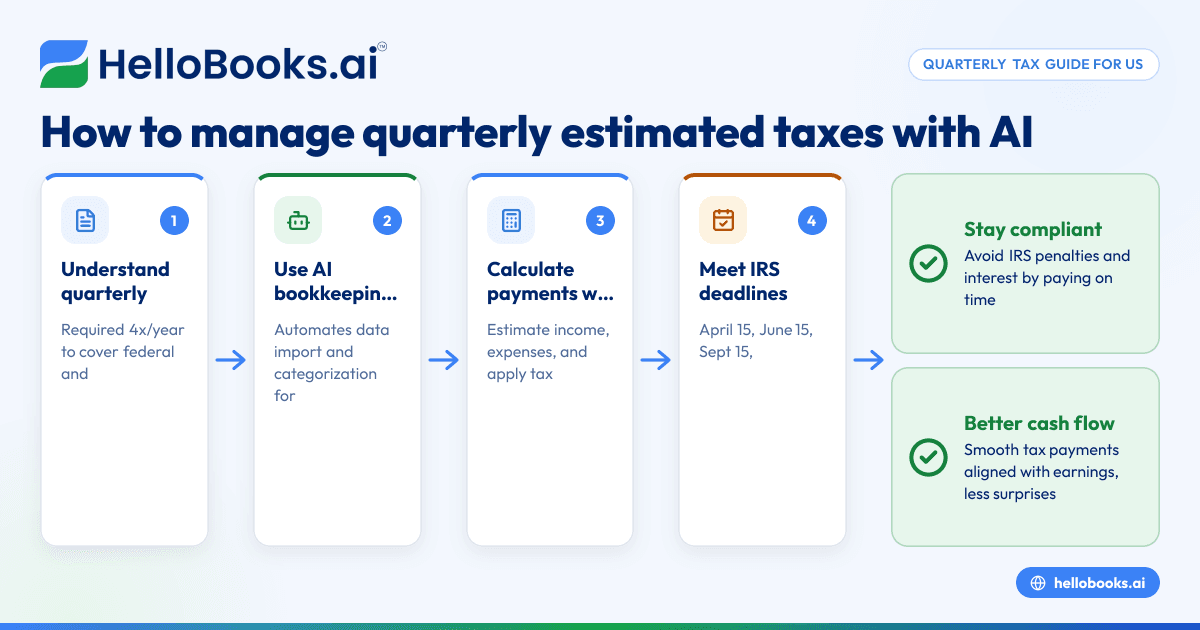
- The IRS deadlines for quarterly payments are usually April 15, June 15, September 15, and January 15 of the following year.
- Accurate bookkeeping reduces the risk of underpayment penalties and eases quarterly filing.
- IRS Form 1040-ES guides freelancers on calculating and submitting estimated tax payments.
Understanding quarterly estimated tax payments for freelancers in the United States
Freelancers are considered self-employed by the IRS, meaning your income is not subject to withholding like a W-2 employee. Because no taxes are deducted from your payments, you need to estimate your annual tax liability and pay it throughout the year to avoid a large tax bill and potential penalties on April 15.
The IRS requires estimated tax payments if you expect to owe at least $1,000 in tax after subtracting your withholding and refundable credits. This includes both federal income tax and self-employment tax—which covers Social Security and Medicare taxes normally paid partially by employers.
Failing to make these payments, or underpaying, can result in penalties and interest. Proper estimation requires tracking your income, expenses, deductions, and credits accurately throughout the year.
What counts as quarterly estimated tax for freelancers?
Quarterly estimated tax payments consist of your projected:
- Federal income tax liability based on your expected net earnings.
- Self-employment tax calculated at approximately 15.3% on net earnings.
- Any additional taxes due such as the Net Investment Income Tax if applicable.
You do not pay state estimated taxes here—those are separate and vary by state.
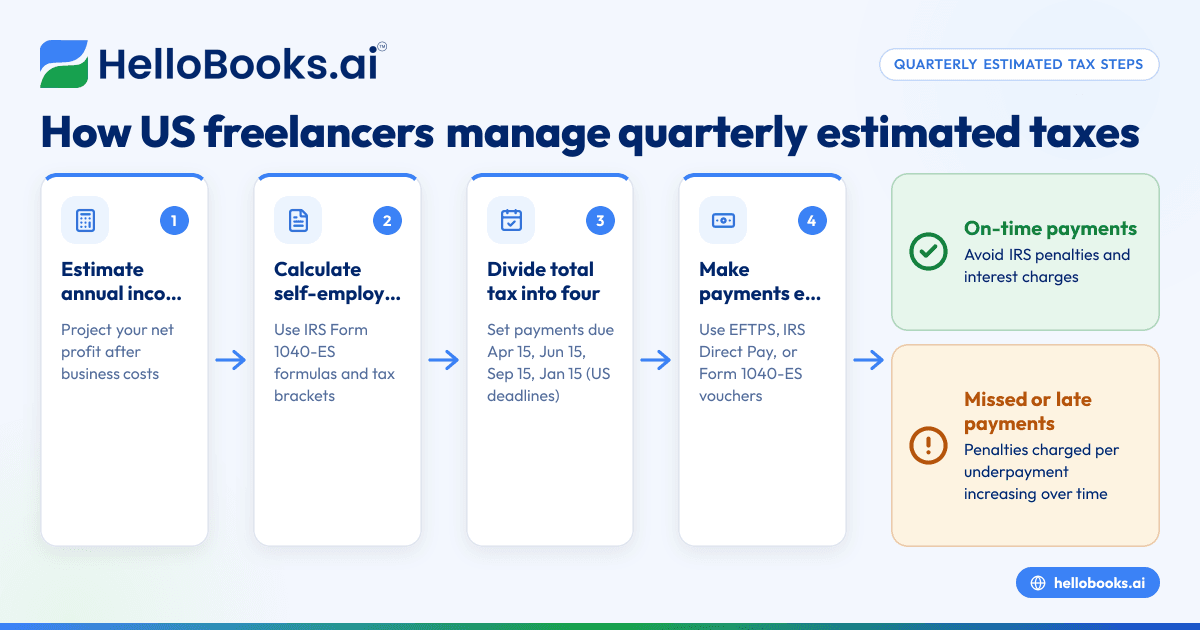
Estimated taxes are paid in four installments due on:
- April 15 (for income earned Jan 1 – Mar 31)
- June 15 (Apr 1 – May 31)
- September 15 (Jun 1 – Aug 31)
- January 15 of the next year (Sep 1 – Dec 31)
If the due date falls on a weekend or holiday, payments are due the next business day.
How do I calculate my quarterly estimated tax as a freelancer?
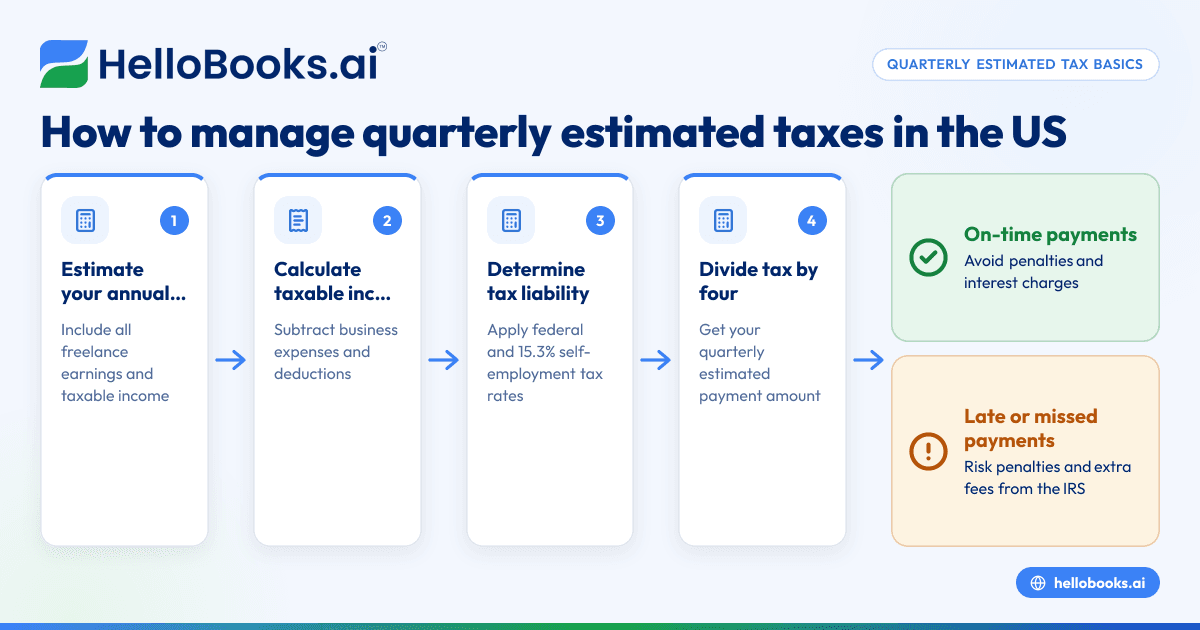
Calculating quarterly estimated tax can be simplified by following these steps:
- Estimate your total expected income for the year.
- Subtract your expected business expenses and deductions to get net profit.
- Calculate self-employment tax (15.3% on approximately 92.35% of net profit).
- Estimate your federal income tax based on tax brackets and applicable credits.
- Add self-employment and income tax to get total estimated annual tax.
- Divide this amount into four equal payments or adjust based on expected income fluctuations.
- Submit your payments by IRS deadlines using Form 1040-ES vouchers or electronically.
Tracking income and expenses monthly is critical to accurate estimates. Many freelancers use spreadsheets or software like QuickBooks, but AI bookkeeping can automate data capture and calculation for better accuracy.
How does AI bookkeeping help manage quarterly estimated taxes?
AI bookkeeping automates income and expense categorization by linking your bank accounts, invoicing, and payment platforms. It continuously updates your profit and loss numbers and can:
- Estimate quarterly tax liabilities in real time.
- Send reminders before IRS due dates.
- Generate IRS Form 1040-ES payment vouchers.
- Reconcile invoices and payments to reduce missed income.
- Provide cash flow insights to plan payments without liquidity issues.
Using AI quarterly estimated tax features reduces manual data entry, calculation errors, and last-minute scrambling to meet deadlines. This saves time and lowers penalty risk. For freelancers managing multiple clients or projects, automation ensures nothing gets overlooked.
What are the IRS rules and deadlines for quarterly estimated taxes?
The IRS requires quarterly estimated payments if you expect to owe $1,000 or more in federal tax after subtracting withholding and refundable credits. The four payment deadlines each year are:
- April 15 for income earned Jan 1 – Mar 31
- June 15 for Apr 1 – May 31
- September 15 for Jun 1 – Aug 31
- January 15 (next year) for Sep 1 – Dec 31
Late or insufficient payments trigger penalties calculated on the underpaid amount. If you miss a deadline, pay the amount as soon as possible to minimize penalties. The IRS offers an online payment system for estimated taxes.
Form 1040-ES contains worksheets that guide you in estimating tax based on last year’s return or current year projections. For safer estimates, track your income and expenses regularly rather than relying solely on last year’s data.
What happens if I don’t pay quarterly estimated taxes on time?
If you don’t pay enough estimated tax or miss the deadlines, the IRS charges a penalty based on the shortfall. This penalty increases with time until you pay the full amount due.
The penalty is calculated separately for each installment underpayment. Even if you pay your entire tax when filing your annual return, you can still owe penalties for the missed quarterly payments.
To avoid this, estimate taxes correctly and pay on time. If you expect lower income in later quarters, you can adjust the payment amounts accordingly. Using AI bookkeeping tools helps maintain accuracy and alerts you when payments are due.
How can I pay my quarterly estimated taxes?
You have several options to pay your quarterly estimated taxes to the IRS:
- Electronic Federal Tax Payment System (EFTPS)
- IRS Direct Pay from your bank account
- Debit or credit card payments online
- Mailing IRS Form 1040-ES with a check or money order
Electronic payments are preferred for speed and confirmation. Many freelancers combine payment with electronic filing of their annual returns for easy record-keeping.
Keep detailed records of payments and amounts to ease annual tax filing and reconciliation.
How do I track and adjust my estimated tax payments during the year?
Because freelance income can be irregular, you should track your actual earnings and expenses monthly or quarterly. This helps you:
- Compare actual income to original estimates.
- Adjust remaining payments to avoid large overpayments or underpayments.
- Update your tax calculations based on business deductions or credits you discover.
- Maintain up-to-date profit and loss reports.
AI accounting software is particularly useful here. It can automatically analyze your incoming payments, categorise expenses, and recalculate estimated taxes in real time. This makes it easier to avoid penalties and cash flow surprises by staying on track with accounting software for small business.
How do state estimated tax payments relate to federal quarterly payments?
Your quarterly estimated tax payments to the federal government do not cover state income taxes. Most states require freelancers to make separate estimated tax payments to state tax authorities based on state tax rules.
Deadlines usually align with federal due dates, but rates and forms vary by state. For example, California requires Form 540-ES and New York uses Form IT-2105.
Always check your state’s tax department website or consult a tax professional to ensure you meet all your state estimated tax requirements.
Quarterly estimated tax payments are essential for freelancers to stay compliant, avoid penalties, and manage cash flow in the United States. Using AI bookkeeping tools can automate income tracking, tax calculation, and remind you of due dates, saving you time and stress. If you want to see how AI can simplify your tax management, consider booking a demo at hellobooks.ai or check out the plans at hellobooks.ai/pricing.
Frequently asked questions
Do all freelancers have to pay quarterly estimated taxes?
Not necessarily. You must pay only if you expect to owe at least $1,000 in taxes after withholding and credits. If your freelance income is low or taxes are withheld elsewhere, you may not need to pay quarterly.
Can I use AI bookkeeping software for calculating my quarterly estimated taxes?
Yes, many AI bookkeeping tools automate real-time income tracking and tax estimates, helping you make accurate quarterly payments on time.
What IRS form do I use to pay quarterly estimated tax?
You use IRS Form 1040-ES to calculate and submit your quarterly estimated tax payments. Electronic payments are commonly made via IRS Direct Pay or EFTPS.
What if my freelance income varies a lot each quarter?
You can adjust your estimated tax payments each quarter based on your actual earnings. This reduces penalties and prevents overpaying during slower months.
Is there a penalty for overpaying estimated taxes?
No penalty exists for overpaying; you will receive a refund or credit when you file your annual tax return.
How can AI quarterly estimated tax features help me avoid IRS penalties?
They automate calculations based on your updated income and expenses, send you reminders before payments are due, and reduce human errors that cause underpayment penalties.
Read next
This article covers one part of a bigger topic. For the complete picture, read our guide to quarterly estimated tax.