Key takeaways
What this article covers, in order:
- What AI bookkeeping actually changes in GST work
- Cleaner invoices mean cleaner GSTR-1
- Purchase capture and GSTR-2A/2B reconciliation are where AI earns its keep
- Bank statement uploads help connect invoices, receipts, and real cash movement
- Place of supply, tax head split, and reverse charge are not minor details
- E-invoice and e-way bill workflows reduce duplicate entry
India’s small businesses use AI bookkeeping to make GST return filing less painful by turning invoices, purchase bills, and bank statement uploads into cleaner books before anything reaches the GST portal. In practice, that means fewer mismatches in GSTR-1 and GSTR-3B, better visibility into ITC from GSTR-2A/2B, and less last-minute chasing across Excel, Tally exports, PDFs, and WhatsApp chats. The real value is not “AI” as a buzzword; it is better source data for GST under the Central Goods and Services Tax Act, 2017 and related GST law administered through CBIC and GSTN.
What AI bookkeeping actually changes in GST work
Most GST filing problems in India do not begin on filing day. They begin when a sale is invoiced with the wrong place of supply, when a purchase bill sits in someone’s phone gallery, when a receipt comes through UPI or NEFT and no one matches it to the right invoice, or when books in Tally and the GST working sheet drift apart.
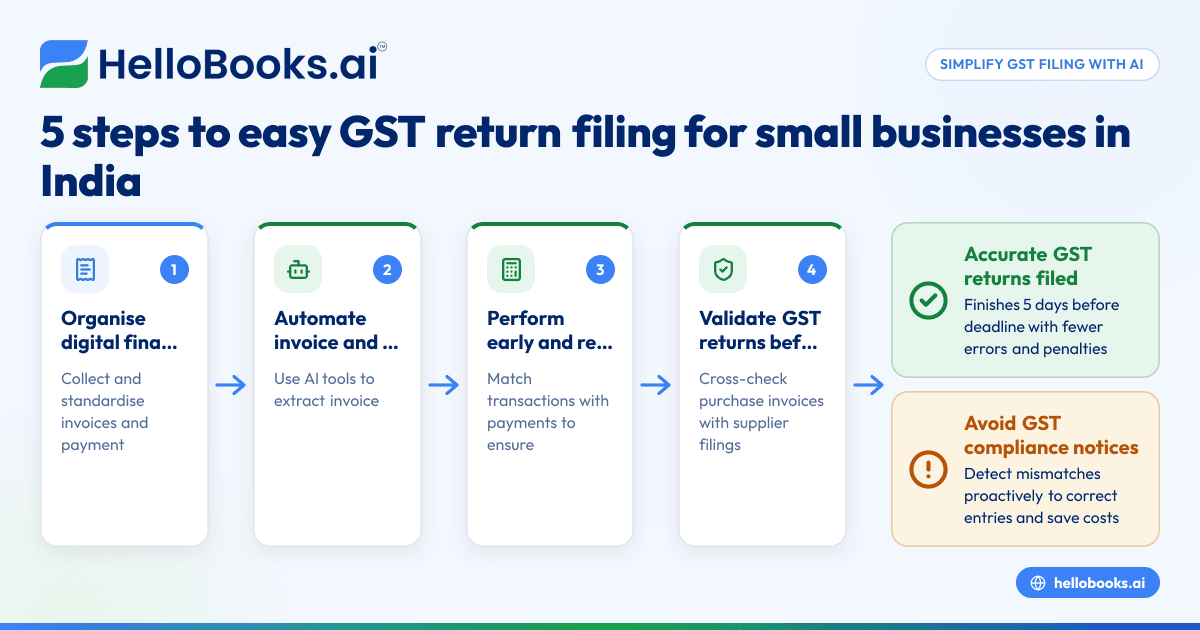
AI bookkeeping helps by reducing manual retyping and by surfacing exceptions earlier. If a system can read a supplier bill from a PDF, identify the GSTIN, invoice number, taxable value, and tax heads, and then compare that purchase against GSTR-2A/2B, your team has a chance to fix issues before GSTR-3B is filed. If the same system creates GST invoices with the right CGST/SGST or IGST split based on place of supply, GSTR-1 becomes a by-product of day-to-day bookkeeping instead of a separate month-end exercise.
For Indian businesses, this matters because GST compliance sits across several moving parts: invoicing, e-invoice requirements where applicable, e-way bill generation for movement of goods where applicable, purchase capture, ITC tracking, and payment reconciliation through bank statements. A bookkeeping tool that understands GST is more useful than generic accounting software that treats tax as an afterthought.
Cleaner invoices mean cleaner GSTR-1
GSTR-1 is only as reliable as the sales data underneath it. For many proprietors and small finance teams, the main cause of trouble is not the return screen itself; it is inconsistent invoicing. One invoice shows a customer name without GSTIN, another uses the wrong HSN or SAC, another applies IGST when the transaction should have been split into CGST and SGST, and another is missing transport details later needed for an e-way bill.
Software built for India can reduce that drift at the time of entry. HelloBooks, for instance, can create GST invoices with the tax split based on place of supply and customer details, so the sale recorded in the books is already closer to what GSTR-1 needs. If a business is covered by e-invoicing under the rules issued under GST law, the same workflow can generate the IRN and signed QR so the invoice record and the compliance record do not diverge.
That is particularly useful for businesses handling multiple kinds of outward supplies across states. A firm billing customers in Maharashtra, Karnataka, and Delhi may otherwise end up with a mix of local and inter-state supplies classified inconsistently. When the invoice logic accounts for GSTIN, state, and place of supply from the start, the monthly return is less of a reconstruction exercise.
If you want to see how invoice workflows connect to GST-ready books, smart invoicing and e-invoicing software are the relevant places to start.
Purchase capture and GSTR-2A/2B reconciliation are where AI earns its keep
Sales are only half the story. On the purchase side, small businesses often receive bills through email PDFs, paper copies, courier packets, and accountant WhatsApp forwards. That creates two risks: the bill never enters the books, or it enters with the wrong values. Either way, the ITC working becomes unreliable.
AI-assisted OCR can help here by reading purchase bills from photos or PDFs and drafting entries instead of forcing someone to key in every field manually. But the real gain is not speed alone. It is the ability to compare what you recorded with what appears in GSTR-2A/2B on GSTN and then track which supplier invoices are missing or mismatched before you decide what to claim in GSTR-3B.
Under the CGST Act, 2017 and related rules, ITC conditions and matching discipline matter. The current legal position, conditions, and any changes should always be checked in the GST law, CBIC notifications/circulars, and on the official GST portal. Software cannot replace judgement, but it can show you where judgement is needed.
HelloBooks is useful here because purchase bills can be captured through OCR and then reviewed against GSTR-2A/2B for ITC tracking. That is a much better monthly habit than waiting until quarter-end and trying to understand why the books show one rupee amount and the portal shows another. If you need a quick starting point, the GST reconciliation checker and GSTIN validator can help test raw data quality before filing.
Bank statement uploads help connect invoices, receipts, and real cash movement
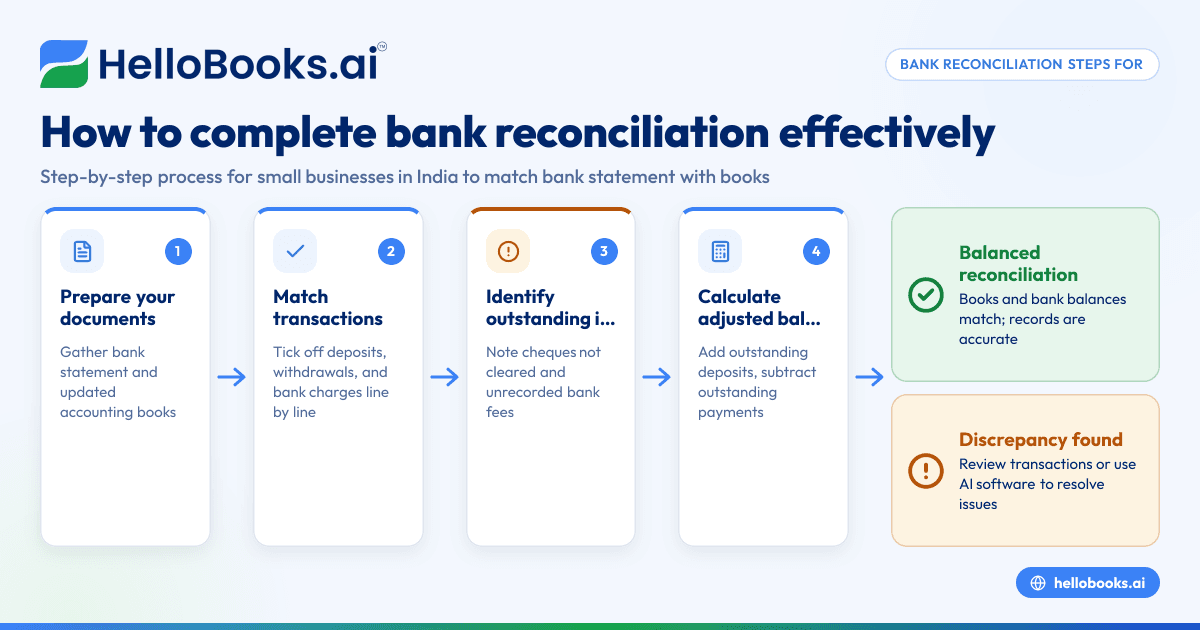
A GST return is not a bank statement, but weak bank reconciliation often exposes weak bookkeeping. In India, receipts may come via UPI, IMPS, NEFT, RTGS, or direct transfers with cryptic narration. If those credits are not matched back to invoices, receivables ageing becomes unreliable and month-end turnover checks become harder. On the payments side, supplier settlements, reimbursements, and bank charges can sit unmatched for months.
This is where bank statement upload with AI reconciliation is practical. Instead of manually typing every bank line, a business uploads the monthly statement and the software suggests matches against invoices and bills already in the books. That makes it easier to spot missing sales entries, duplicated expenses, or receipts posted to the wrong party.
For GST work, the benefit is indirect but real. Better bank matching supports more trustworthy turnover, receivables, and purchase records. It also gives the owner confidence that the books used for GSTR-1 and GSTR-3B broadly align with actual collections and payments.
HelloBooks supports bank statement upload and AI reconciliation for India, which is especially helpful for owner-managed businesses that do not have a dedicated accounts team. If your current process lives in spreadsheets plus downloaded statements, bank reconciliation software is the relevant path.
Place of supply, tax head split, and reverse charge are not minor details
A lot of GST pain comes from errors that feel small while invoicing but become bigger in returns. A common one is the wrong tax head split: charging CGST and SGST when the supply should be under IGST, or the reverse. Another is mishandling reverse charge or not recording TDS/TCS impacts properly in the books.
These are not cosmetic issues. They affect how outward and inward supplies are classified, what appears in summary figures, and how easily your CA or internal team can defend the numbers if questions come later. The governing position comes from the GST law, CBIC notifications and circulars, and the guidance reflected on the GST portal; current interpretations should be checked there and, where necessary, with a qualified professional.
A bookkeeping system that understands Indian tax structure can reduce these avoidable errors. HelloBooks can split tax heads based on place of supply and handle reverse charge and TDS/TCS within the accounting flow, so businesses are not maintaining a side spreadsheet for adjustments and then manually pushing the net effect into returns.
That matters even more if you operate more than one GSTIN. A business with registrations in two states may have separate outward supplies, stock movement, and purchase patterns for each registration. Keeping each GSTIN distinct inside one system is simpler than running disconnected files and trying to consolidate them later.
E-invoice and e-way bill workflows reduce duplicate entry
For businesses to which e-invoicing rules apply, the biggest nuisance is often duplication: raise the invoice in one system, generate compliance data elsewhere, then correct differences when the IRN or signed QR details do not line up. Similar duplication appears in e-way bill work when transport details are keyed again after the invoice is already complete.
A better setup is one where the commercial document and the compliance document come from the same underlying record. HelloBooks can generate the IRN and signed QR during invoicing where e-invoicing applies, and it can also create the e-way bill from invoice data so consignment details do not need to be typed twice.
The current applicability rules, document requirements, and any turnover-linked criteria are set under GST law and published through CBIC notifications, advisory updates, and the relevant official portals. Because these can change, any specific current threshold or operational requirement should be checked on official sources or confirmed by your advisor.
For businesses moving goods regularly, this matters beyond convenience. Duplicate entry is how invoice values, vehicle details, and item information drift apart. One corrected source record is easier to trust than three manually updated systems. You can explore that workflow through e-way bill software.
An illustrative invented working shows the difference better than a slogan
Take an illustrative and invented small wholesaler in India with one GSTIN, monthly sales to customers in Gujarat and Rajasthan, and purchases from three suppliers. Suppose the books show sales of ₹12 lakh for a month and purchases of ₹7 lakh, but the team has entered some bills late and one inter-state sale was mistakenly treated as a local sale. These figures are invented only to explain the workflow; they leave out many realities, including debit notes, credit notes, exempt supplies, valuation issues, blocked credits, and legal interpretation points.
In a manual process, the owner may raise invoices in one tool, track collections in a separate Excel file, receive supplier bills as PDF attachments, and then ask the accountant to prepare GSTR-1 and GSTR-3B near the filing date. The accountant has to identify whether each sale should fall under IGST or CGST/SGST, manually total outward supplies, compare purchase entries with GSTR-2B, and then ask why ₹80,000 of supplier invoices appear on the portal but only ₹60,000 is recorded in the books. NEEDS EXPERT REVIEW
In an AI-assisted process, the same business records the sale once as a GST invoice, so place of supply drives the tax head split. Purchase PDFs are scanned into draft bills. The bank statement is uploaded and matched to receipts and supplier payments. Then GSTR-2A/2B reconciliation highlights the missing purchase entries before GSTR-3B is prepared. The business still needs review and judgement, but the review is focused on exceptions rather than on typing.
That is the practical promise: not “one-click compliance,” but fewer hidden gaps between commercial activity and GST data.
Direct filing is useful only if the books are reliable first
Many businesses think filing software is the answer. Filing matters, but direct filing only helps after the books are in shape. If source data is poor, a direct connection just sends poor data faster.
The more valuable approach is an accounting workflow in which invoices, purchase bills, reconciliation, and return preparation sit together. HelloBooks can directly file GSTR-1 and GSTR-3B, which is genuinely useful once the underlying entries have been reviewed. It also helps that financial reports come from the same data used for GST, so management can compare turnover, receivables, and expenses without rebuilding reports outside the system.
This is especially relevant for businesses moving away from patchwork processes: Tally on one desktop, stock in another file, purchase bills in email, and return workings in spreadsheets. If you are evaluating alternatives to that setup, accounting software India, AI bookkeeping, and tally alternative are the most relevant next reads.
What small businesses in India should look for before they switch
Not every business needs a dramatic systems change. But if you are repeatedly facing GST mismatches, late purchase capture, unclear ITC workings, or confusion across multiple users, the software should solve Indian bookkeeping problems, not just offer generic automation.
Look for a setup that can:
- create GST-ready invoices with the correct place-of-supply treatment
- support e-invoice workflows with IRN and signed QR if your business falls within applicability rules published by official sources
- capture purchase bills from PDFs and photos
- reconcile GSTR-2A/2B for ITC tracking
- accept uploaded bank statements and suggest matches
- keep inventory and financial reports tied to the same underlying entries
- handle more than one GSTIN if your business operates in multiple states
- help teams that still rely on mobile-first working or quick clarification through WhatsApp in Hindi, English, or Hinglish
HelloBooks fits that India-specific pattern better than a generic ledger because the GST tasks are woven into everyday bookkeeping. That includes invoicing, purchase capture, reconciliation, inventory, returns, and reporting rather than treating GST as a separate month-end add-on.
The bottom line for GST return filing
AI bookkeeping helps Indian small businesses with GST return filing when it improves the books before the return is generated. The biggest gains come from GST-compliant invoicing, OCR on purchase bills, GSTR-2A/2B reconciliation, uploaded bank statement matching, and direct filing of GSTR-1 and GSTR-3B from the same records.
That does not remove the need to check the law. Current rates, thresholds, due dates, penalties, interest, and form requirements should be verified from the CGST Act, 2017, related GST law and rules, CBIC notifications/circulars, and the official GST portal/GSTN. Where your facts are messy, or where reverse charge, TDS, inter-state supplies, or e-invoice applicability are involved, a CA or tax professional should review the position.
If you want to see whether this fits your business, start with the India pages for GST return filing software, accounting software for small business, or book a demo. For plan details, use /in/pricing.