Key takeaways
What this article covers, in order:
- Mistake 1: Treating bookkeeping as just data entry
- Mistake 2: Why do we wait to reconcile bank transactions?
- Mistake 3: Is GST compliance only about filing returns?
- Mistake 4: Handling invoices and payments disjointedly — How can this be managed better?
- Why do finance teams hesitate to switch from Tally or spreadsheets?
- How can AI bookkeeping software be fully supported for small businesses?
Small business finance teams in India often face overwhelming manual data entry, reconciliation backlogs, and compliance deadlines. These challenges cost time and money while increasing risks of errors and audit issues. Without strong support, the accounting workload can spiral out of control, delaying critical decisions and growth. For example, a Pune-based manufacturing unit once delayed its GST return filing due to messy books and missed input tax credits. As a result, they faced penalties and cash flow stress that could have been avoided with better bookkeeping practices.
Mistake 1: Treating bookkeeping as just data entry
Many small businesses think bookkeeping means only entering invoices, bills and receipts into spreadsheets or legacy software like Tally. This narrow view leads to hours of manual labor and repetitive mistakes. Imagine a Bengaluru digital marketing agency where the accounts person repeatedly enters ₹25,000 client invoices but enters ₹250,000 by mistake once. Such errors result from copy-paste routines, ignoring GST details like HSN codes or capturing invoice dates incorrectly.
Why does this happen? Manual data entry is tedious and prone to fatigue. Traditional tools often require each transaction to be keyed in individually, increasing the chance of human error. Also, many teams lack accounting expertise to recognize discrepancies upfront, leading to data quality issues accumulating.
The fix is to adopt AI-powered bookkeeping tools that automatically capture, classify and record transactions. For instance, AI software can scan invoices received via WhatsApp or email, extract key data such as invoice number, date, GSTIN, and amounts, and enter them correctly into your books. This reduces time spent on data entry and lowers errors significantly. The AI learns from regular patterns—recovering vendor names, payment terms, and tax rates—avoiding repetitive input and speeding up bookkeeping. This frees your team for higher-value finance tasks like cash flow analysis or GST return review.
Mistake 2: Why do we wait to reconcile bank transactions?
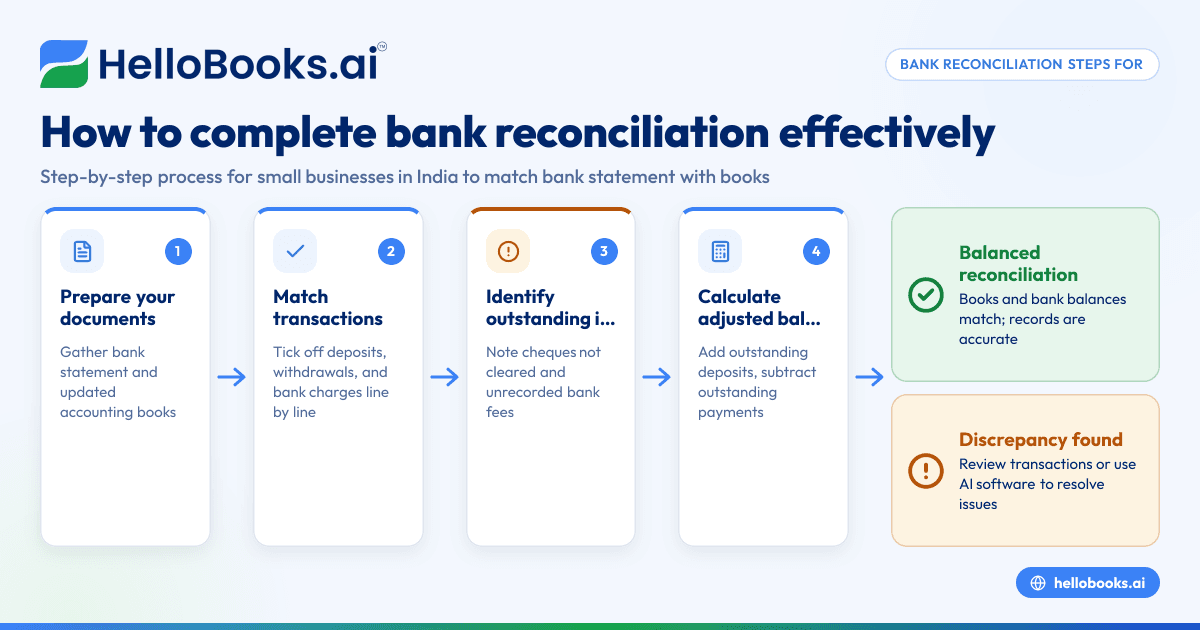
Waiting to reconcile bank transactions until the end of the month or quarter is common because reconciliation feels tedious or the bank statement format complicates matching. For example, a Chennai-based retailer receives dozens of UPI payments daily but leaves reconciliation until month-end, piling up an enormous backlog. This creates risks of missing suspicious transactions or unrecorded income, which can impact financial statements and tax compliance negatively.
Reconciliation delays can also disrupt decisions in working capital management. If a business does not know which invoices have cleared, it cannot accurately forecast cash flow or decide on vendor payments.
The better approach is to reconcile continuously. AI bank reconciliation software connects with your bank and UPI systems, instantly matching transactions with invoices and expenses. For example, a Mumbai ecommerce startup implemented this and now sees the day's receipts matched in real-time. This immediate matching highlights short payments, overpayments, or missing invoices quickly and supports better cash management.
Steps to make reconciliation routine:
- Enable automatic bank and payment feeds in your software.
- Set daily or weekly alerts for unmatched transactions.
- Investigate discrepancies immediately rather than delaying.
- Use dashboard reports to monitor outstanding invoices and payments.
Continuous reconciliation eliminates backlogs and irregularities, reducing risks of detection delays, fines, or fraud losses.
Mistake 3: Is GST compliance only about filing returns?
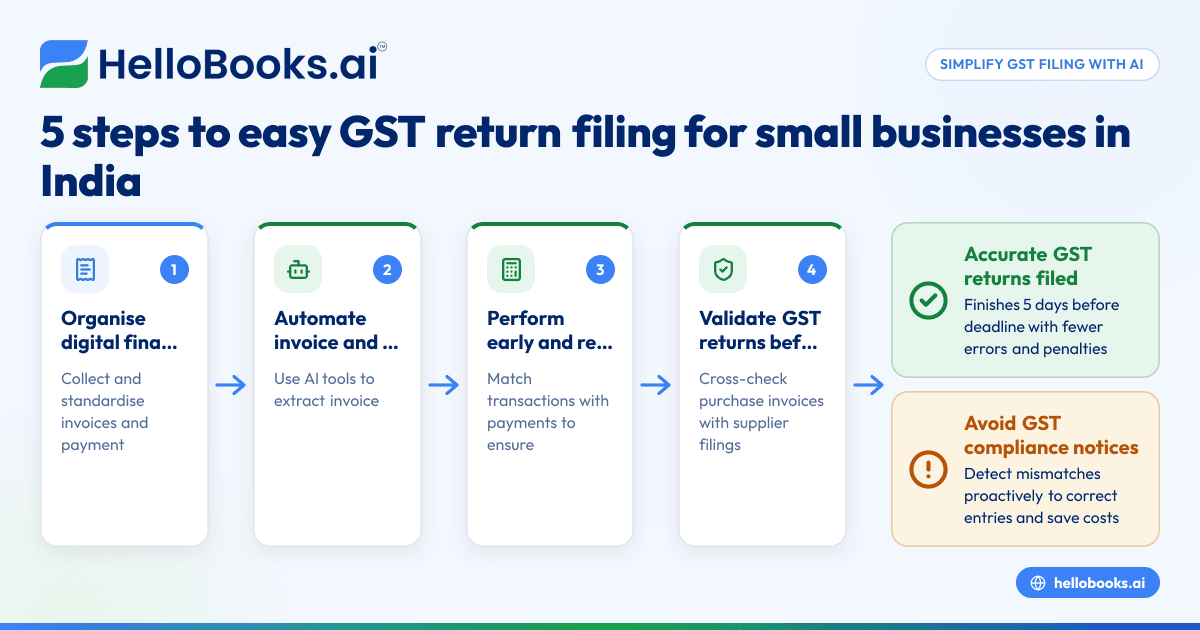
GST return filing is crucial but it’s only one part of compliance. Errors in input tax credit claims, invoice mismatches, or incomplete e-invoicing disrupt returns and invite scrutiny from the GST Network. Small businesses operating in tier-2 cities like Indore or Nagpur often struggle because suppliers and customers delay sharing invoice details or filing returns promptly. This causes mismatches in GSTR-2A and your books, risking GST audit inquiries.
Why do these errors happen?
- Manually entering invoice data without cross-checks
- Ignoring or mistyping GSTINs and HSN codes
- Missing e-invoice or e-way bill data for applicable transactions
- Lack of integration between billing and GST software
The fix is AI-driven GST return filing software that integrates invoice data automatically, cross-checks with suppliers’ filings, and alerts you to inconsistencies before submission. For example, AI can flag if an input tax credit claim appears without a matching supplier invoice. It also helps ensure e-invoicing is generated for transactions exceeding ₹50 lakh turnover (effective 1 Oct 2023 for certain sectors). Early detection reduces amendments, penalties, and audit risks.
Mistake 4: Handling invoices and payments disjointedly — How can this be managed better?
Small businesses in Mumbai, Pune or Bengaluru typically use WhatsApp for order confirmations and Razorpay or UPI apps for payments. But managing invoices separately from payment data can cause delays or inconsistencies in books and cash flow forecasting.
Why does this occur? Often, sales teams chat with customers on WhatsApp to confirm orders, while accounting teams generate invoices later, sometimes manually. Payment confirmations received via UPI apps may not sync automatically with invoices. This disconnect leads to:
- Delayed matching of payments to invoices
- Missed or duplicate payment entries
- Discrepancies in ledger and cash flow reports
For example, a Pune-based event management firm realized after months of delayed payment follow-ups that many client payments recorded on WhatsApp were not entered in their books promptly, leading to confusion in bank reconciliations.
The fix is to use invoice software integrated with payment platforms and expense management software. AI extracts invoice details from WhatsApp chats or emails, links payments recorded on Razorpay or UPI automatically, and updates your ledger in real-time. This creates a seamless flow from order confirmation to invoice generation, payment receipt, and recording.
The benefits include:
- Faster collections because payment reminders are automated
- Fewer payment disputes with customers due to transparent invoice tracking
- Accurate, up-to-date cash position for finance teams
Why do finance teams hesitate to switch from Tally or spreadsheets?
Many small businesses stick to Tally or Excel because they are familiar or cheap initially. However, these tools lack modern AI capabilities to automate data capture, reconciliation, and GST validation, which increasingly consume hours every month.
Transition fears include:
- Data migration complexity and risk of errors during transfer
- Change management — staff need to learn new software and workflows
- Concerns about cloud security and data privacy under the DPDP Act 2023
- Initial time investment before benefits become evident
The fix is to choose an accounting software for small business that offers demos and onboarding help. HelloBooks.ai provides personalized support, easy-to-follow guides, and a Tally alternative that is cloud-based, mobile-friendly and fully compliant with Indian GST norms. This removes much of the friction associated with new software adoption.
How can AI bookkeeping software be fully supported for small businesses?
AI fully supported bookkeeping means more than automation. It’s about personalized help, reports tailored to your business, and smooth compliance workflows, even if you have limited accounting knowledge.
HelloBooks.ai offers features like auto bank feeds, GST validation, invoice automation, and monthly cash flow reports, designed for Indian SMEs and accounting firms. For example, a Bengaluru-based consultancy uses HelloBooks.ai to automatically import its bank and UPI transactions, validate GST input credits, and generate P&L statements each month without manual intervention.
This level of support empowers finance teams to trust the software and spend less time firefighting data issues. It also simplifies audits because records are clean, consistent, and ready for scrutiny on demand.
A simple routine to avoid bookkeeping mistakes
Here is a weekly/monthly routine finance teams in India can follow to keep accounting accurate and compliant:
- Set up auto bank and payment feeds to import transactions daily.
- Review AI-matched invoices and payments weekly to catch mismatches.
- Validate GST invoice data as it is generated with e-invoicing software.
- Reconcile bank statements and cash books every week using bank reconciliation software.
- Keep track of expenses with automated import from WhatsApp and receipts through expense management software.
- Generate monthly financial reports to monitor profit, expenses, and tax liabilities.
- Cross-check GST returns with supplier filings before final submission using GST return filing software.
Following this routine helps finance teams transform accounting from a reactive, error-prone process into a proactive, streamlined business tool.
AI bookkeeping ensures small business finance teams are fully supported from day one, transforming routine accounting tasks from burdens to streamlined processes. Instead of spending long hours on data, your team can focus on decision-making and growth strategies.
See how HelloBooks.ai’s AI accounting software can simplify your finance operations. Book a free demo today or compare plans to find the right fit for your business at pricing. This way, you can stay compliant, control cash flow and run your business with confidence.
Related reading
- AI bookkeeping
- How AI Bookkeeping Supports Small Businesses While Highlighting Limitations in India
- How Small Businesses Can Use AI Bookkeeping Tools Without Losing Control, Supported with Caveats
Read next
This article covers one part of a bigger topic. For the complete picture, read our guide to fully supported.