
Key takeaways
What this article covers, in order:
- When to choose AI bookkeeping software for small business?
- When to stick with traditional bookkeeping methods?
- What does AI-powered bookkeeping cost for small businesses in India?
- How does AI bookkeeping help with GST return filing and e-invoicing?
- What are AI bookkeeping limitations in India?
- Questions to ask before you decide on AI bookkeeping software
How AI Bookkeeping Supports Small Businesses While Highlighting Limitations in India
======================================================================================
Small business owners in India often face a tough decision: should they adopt AI bookkeeping for small business needs or stick to traditional accounting methods? The primary factor influencing this choice is usually the balance between ease of automation and the specific compliance complexities under Indian law, such as GST and e-invoicing requirements.
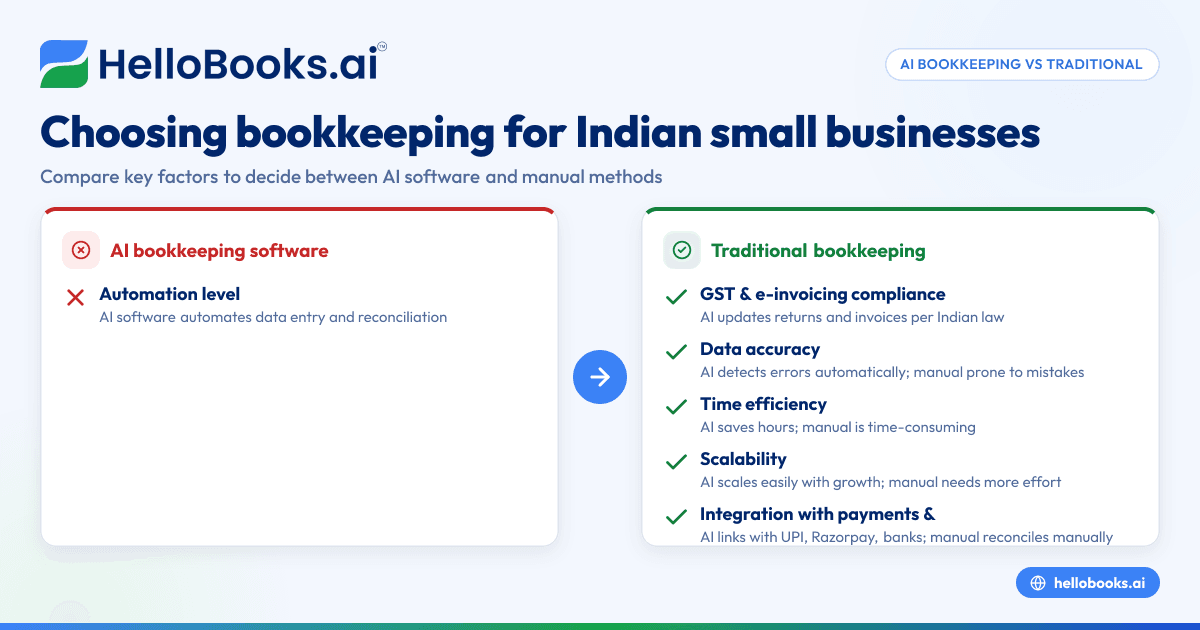
To help you decide, here is a comparison table outlining key criteria relevant to Indian small businesses seeking bookkeeping solutions:
| Criteria | AI Bookkeeping Software | Traditional Bookkeeping (Manual/Tally/Spreadsheets) |
|---|---|---|
| Automation Level | High – Automated with AI | Low to medium – manual entry and reconciliation |
| GST & E-invoicing Compliance | Built-in GST return filing and e-invoicing support, real-time updates as per Indian regulations | Requires manual updates and checks for GST and e-invoicing rules |
| Data Accuracy | AI-powered error detection and correction | Prone to human error; depends on user diligence |
| Time Efficiency | Saves hours by automating bank reconciliation, invoices, expenses | Time-consuming manual data entry and review |
| Cost | Varies – subscription-based pricing available; no upfront IT infrastructure needed | Usually low upfront cost but higher ongoing labor cost |
| Scalability | Easily scales with business growth, processing large transaction volumes | Scaling requires more manual effort and resources |
| Integration with Payments & Banking | Integrates with UPI, Razorpay, banks for automated data capture | Manual upload or reconciliation with bank statements |
When to choose AI bookkeeping software for small business?
Choose AI bookkeeping software when you want to save time on repetitive data entry and reconciliation tasks. AI automation helps you keep your books updated with minimal effort. It is especially useful if you handle many transactions, want easy GST compliance, and seek quick financial reports to make informed decisions.
For example, a growing Bengaluru-based ecommerce startup processing hundreds of daily transactions will find AI bookkeeping a good fit. AI-powered software can automatically book sales invoices, reconcile payments via UPI or Razorpay, and flag GST errors before filing. This reduces delays and the risk of non-compliance penalties.
However, keep in mind that AI bookkeeping solutions require reliable internet and some level of digital literacy. They usually come with a licensing cost, although this might be less than the fee for a full-time accountant or outsourced bookkeeper.
When to stick with traditional bookkeeping methods?
Traditional bookkeeping, such as maintaining Excel sheets or Tally ERP, fits businesses with low transaction volumes or very simple accounting needs. Many small shops in tier-2 or tier-3 cities rely on these tools because they understand them well and avoid the cost and learning curve of new technology.
This approach works when you have only a handful of clients and suppliers and the GST returns are manageable. For instance, a Pune-based boutique or offline retailer with a few dozen monthly bills might prefer manual bookkeeping.
The downside: manual bookkeeping tends to be more error-prone, time-consuming, and delays financial closures. It also struggles to scale quickly as the business grows, making compliance harder to maintain.
What does AI-powered bookkeeping cost for small businesses in India?
AI-powered bookkeeping software typically works on subscription plans with different tiers suited to the size and needs of your business. Pricing varies by number of invoices, employees, and features like GST return filing with government integration.
While the upfront cost might look higher than free spreadsheets or single Tally licenses, consider your savings in time and reduced errors. Many users find the monthly fee justified given how much AI automation reduces manual work and helps avoid costly GST penalties.
HelloBooks.ai offers such cloud-based AI accounting software for small businesses in India that includes automated banking, invoicing, GST compliance, and financial reports. You can compare plans anytime at /pricing and see if adopting an AI tool fits your budget and goals.
How does AI bookkeeping help with GST return filing and e-invoicing?
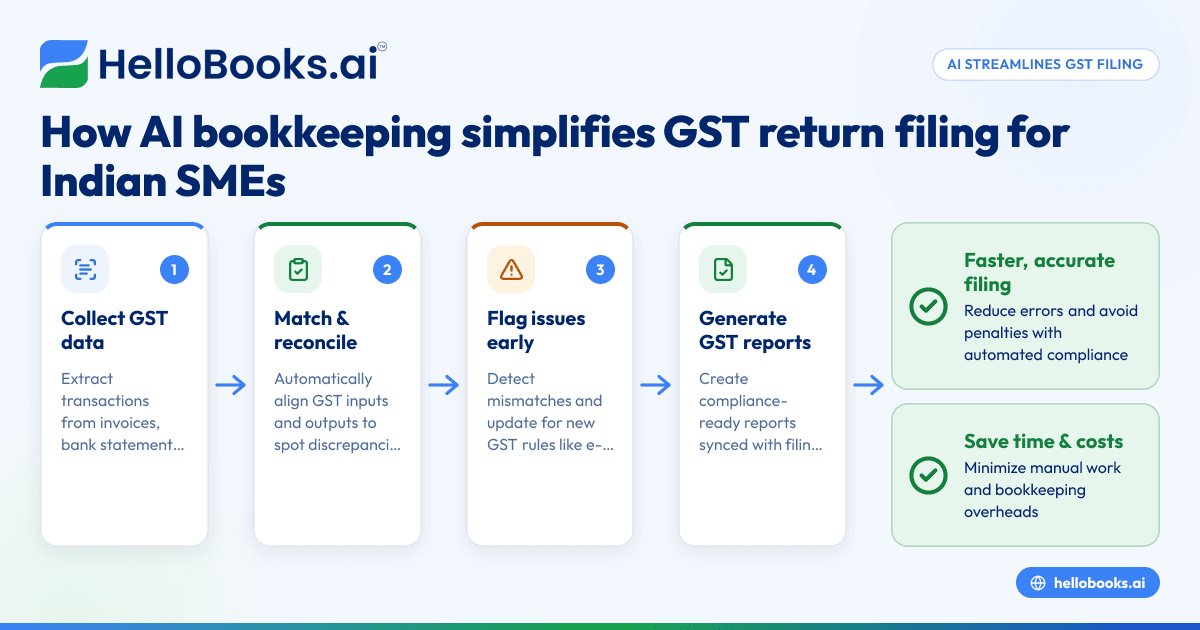
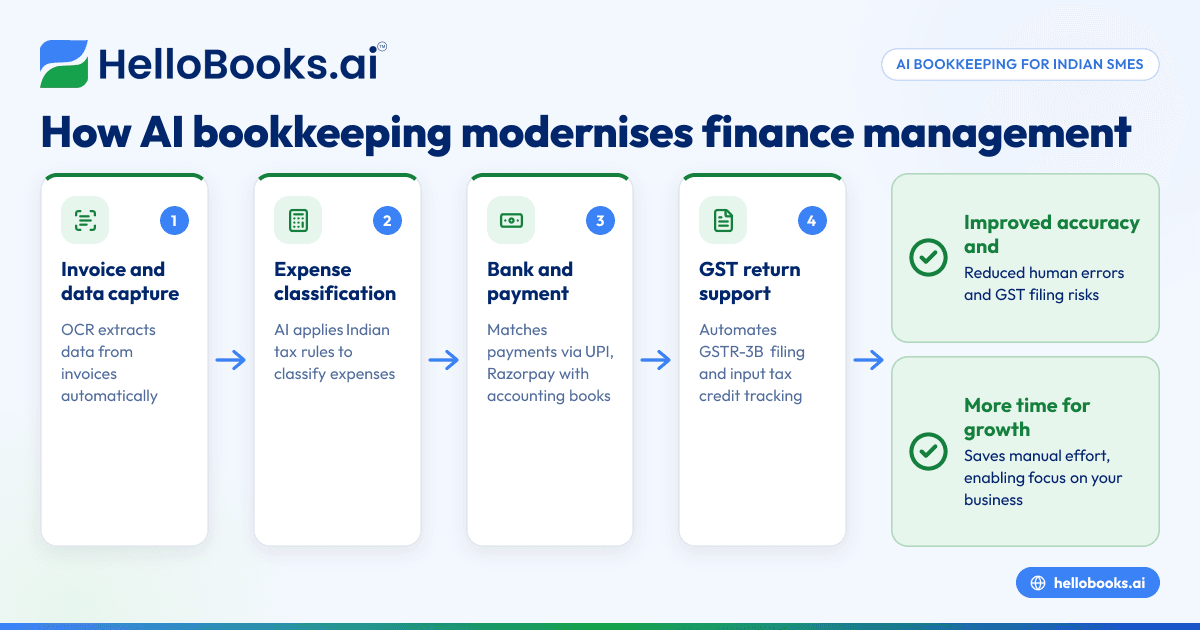
AI bookkeeping software automatically classifies transactions under the correct GST heads and formats invoices as per India’s GST and e-invoicing standards. This reduces errors on tax returns and saves time spent manually reviewing forms.
For example, the software may scan your bills, extract GSTINs, rates, and taxable values, then prepare GSTR-1 and GSTR-3B reports. It also verifies that your e-invoices comply with the government’s IRN requirements, helping you avoid filing issues.
Such automation is especially valuable for small businesses juggling multiple GST-registered branches or inter-state sales, where manual compliance can be complex and error-prone.
What are AI bookkeeping limitations in India?
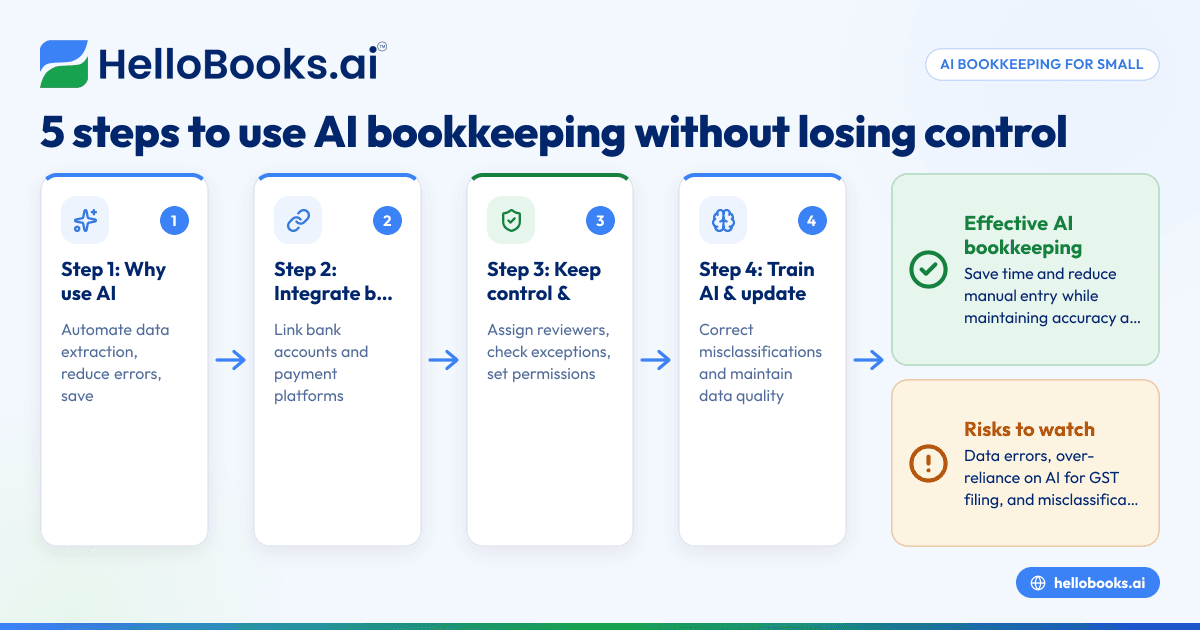
Despite many benefits, AI bookkeeping isn’t a silver bullet. There are limitations you must consider:
- Local Language and Document Formats: Many Indian small businesses still receive and store invoices in regional languages or handwritten formats; AI tools may struggle to process these accurately.
- Data Privacy and Compliance: With the recent Personal Data Protection Bill (DPDP Act 2023) emerging in India, AI tools processing financial and personal data need to ensure strong data privacy measures are in place, which not all providers guarantee.
- Customization and Complex Accounting: Certain complex accounting judgments, advance tax calculations, or industry-specific nuances might still require human accountant intervention.
- Dependence on Internet Connectivity: AI cloud tools require reliable internet, which could be a challenge in some smaller towns or rural areas.
- Onboarding and Learning Curve: Transitioning from Tally or spreadsheets to AI software involves training and process changes, which some business owners find disruptive initially.
Questions to ask before you decide on AI bookkeeping software
- Is the AI bookkeeping software updated continuously to reflect the latest GST rules and e-invoicing mandates?
- How easily does the tool integrate with your existing bank accounts, payment gateways, and inventory systems?
- Does the software support data input in formats and languages common to your suppliers and customers?
- What are the security and data privacy policies of the provider, particularly regarding Indian law?
- Can you onboard and train your team smoothly to use AI software without impacting ongoing business operations?
- What is your budget compared to the expected time and cost savings with automation?
If your goal is to reduce manual bookkeeping work, speed up your monthly financial closings, and maintain compliance without constantly checking all details, exploring an AI-powered tool makes sense. For growing SMEs in cities like Mumbai, Bengaluru, and Pune hoping to modernize accounting workflows, AI bookkeeping can be a powerful enabler.
You can book a demo of HelloBooks.ai to see how AI automation helps your specific business workflows or compare available plans at /pricing to find one suited for your scale and needs.
At the same time, for very small businesses operating offline with simple accounting tasks, manual bookkeeping or Tally may remain enough, at least until volume or compliance demands push the need for automation.
In conclusion, AI bookkeeping for small business in India offers substantial benefits of automation, accuracy, compliance support, and time savings. But it requires internet, some tech comfort, and may not fit every micro business’s needs. Balancing pros and cons based on your scale, industry, and GST complexity will guide you to the right choice. Consider starting with a trial or demo to judge how AI-powered accounting software aligns with your business ambitions.
Related reading
- AI bookkeeping
- How HelloBooks AI Simplifies Bookkeeping for Small Businesses in India
- How Small Businesses Can Use AI Bookkeeping Tools Without Losing Control, Supported with Caveats
Read next
This article covers one part of a bigger topic. For the complete picture, read our guide to supported with caveat.