
Key takeaways
What this article covers, in order:
- What is AI bookkeeping for small business?
- What can an AI tool for bookkeeping do for my small business?
- How does AI automation improve bookkeeping accuracy and compliance?
- Why should small businesses in India consider AI bookkeeping now?
- What are the main challenges of AI bookkeeping software?
- How do I choose the right AI bookkeeping software for Indian SMEs?
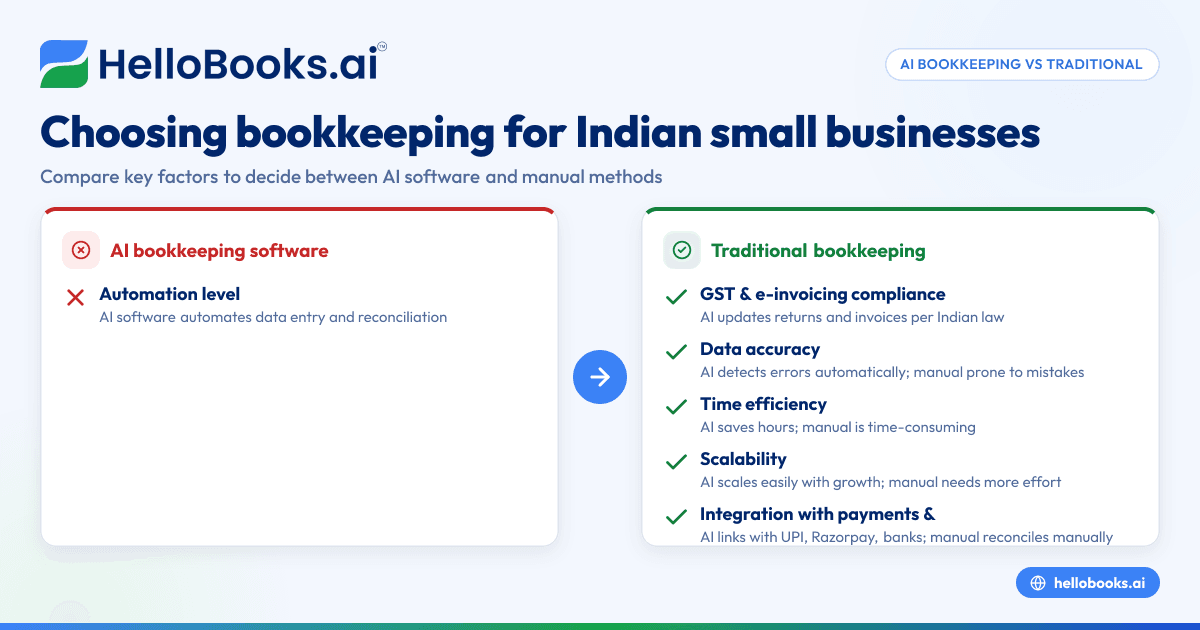
AI bookkeeping helps small businesses reduce manual effort and improve accuracy by automating routine accounting tasks using AI-powered software. This technology captures data from invoices, classifies expenses, reconciles accounts, and generates reports with less human error, saving time and ensuring compliance.
AI bookkeeping software uses ai automation to learn your business patterns and integrates with Indian payment systems and GST filing, making bookkeeping faster and more reliable.
What is AI bookkeeping for small business?
AI bookkeeping is the use of artificial intelligence software to automate bookkeeping tasks like data entry, expense categorisation, invoice matching, GST reconciliation, and financial report generation. AI-powered tools can scan invoices, extract data, and classify transactions automatically, reducing manual work drastically.
Automated with AI, these tools learn from your financial data over time to improve accuracy and speed. They connect with your bank accounts, GST systems, and payment platforms like UPI and Razorpay to keep records updated without extra effort.
What can an AI tool for bookkeeping do for my small business?
AI bookkeeping software automates key tasks for small businesses, such as:
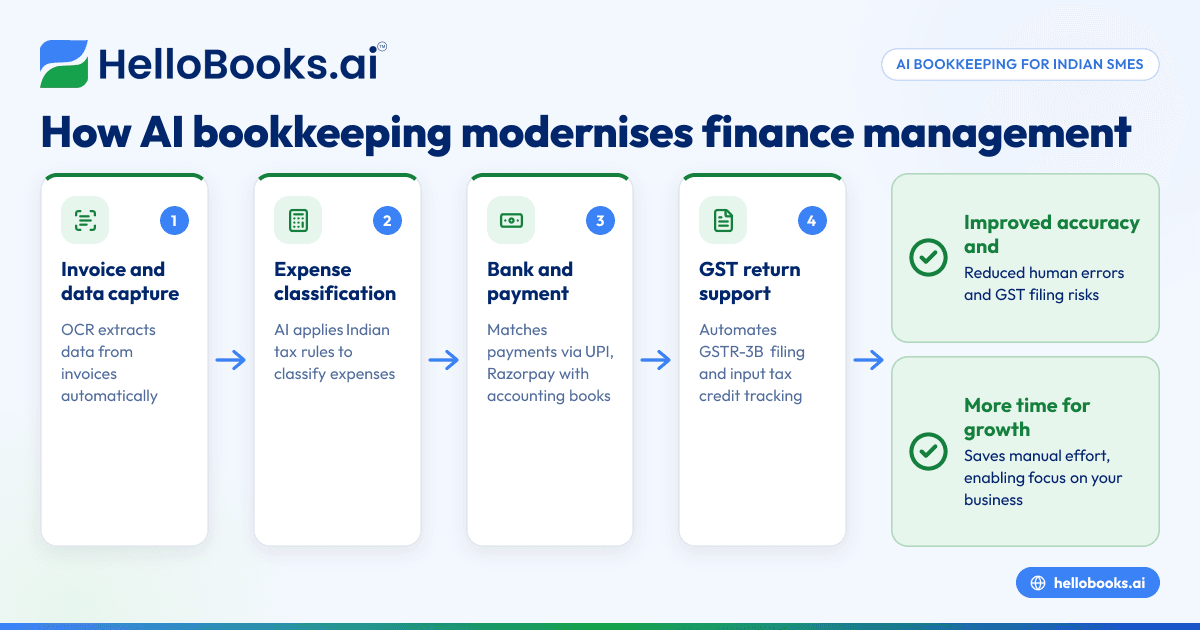
- Extracting data from bills using OCR (Optical Character Recognition).
- Matching invoices and purchase orders with payments.
- Automatically classifying expenses according to Indian tax rules.
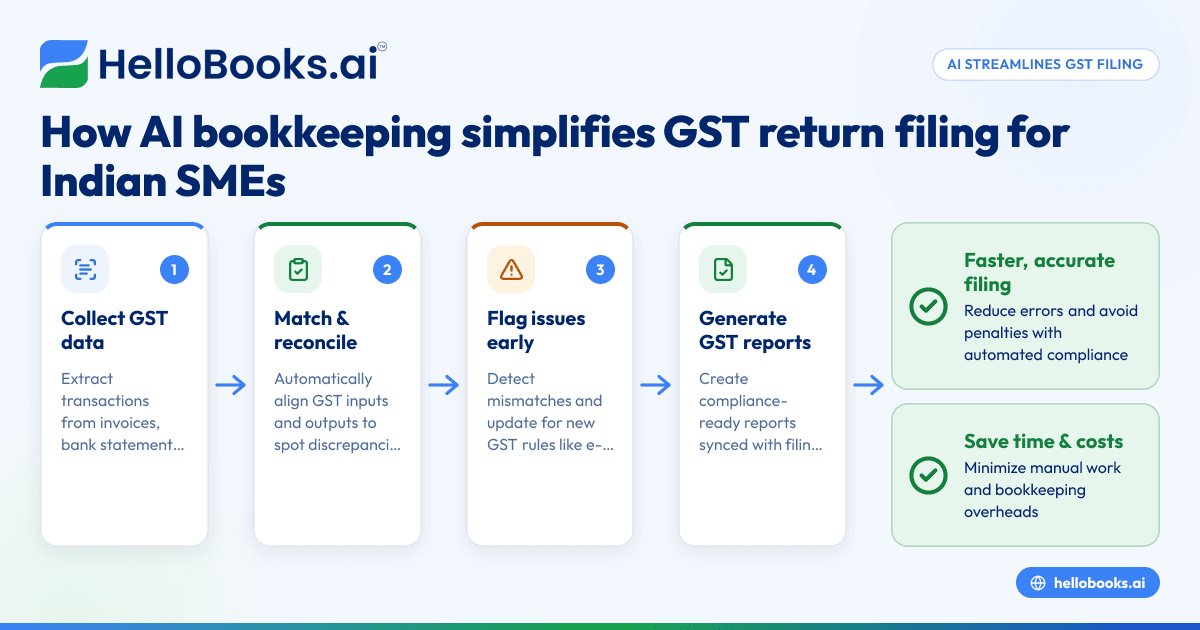
- Reconciling bank statements with accounting books within minutes.
- Assisting with GST return filing by summarising sales, purchases, and applying correct HSN/SAC codes.
- Monitoring cash flow and alerting for unusual transactions.
These features help businesses in Mumbai, Bengaluru, Pune, and beyond save days of manual effort each month and focus on growing their company.
How does AI automation improve bookkeeping accuracy and compliance?
AI automation reduces human errors like wrong data entry or missing transactions by cross-verifying inputs from invoices, bank feeds, and payments. It audits your books for GST compliance, flags inconsistencies, and alerts you before filing monthly returns.
For Indian SMEs, compliance with GST regulations, including timely filing of GSTR-3B and accurate input tax credit tracking, is crucial. AI-powered bookkeeping software often includes built-in GST return filing software features simplifying these tasks.
Automated bank reconciliation and invoice verification lower the risk of mismatches that cause penalties. Your accountant or finance lead can review AI-generated reports and concentrate on exceptions for faster resolution.
Why should small businesses in India consider AI bookkeeping now?
AI bookkeeping suits those moving beyond manual bookkeeping or spreadsheets to save time and reduce mistakes. Indian tax norms and compliance requirements like the DPDP Act 2023 on data protection increase bookkeeping complexity.
AI software adapts quickly to regulatory changes and improves data security. Integration with WhatsApp invoicing groups or payment channels like UPI makes finance operations smoother and more transparent.
With digitalisation and rapid adoption of payments platforms, AI-powered bookkeeping software in India offers a practical way to modernise finance management and improve business agility.
What are the main challenges of AI bookkeeping software?
AI bookkeeping automation is powerful but not flawless:
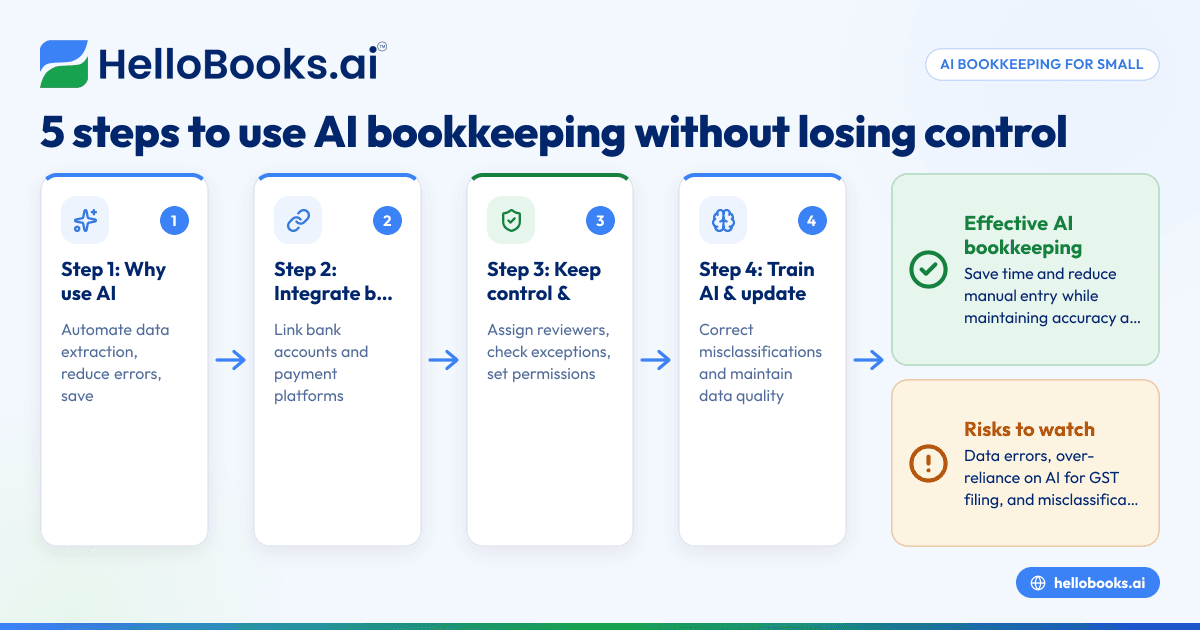
- Initial data migration from spreadsheets or Tally needs time and attention.
- Software accuracy depends on good quality, standard digital invoices and consistent data.
- Complex accounting judgments still require human intervention.
- Concerns about compliance with the DPDP Act 2023 on personal data can arise.
- Subscription costs must be balanced against time saved and error reduction.
Knowing these helps you set realistic expectations and choose software suited for your business.
How do I choose the right AI bookkeeping software for Indian SMEs?
Look for AI software with features matching your pain points—invoice capture, GST return support, bank reconciliation, or expense tracking. Prioritise software developed for Indian tax laws and payment ecosystems.
Ensure integration with your bank, UPI channels, or Razorpay for smooth payment reconciliation. Check data security measures addressing the DPDP Act.
User-friendly interfaces and local language support matter, especially if your team is shifting from manual bookkeeping. Compare demos and plans before deciding. HelloBooks.ai is an AI accounting software designed for Indian SMEs.
What does it cost to implement AI bookkeeping software?
Pricing is usually subscription-based with tiers for features, user count, and invoice volume. Plans start affordable for micro and small businesses and scale with growth.
Costs should be weighed against saved hours, fewer errors, and reduced risk of penalties. Vendors may offer onboarding help and training.
Explore options on our pricing page to find a plan suited to your business size and needs.
How do I start and keep AI bookkeeping up to date?
First, list your current bookkeeping challenges and which tasks you want AI to handle. Prepare data and invoices for import.
Use demos or trial versions to learn the software. Train your team on AI automation features.
Regularly review AI-generated reports and reconciliations. Coordinate with your accountant to resolve alerts or flagged issues.
Keep software updated with new GST rates and regulatory changes. Regularly audit your bookkeeping data for ongoing accuracy.
For help setting up AI bookkeeping for your SME, book a demo with HelloBooks.ai or compare plans on our pricing page.
AI-powered bookkeeping enables Indian small businesses to cut manual effort, reduce errors, and stay compliant in a complex tax environment. Understanding how AI accounting tools automate core tasks and integrate with GST and payment systems helps you modernise financial management. Investing in AI bookkeeping tailored for Indian SMEs fosters efficiency and supports growth.
Related reading
- AI bookkeeping
- Mastering Quarterly Estimated Tax Payments for US Small Businesses Using AI Bookkeeping
- How to Streamline Month-End Close for Small Businesses in the United States Using AI Bookkeeping
Read next
This article covers one part of a bigger topic. For the complete picture, read our guide to supported with caveat.