


Key takeaways
What this article covers, in order:
- Key takeaways
- What are quarterly estimated tax payments?
- Why must small businesses pay quarterly estimated taxes?
- How does AI quarterly estimated tax automation work?
- What are the IRS deadlines for quarterly estimated tax payments?
- How to calculate your quarterly estimated taxes?
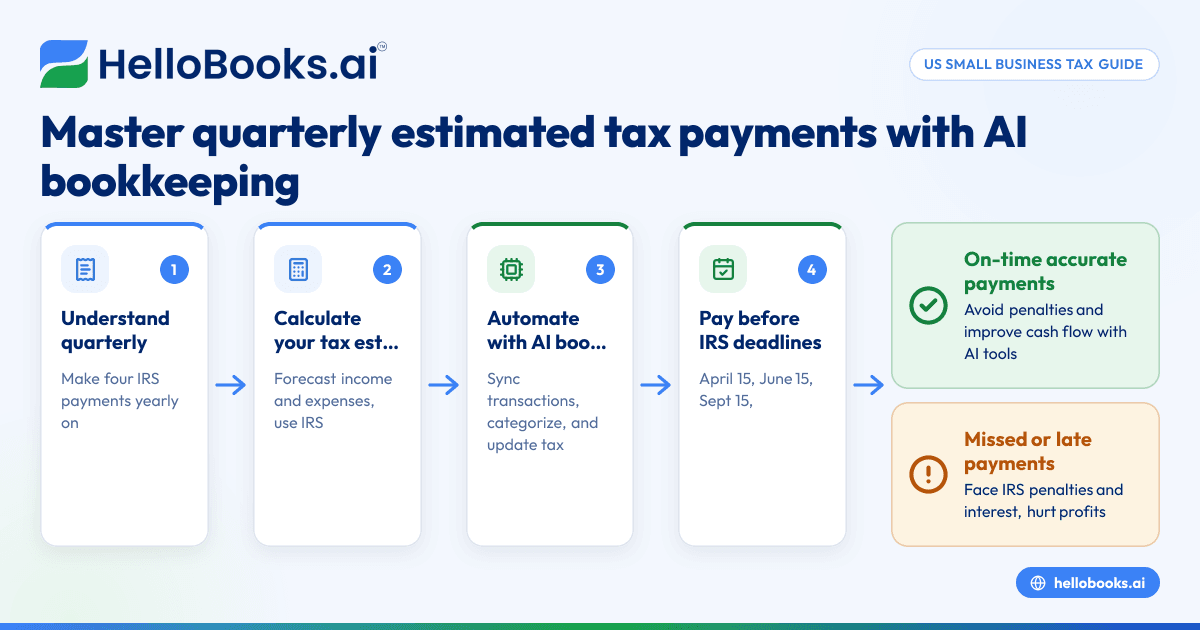
Mastering quarterly estimated tax payments is crucial for US small businesses to avoid IRS penalties and manage cash flow effectively. AI bookkeeping tools simplify calculating, tracking, and paying these taxes with improved accuracy and timeliness.
Key takeaways
- Quarterly estimated tax payments prevent tax underpayment penalties for US small businesses.
- Owners and contractors pay estimated taxes on income not subject to withholding.
- AI bookkeeping automates tax estimates by integrating data from expenses, invoices, and payments.
- IRS deadlines are April 15, June 15, September 15, and January 15 of the following year.
- Timely payments improve cash flow and reduce tax season stress.
What are quarterly estimated tax payments?
Quarterly estimated tax payments are periodic prepayments of your expected annual tax liability. The IRS requires self-employed individuals, freelancers, and small businesses without enough tax withholding to submit four payments each year. This spreads the tax burden and helps avoid big lumpsum payments or penalties.
These payments cover federal income tax, self-employment tax, and may include certain other taxes. Many US states also require similar quarterly payments on state income tax, so check your state’s rules.
Why must small businesses pay quarterly estimated taxes?
Small businesses must pay quarterly estimated taxes to avoid IRS penalties for underpayment. Since these businesses often don’t have tax withheld from paychecks, quarterly payments ensure taxes are paid progressively through the year. This aids government funding and helps businesses manage their taxes prudently.
Failure to pay on schedule results in penalties and interest, cutting into profits. Quarterly payments act as forced savings to cover the eventual tax bill, smoothing out cash flow for businesses large and small.
How does AI quarterly estimated tax automation work?
AI quarterly estimated tax automation collects financial data, categorizes income and expenses, and forecasts your tax obligation using machine learning. It continuously updates your tax estimate as new sales, invoices, and expenses enter your books. This reduces manual calculation errors and helps you make accurate quarterly payments on time.
AI systems can also send reminders before IRS deadlines and integrate with payment platforms, streamlining compliance and saving you time. With this, your small business stays on track effortlessly.
What are the IRS deadlines for quarterly estimated tax payments?
Quarterly estimated tax payments in the US are due four times yearly: April 15, June 15, September 15, and January 15 of the following year. Timely payments avoid penalties.
- April 15 covers income from January 1 to March 31.
- June 15 covers April 1 to May 31.
- September 15 covers June 1 to August 31.
- January 15 (next year) covers September 1 to December 31.
If a deadline falls on a weekend or federal holiday, the due date shifts to the next business day. Many states align with federal deadlines but verify local rules.
When do quarterly estimated tax payments need to be submitted?
The IRS deadlines divide the tax year into four payment periods matching the above dates. Businesses should plan payments accordingly to remain compliant. Missing deadlines triggers penalties and interest charges.
How to calculate your quarterly estimated taxes?
Calculating quarterly taxes involves estimating your taxable income for the year to compute the total tax due, then dividing this into four payments.
Steps to calculate:
- Forecast annual income and deductible expenses based on business trends.
- Use the IRS Form 1040-ES worksheet to estimate your tax liability.
- Split the tax estimate into four equal installments.
- Adjust payments in later quarters if income or expenses change significantly.
Manual calculations can be complex and error-prone, so many small businesses prefer using AI bookkeeping or accounting software to automate this process.
How can AI bookkeeping help with compliance and record-keeping?
AI bookkeeping software automatically tracks income, expenses, and tax payments with real-time data from bank accounts and invoicing platforms. It reconciles payments against bank records and maintains a clear audit trail. This simplifies preparing tax returns and responding to IRS inquiries.
For US businesses in cities like Chicago, Houston, or Detroit, AI tools also help manage complex state and local tax rules by integrating compliance effortlessly into daily accounting.
What if my income varies during the year?
If your income fluctuates, you can adjust your quarterly estimated payments each period. The IRS allows recalculating your tax liability as actual income data emerges, preventing underpayment penalties.
AI quarterly estimated tax features analyze incoming financial data continuously and alert you to update your payment amounts as needed. This helps keep your payments aligned with your current earnings.
How to submit quarterly estimated tax payments?
You can submit estimated taxes using these IRS methods:
- Direct Pay: Online payments directly from your bank account with no fees.
- Electronic Federal Tax Payment System (EFTPS): Free system requiring registration, ideal for multiple tax types.
- Debit or Credit Card: Online or phone payments with a processing fee.
- Mail: Send a check with the Form 1040-ES voucher.
Electronic payments are most convenient and faster. AI bookkeeping platforms can remind you of upcoming deadlines and sometimes link to payment portals to avoid missing submissions.
What records should you keep for quarterly estimated taxes?
Maintain records of your:
- Payment receipts or vouchers.
- Calculations or worksheets backing your estimates.
- Bank statements showing payments made.
- Quarterly financial reports summarizing income and expenses.
Keeping organized records helps reduce errors, simplifies tax filings, and prepares you for potential IRS audit requests. AI bookkeeping automates document storage and improves data accessibility.
How to integrate AI bookkeeping into your accounting workflow?
To start with AI bookkeeping for quarterly estimated taxes:
- Connect your bank and credit card accounts to sync transactions.
- Integrate invoicing, payment processors like Stripe, and expense tracking.
- Customize categories to fit your business revenue and deductions.
- Monitor dashboards for live income, expense, and tax forecasts.
- Use automated reminders or scheduling for estimated tax payments.
This cuts down manual data entry, reduces mistakes, and eases tax compliance so you can focus on your business growth.
Why choose HelloBooks.ai for quarterly estimated tax management?
HelloBooks.ai offers AI accounting software tailored for US small businesses. It automates bookkeeping, bank reconciliation, expense categorization, and tax estimation. Its AI-driven quarterly estimated tax automation reduces errors and ensures timely payments, keeping your finances compliant and organized.
If you use spreadsheets or legacy systems, HelloBooks.ai is a smart alternative that saves time, integrates popular payment tools, and delivers clear financial reports for tax prep.
Explore how it fits your business needs by booking a demo or checking pricing.
Frequently asked questions
Who needs to pay quarterly estimated taxes?
Self-employed individuals, small business owners, and contractors usually pay estimated taxes if they expect to owe $1,000 or more after withholding. This applies to income not subject to withholding taxes.
Can I use AI tools with QuickBooks or other accounting software?
Yes. AI accounting software like HelloBooks.ai can integrate with QuickBooks and Stripe, enhancing tax automation and accuracy without replacing your existing stack.
What happens if I underpay my quarterly estimated taxes?
Underpayment can trigger IRS penalties and interest. You can adjust future payments to reduce penalties, but making accurate, timely payments is best to avoid extra costs.
Are there state-level quarterly estimated tax requirements?
Many states require quarterly estimated taxes with deadlines similar to federal ones. Check your state’s revenue department for specific rules that apply to your business location.
How can I make quarterly estimated tax payments more manageable?
Using AI bookkeeping automates calculations and reminders, reducing errors and the administrative burden. This makes quarterly payments simpler and less stressful.
Can AI tools predict end-of-year tax liability accurately?
AI improves forecasting by analyzing ongoing transactions, providing more accurate tax estimates than manual methods, especially when data is updated regularly. However, results are still estimates, not guarantees.
For a streamlined solution to managing your quarterly estimated taxes, consider HelloBooks.ai. You can book a demo or explore pricing to see the benefits firsthand.
Read next
This article covers one part of a bigger topic. For the complete picture, read our guide to quarterly estimated tax.


