
Key takeaways
What this article covers, in order:
- Why this comes up / what goes wrong
- Step-by-step
- Example (fictional figures)
- Common mistakes
- Frequently asked questions
- Key takeaways
Hospital accounting software is designed specifically to handle the financial and compliance needs of hospitals, clinics, diagnostic labs, and other healthcare providers. It helps track patient billing, pharmacy sales, lab services, expenses, GST invoicing, and generates reports that are essential for managing a healthcare business effectively. This article covers why hospital accounting software is needed, the step-by-step process to choose and use it, practical examples from Indian healthcare businesses, common mistakes to watch out for, and answers to frequently asked questions.
Why this comes up / what goes wrong
Hospital business owners and accountants often face challenges managing multiple revenue streams such as patient consultation fees, lab test charges, pharmacy sales, insurance reimbursements, and payroll. Many still use manual methods like Excel spreadsheets, Tally, or traditional bill books, which can cause errors, delays in GST filing, and difficulty tracking receivables and payables.
Healthcare providers must comply with GST invoicing rules, including using correct HSN/SAC codes for medical services and goods, and file GSTR-1 and GSTR-3B returns on time. Without specialised software, reconciling input tax credit (ITC) and preparing accurate financial reports can be time-consuming and error-prone. This affects cash flow, compliance, and business decisions.
Choosing the right hospital accounting software helps streamline these processes, reduce manual work, and ensure statutory compliance.
Step-by-step
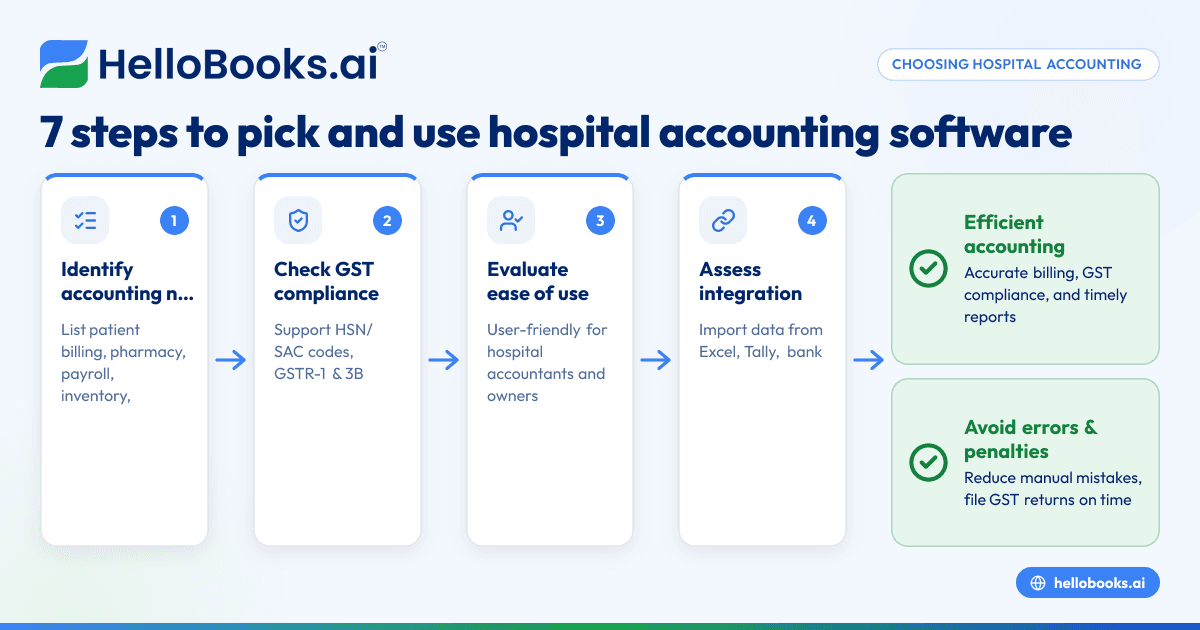
- Identify your hospital’s accounting needs: List all financial activities including patient billing, pharmacy and lab sales, insurance claims, payroll, and inventory management.
- Check GST compliance features: Ensure the software supports GST invoicing with correct HSN/SAC codes for healthcare services, e-invoicing if applicable, GSTR-1 and GSTR-3B filing, and ITC reconciliation.
- Evaluate ease of use: The software should be user-friendly for hospital accountants and owners who may not be accounting experts.
- Assess integration options: Check if the software can import data from your existing Excel sheets, Tally accounts, or bank statements to avoid re-entering data.
- Look for financial reporting capabilities: The software should generate profit and loss statements, balance sheets, GST reports, and other reports relevant to healthcare businesses.
- Consider scalability: Choose software that can grow with your hospital, such as handling multiple departments or locations.
- Compare pricing and support: Review pricing plans and customer support options to ensure you get ongoing help when needed.
For general guidance on software suitable for small businesses and Indian accounting needs, see accounting software for small business and accounting software in India.
Example (fictional figures)
Consider a diagnostic lab in Lucknow for May 2024:
- Total patient test revenue: ₹2,50,000
- Pharmacy sales: ₹1,00,000
- Expenses (staff salaries, supplies): ₹1,20,000
- GST on sales assumed at 18% (illustrative rate)
Calculations:
GST on sales = (₹2,50,000 + ₹1,00,000) × 18% = ₹3,50,000 × 18% = ₹63,000
Total revenue including GST = ₹3,50,000 + ₹63,000 = ₹4,13,000
Profit before tax = Total revenue - Expenses = ₹3,50,000 - ₹1,20,000 = ₹2,30,000
The accounting software should help generate GST-compliant invoices, record expenses, calculate GST payable, and prepare GSTR-1 and GSTR-3B returns accurately.
Another example is a two-doctor dental clinic in Chennai:
- Consultation fees: ₹1,80,000
- Dental procedure charges: ₹1,20,000
- Expenses (rent, materials, salaries): ₹1,00,000
- GST assumed at 12% (illustrative rate)
Calculations:
GST on sales = (₹1,80,000 + ₹1,20,000) × 12% = ₹3,00,000 × 12% = ₹36,000
Total revenue including GST = ₹3,00,000 + ₹36,000 = ₹3,36,000
Profit before tax = ₹3,00,000 - ₹1,00,000 = ₹2,00,000
The software should track these amounts, apply GST correctly, and prepare returns.
Common mistakes
- Incorrectly mapping healthcare services to GST codes: Use the correct HSN/SAC codes for medical services and lab tests to avoid GST errors. Check official GST resources or consult a tax professional.
- Missing GST filing deadlines: Delayed filing of GSTR-1 and GSTR-3B can lead to penalties. Use reminders or software alerts to stay compliant.
- Manual data entry errors: Entering data manually from bill books or spreadsheets increases mistakes. Choose software that can import existing data to reduce errors.
- Not reconciling ITC regularly: Failure to reconcile GSTR-2B with purchase invoices can cause ITC mismatches and tax issues. Regular reconciliation ensures accurate tax credits.
- Ignoring inventory management: For hospitals with pharmacies or medical supplies, not tracking inventory can cause stockouts or losses.
- Choosing generic accounting software without healthcare features: Software not tailored for healthcare may lack modules for patient billing or lab services, increasing manual work.
For more on healthcare-specific accounting needs, see Clinics, labs and healthcare.
Frequently asked questions
What features should hospital accounting software have?
It should handle patient billing, GST invoicing with correct HSN/SAC codes, expense tracking, payroll, inventory management, GST filing (GSTR-1, GSTR-3B), and generate financial reports. Integration with tools like Excel or Tally is beneficial.
Can general accounting software work for hospitals?
General software may work but might lack healthcare-specific features such as managing multiple service types, insurance claims, or pharmacy stock, which can increase manual work and errors.
How does hospital accounting software help with GST compliance?
It automates GST invoicing, calculates tax accurately, helps file returns on time, and reconciles ITC to avoid penalties, ensuring statutory compliance.
Is switching from Tally or spreadsheets difficult?
Switching requires data migration and user training. Good software supports importing data from Excel or Tally and offers tutorials or support to ease the transition.
Can small clinics or labs afford hospital accounting software?
Many providers offer affordable plans tailored for small healthcare providers. Starting with basic features and scaling up as needed is possible.
Key takeaways
- Hospital accounting software must support healthcare-specific billing, GST invoicing, and compliance.
- Correct mapping of services to HSN/SAC codes is essential for GST compliance.
- Automating data entry and reconciliation reduces errors and saves time.
- Timely GST filing and ITC reconciliation prevent penalties.
- Choose software that integrates with existing tools and scales with your business.
- Evaluate pricing, support, and ease of use before deciding.
Start managing your hospital accounts efficiently today. You can Start on the Free plan (200 transactions a year, GSTR-1 and 3B filing for one GSTIN) to try software suited for Indian small businesses.