


Key takeaways
What this article covers, in order:
- Why this comes up / what goes wrong
- Step-by-step
- Example (fictional figures)
- Common mistakes
- Frequently asked questions
- Key takeaways
Gym accounting software helps gym businesses manage their finances by handling invoicing, expense tracking, inventory, GST filing, and bank reconciliation tailored for gym operations. This article covers why gym owners need industry-specific accounting software, the steps to select the right one, a worked example with Indian figures, common errors to avoid, and answers to FAQs.
Why this comes up / what goes wrong
Gym owners and accountants often juggle multiple revenue sources such as membership fees, personal training sessions, merchandise sales, and supplements. They also manage expenses like rent, staff salaries, equipment maintenance, and utilities. Using generic accounting tools or manual bookkeeping methods like Excel or Tally can cause difficulties in managing these diverse transactions and ensuring GST compliance. This can lead to errors in invoicing, incorrect GST filings, delayed reconciliation of bank statements, and inaccurate financial reports. Without software designed for local service businesses, gym owners spend excessive time on data entry and risk costly compliance mistakes.
Step-by-step
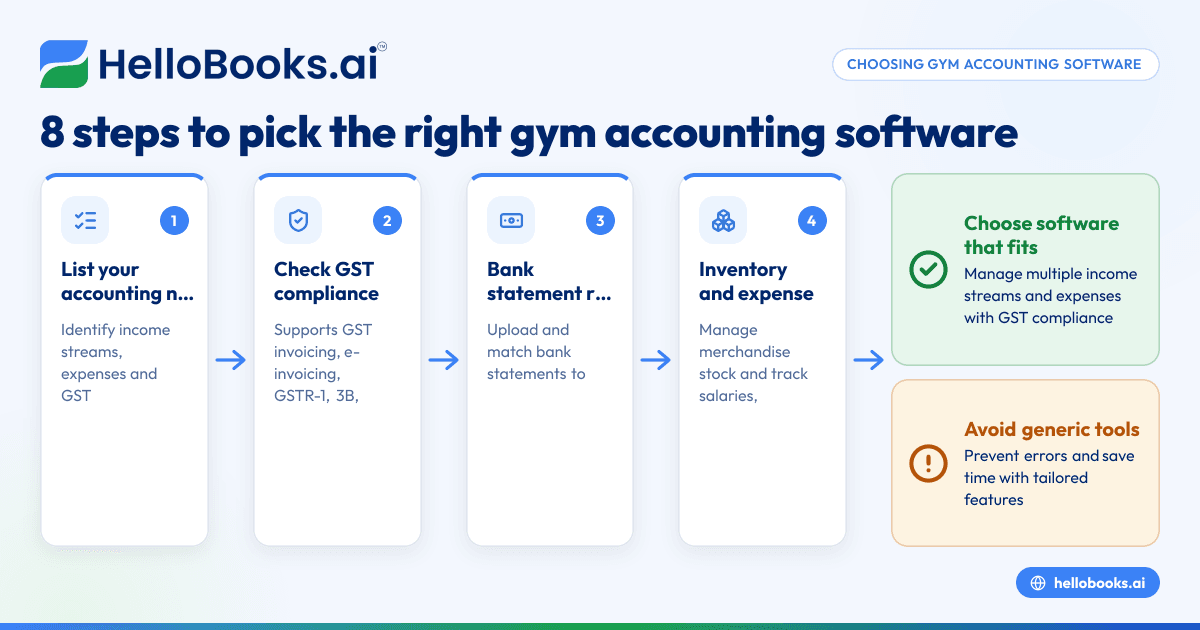
- List your gym’s accounting needs: Identify all income streams (memberships, classes, merchandise), expense types (rent, salaries, equipment), and compliance tasks such as GST invoicing, e-invoicing, and filing.
- Check for GST compliance features: Confirm the software supports GST invoicing, e-invoicing with IRN and QR codes, GSTR-1 and GSTR-3B filing, and GSTR-2B reconciliation to manage input tax credit.
- Look for bank statement reconciliation: The software should allow easy upload and matching of bank statements to reduce manual errors and speed up reconciliation.
- Ensure inventory and expense tracking: For gyms selling merchandise or supplements, inventory management is crucial. Expense tracking for salaries, maintenance, and utilities must be straightforward.
- Evaluate ease of use and integration: The software should be user-friendly for your accountant or finance lead and integrate smoothly with existing tools such as Tally or Excel.
- Consider scalability and reporting: Choose software that can grow with your gym, offering detailed financial reports and the ability to handle increased transactions.
- Compare pricing and support: Review different plans, check for customer support availability, and see if there is a free trial or free plan to test the software.
- Request demos and references: Ask other gym owners about their experiences or schedule a demo to ensure the software fits your workflow.
For more information on software suited to small businesses like gyms, see accounting software for small business and accounting software in India.
Example (fictional figures)
Consider a gym in Bhopal with these transactions for April 2024:
- Membership fees collected: ₹1,50,000
- Personal training fees: ₹50,000
- Merchandise sales: ₹30,000
- Equipment maintenance expenses: ₹20,000
- Salaries paid: ₹70,000
- GST rate assumed: 18%
Calculations:
- Total sales = ₹1,50,000 + ₹50,000 + ₹30,000 = ₹2,30,000
- GST on sales = ₹2,30,000 × 18% = ₹41,400
- Total expenses = ₹20,000 + ₹70,000 = ₹90,000
- GST on expenses (assumed input tax credit) = ₹90,000 × 18% = ₹16,200
- GST payable = GST on sales − GST on expenses = ₹41,400 − ₹16,200 = ₹25,200
This gym needs software that can record these transactions, generate GST-compliant invoices, reconcile bank statements, and prepare GSTR-1 and GSTR-3B returns accurately.
Common mistakes
- Using generic accounting software without GST features: Avoid this by choosing software with GST invoicing and filing support to ensure compliance.
- Not properly categorising income and expenses: Prevent errors by setting up a clear chart of accounts tailored to gym operations.
- Ignoring bank statement and GST ITC reconciliation: Regularly reconcile bank statements and use software that supports GSTR-2B reconciliation to claim correct input tax credit.
- Delaying GST filing leading to penalties: Schedule reminders and use software with filing alerts to file returns on time.
- Overcomplicating bookkeeping without automation: Select software with AI bookkeeping features to reduce manual data entry and improve accuracy. See AI bookkeeping for more.
- Not considering scalability and reporting needs: Choose software that can handle your gym’s growth and provides detailed financial reports.
- Neglecting user-friendliness and integration: Ensure the software is easy to use and integrates with tools like Tally or Excel to avoid workflow disruptions.
See also Local service businesses for software tailored to Indian service sectors.
Frequently asked questions
What is gym accounting software?
Gym accounting software is a tool designed to manage all financial aspects of a gym, including membership billing, expense tracking, inventory management for merchandise, and GST compliance. It helps reduce manual errors and saves time.
How does gym bookkeeping differ from general bookkeeping?
Gym bookkeeping involves multiple revenue streams such as memberships, classes, merchandise, and personal training. It requires categorisation specific to fitness services and must handle GST invoicing and reconciliation according to Indian regulations.
Can I use Tally or Excel for gym accounting?
Yes, but these tools often require more manual work and lack automation for GST filing and bank reconciliation. Dedicated gym accounting software can simplify these tasks and reduce errors.
What features should a gym accounting software have?
Key features include GST invoicing, e-invoicing with IRN and QR codes, bank statement reconciliation, expense and inventory tracking, and automated GSTR-1 and GSTR-3B filing.
Is there software tailored for local Indian gyms?
Yes, some accounting software in India cater specifically to local service businesses like gyms, offering compliance and reporting features suited to Indian GST laws. See Local service businesses for examples.
Key takeaways
- Gym accounting software helps manage multiple income streams and expenses effectively.
- Ensure the software supports GST invoicing, e-invoicing, and filing requirements.
- Regular reconciliation of bank statements and GST ITC claims prevents errors.
- Avoid generic tools lacking automation for GST compliance.
- Consider ease of use, integration with existing tools, scalability, and pricing.
Start managing your gym’s finances efficiently. Start on the Free plan (200 transactions a year, GSTR-1 and 3B filing for one GSTIN).


