
Key takeaways
What this article covers, in order:
- Start with your filing pattern, not a copied date table
- The FY 2026-27 returns most businesses actually watch
- Where the current dates are officially published in India
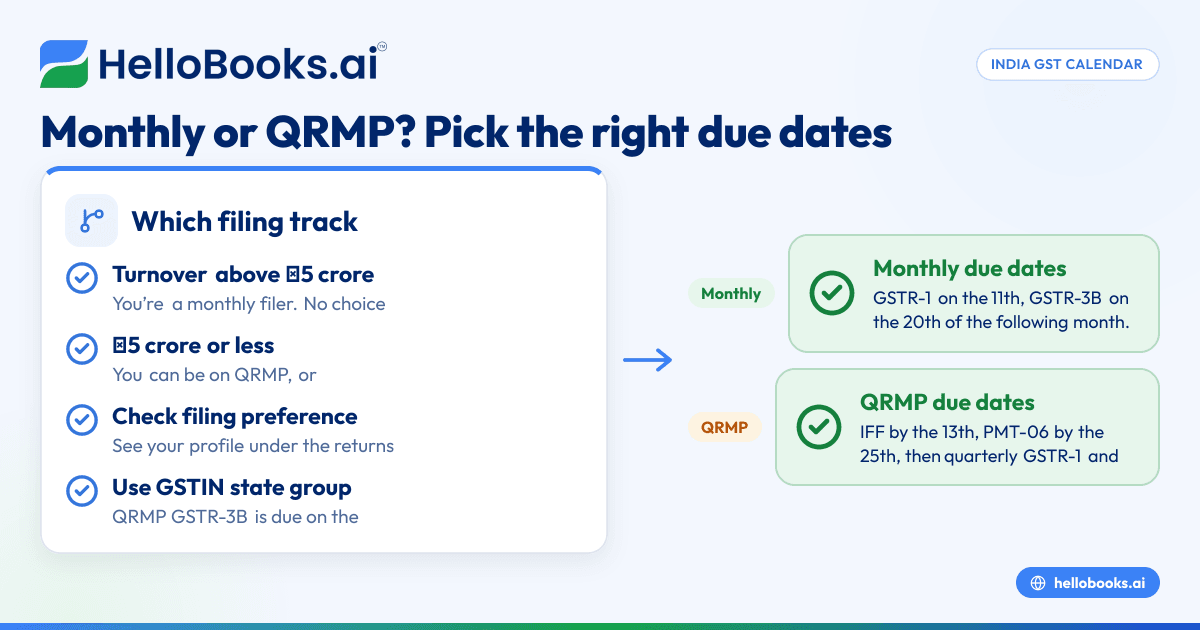
- Monthly filers: what your year usually looks like
- QRMP filers: your calendar is quieter, but not simpler
- The real risk is mismatch, not just lateness
India does not have one permanent GST return due-date calendar for FY 2026-27 that is safe to print once and trust all year. For any GSTIN, the right answer depends on whether you file monthly or under QRMP, whether a state-group rule applies to your GSTR-3B cycle, and whether the GST portal or CBIC has issued a fresh notification, advisory, or extension under the Central Goods and Services Tax Act, 2017 and the CGST Rules. So use this article to know what to check, and use the GSTN-run GST portal plus CBIC notifications as the live source for current dates.
Start with your filing pattern, not a copied date table
Most businesses searching for a FY 2026-27 calendar are really asking a simpler question: which dates apply to my registration? In India, that answer begins with your filing pattern.
For a regular taxpayer, the practical calendar usually revolves around GSTR-1 and GSTR-3B. But the cadence changes if the GSTIN is on monthly filing or the Quarterly Return Monthly Payment scheme. The legal framework sits under the Central Goods and Services Tax Act, 2017 and the rules made under it, while the working calendar is surfaced on the GST portal operated by GSTN and updated through CBIC notifications and advisories.
That means a PDF saved last year, a WhatsApp message from a trade group, or an old Tally screenshot is not a reliable authority for FY 2026-27. The portal is.
Before you mark anything in rupees, cash flow, or team workload, confirm three things for each GSTIN:
- whether it files monthly or under QRMP
- whether its GSTR-3B timing depends on state grouping published on the GST portal
- whether any extension or special relief has been notified by CBIC for that tax period
If you operate in more than one state, this matters even more. A business with registrations in Karnataka and Maharashtra may have the same parent entity, but each GSTIN has its own compliance dashboard, outward supplies, inward supplies, and filing history.
The FY 2026-27 returns most businesses actually watch
For most Indian SMEs, traders, agencies, manufacturers, consultants, and ecommerce-adjacent sellers, the annual GST rhythm is built around a short list of recurring tasks.
The ones that usually matter most are:
- GSTR-1 for outward supplies
- GSTR-3B for summary reporting and tax payment
- monthly payment obligations for taxpayers under QRMP
- invoice-level housekeeping that affects GSTR-2A/2B, input tax credit, and customer matching
- transport compliance where goods movement triggers an e-way bill
- e-invoice generation, where applicable under current law and threshold notifications published by CBIC and on the GST portal
Notice what is missing here: a pretend universal wall calendar. In practice, compliance pressure comes less from memorising one list and more from knowing which recurring return applies to your registration and where official changes are published.
If your business raises B2B invoices across states, place of supply also affects whether tax is split as CGST and SGST or charged as IGST. That is not just an invoicing detail; it influences what flows into your returns. A system that applies place-of-supply logic at invoice stage can reduce rework later. HelloBooks does this inside smart invoicing, so a local sale and an inter-state sale do not accidentally get the wrong tax head split.
Where the current dates are officially published in India
If you need the actual filing date for a period in FY 2026-27, go to the official source, not an article like this.
The current position is published through:
- the GST portal run through GSTN
- CBIC notifications, orders, and advisories
- the applicable provisions of the Central Goods and Services Tax Act, 2017 and the CGST Rules
Those are the sources that establish or update due dates, extensions, late-fee relief, state-based groupings, and procedural changes. If a consultant, blog, or spreadsheet shows a day number without citing the official source, treat that number as provisional at best.
This matters because India GST compliance can shift through notification. A business owner may budget for one filing day and then discover that the live portal reflects a different schedule, a grouped-state timeline, or a period-specific relaxation. The official publication point is what counts.
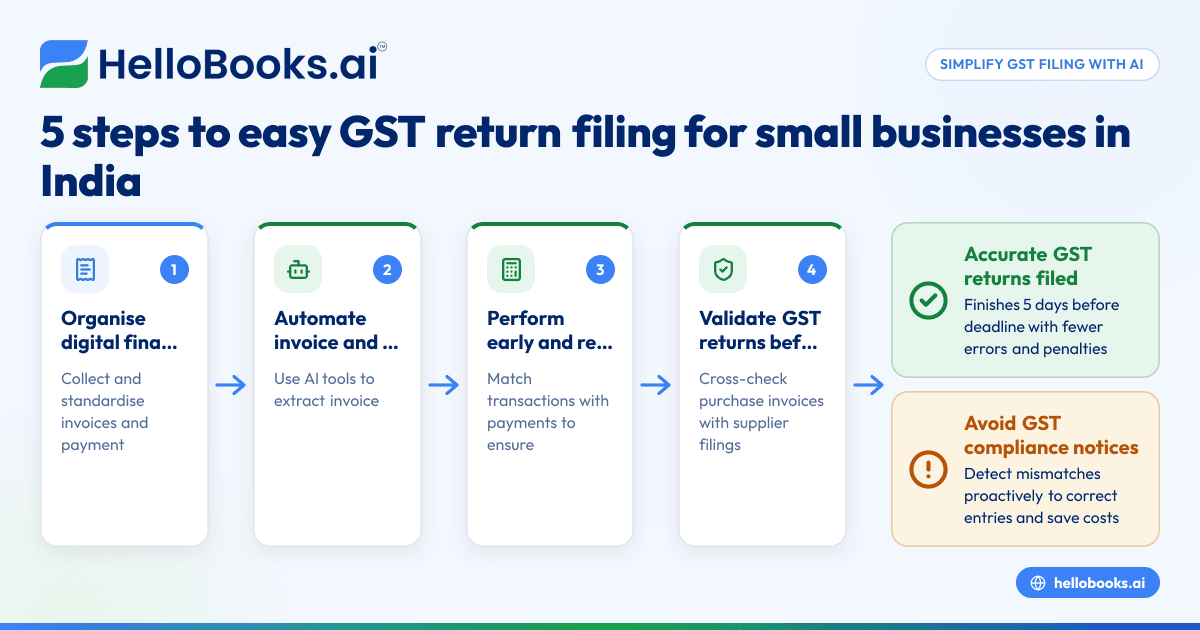
If you want a quick cross-check before filing, HelloBooks can help at the work stage rather than the legal stage: it prepares and files GSTR-1 and GSTR-3B directly from the books in GST return filing software, which reduces the mismatch risk between the invoices you issued and the return you upload. But the final live date still comes from the GST portal and CBIC.
Monthly filers: what your year usually looks like
A monthly filer’s compliance pressure is not just “two returns every month.” It is really a chain:
- raise valid GST invoices
- classify the supply correctly as intra-state or inter-state
- keep sales, credit notes, and debit notes updated
- reconcile purchases and supplier uploads for ITC visibility
- file GSTR-1
- file GSTR-3B
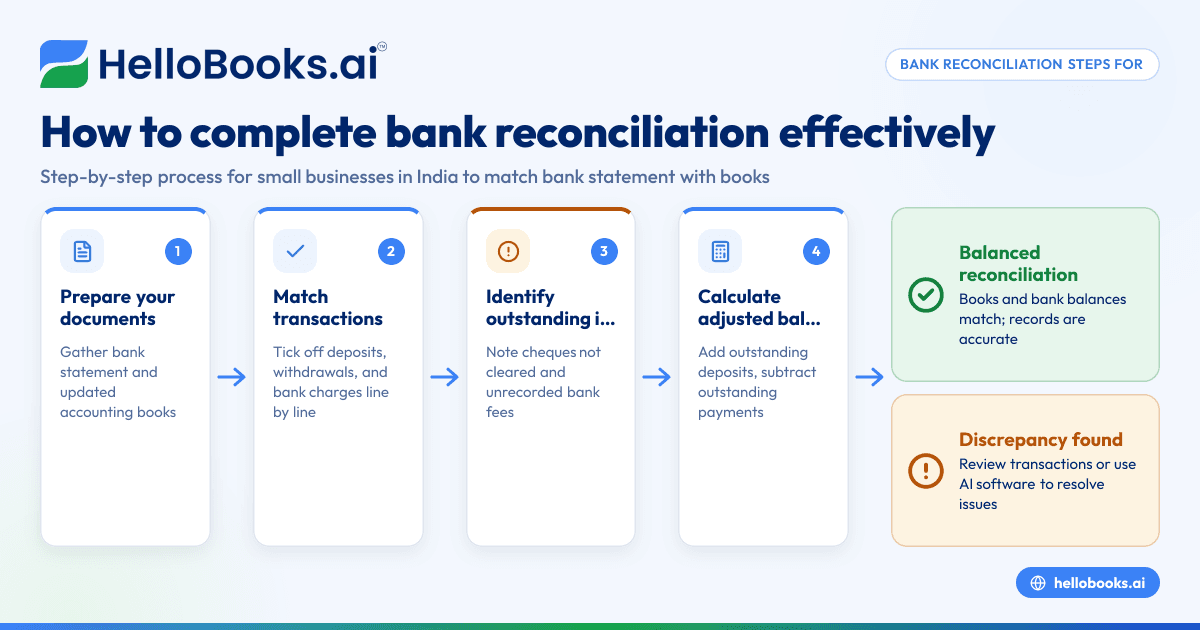
- settle payment through your bank and keep the books aligned
That chain is where most delays happen. Not at the portal screen.
For instance, if receipts come in through UPI, NEFT, RTGS, or IMPS, but the accounts team has not matched those collections to invoices, your receivables picture is wrong. If purchase bills are sitting in email PDFs, your ITC check against GSTR-2B is incomplete. If a transporter is waiting at dispatch because invoice data and vehicle details are being typed twice, your operations team feels the tax calendar as a logistics problem, not just an accounting one.
That is why many Indian businesses try to solve due-date stress upstream. HelloBooks lets you upload a bank statement and use AI-assisted matching in bank reconciliation software, while purchase invoices can be captured with OCR instead of manual re-entry. The point is not automation for its own sake; it is to make sure the books feeding GSTR-1 and GSTR-3B are current before the filing window gets tight.
If your business also needs e-invoicing, the applicable threshold is not something to trust from a blog unless it is cited from the official source. The current threshold and procedural requirements are notified under GST law by CBIC and reflected on the GST portal. In HelloBooks, businesses that fall under the notified requirement can generate the IRN and signed QR during invoicing through e-invoicing software, which avoids separate JSON upload work.
QRMP filers: your calendar is quieter, but not simpler
QRMP often gets described as “quarterly filing,” but in real life it still demands monthly attention.
A QRMP business typically has to manage:
- quarter-end return preparation
n- ongoing invoice discipline during each month of the quarter
- monthly payment obligations as prescribed under GST law and current portal process
- customer expectations around visibility of B2B invoices
- ITC checks and vendor follow-up
The exact dates, eligibility conditions, and payment mechanics are published on the GST portal and through CBIC material under the CGST Act and rules. So if you are on QRMP for FY 2026-27, do not rely on a static chart copied from an earlier financial year.
A practical issue with QRMP is that owners feel less urgency in month one and month two, then get a pile-up in month three. The return may be quarterly, but the paperwork is not. If supplier bills are not entered, if sales are not reviewed for place of supply, or if stock movements are not posted, quarter-end becomes a scramble.
This is especially visible in trading and distribution businesses dealing in cartons, parts, garments, hardware, or FMCG-style movement across state borders. Inventory, outward invoices, and e-way bill details should not live in separate silos. HelloBooks can raise the e-way bill from the invoice through e-way bill software, and stock keeps moving inside inventory, which is far more useful than discovering a quarter’s dispatch differences on filing week.
The real risk is mismatch, not just lateness
When business owners ask about due dates, they are often really worried about the consequences of getting behind. In India GST, the bigger operational risk is often mismatch:
- sales register vs GSTR-1
- books vs GSTR-3B
- purchase register vs GSTR-2B
- invoice tax heads vs place of supply
- bank receipts vs receivables
- physical dispatch vs e-way bill record
Late fee, interest, and other consequences are governed by the Central Goods and Services Tax Act, 2017, related rules, and current notifications by CBIC, with the operative position visible on the GST portal. Because those amounts and rules can change or be subject to relief measures, do not use any stale number unless verified from the official source.
A simple invented illustration shows why mismatch hurts more than the calendar itself. Suppose a wholesaler in India issues invented invoices totalling ₹8 lakh in a month, of which invented inter-state sales are ₹3 lakh and invented local sales are ₹5 lakh. Now suppose one inter-state invoice was mistakenly treated as local and split into CGST/SGST in the books. These figures are illustrative and invented, and they leave out many real-world details such as credit notes, exempt supplies, reverse charge, transport variations, and portal validations. Even without any official rate stated here, you can see the issue: the error is not just a wrong invoice. It affects tax head classification, customer records, and the figures that should flow to GSTR-1 and then GSTR-3B. Fixing it late is harder than avoiding it early.
That is why reconciliation matters. HelloBooks pulls your books, supplier bill capture, and GSTR-2A/2B review into one workflow so you can track likely ITC issues before filing rather than after filing.
Multi-state businesses need a registration-wise calendar
One of the most Indian compliance mistakes is planning by company name instead of by registration.
GST works registration-wise. If your entity has multiple GSTINs across states, each one may have its own:
- outward supply pattern
- inward supply base
- branch team or accountant
- bank statement to reconcile
- stock position
- filing dashboard history
- operational rhythm around transport and dispatch
A Delhi head office may assume “we filed GST,” while the Tamil Nadu registration still has open items. A manufacturer might be current in one state but waiting on supplier bills in another. A services business may invoice from one GSTIN while employees assume everything sits under a single PAN-level compliance calendar.
This is where a multi-GSTIN setup becomes practical, not merely convenient. HelloBooks supports multiple registrations in one login, so a finance team or CA can track return prep registration-wise without forcing everyone into separate tools. That matters if you are migrating from Tally habits where data is split across files and follow-up happens over calls and WhatsApp.
If you are moving from older bookkeeping workflows, the tally-alternative and accounting software india pages are a more useful next read than another generic date table.
Build a filing routine around records that age badly
Some accounting tasks can wait a bit. GST support work often cannot, because the evidence goes stale quickly.
These records age badly:
- supplier invoices left unentered in email or paper folders
- customer GSTIN mistakes on invoices
- missing HSN/SAC classification checks
- dispatch details remembered verbally instead of recorded
- bank receipts not matched to open invoices
- reverse charge or TDS side entries kept in a spreadsheet outside the books
Under Indian practice, the best filing routine is usually weekly, not monthly. Review outward supplies every week, upload purchase bills every week, and reconcile bank collections every week. Then the filing date becomes a submission event, not a data-entry marathon.
HelloBooks is useful here because it handles Indian purchase-bill OCR, bank statement upload for reconciliation, and GST-ready invoicing in the same workflow. If your owner is not sitting at a desk, the mobile app can keep billing and expense capture moving, and Noor on WhatsApp can help with book-related questions in Hindi, English, or Hinglish. That is relevant for many Indian SMEs that still coordinate day-to-day compliance over phone calls and chat, even while formal filing happens on the GST portal.
Use tools and official sources together
The safest approach is not “software instead of law” or “portal instead of bookkeeping.” It is both.
Use official sources for the live legal position:
- GST portal for current return status and filing dates
- CBIC notifications and advisories for changes under the law
- the CGST Act and rules for the legal framework
Use software for the data discipline that makes filing accurate:
- invoice creation with correct GSTIN and tax head split
- IRN and signed QR where e-invoicing applies
- direct preparation and filing of GSTR-1 and GSTR-3B
- GSTR-2A/2B reconciliation and ITC tracking
- e-way bill creation from invoice data
- bank statement upload and reconciliation
- inventory-linked sales and purchase records
If you need a quick utility before you file, HelloBooks also has India-specific checks like the GSTIN validator, GST calculator, and GST reconciliation checker. Those are useful for validation and planning, but the current live due date still belongs to the official GST ecosystem.
What to do for FY 2026-27, in practice
For FY 2026-27, the most reliable calendar is the one you maintain from the portal for each GSTIN, not the one any article hard-codes.
In practical terms:
- log in to the GST portal and confirm filing frequency for each registration
- check whether your GSTR-3B cycle depends on a state group shown on the portal
- review CBIC notifications before each filing period if you manage significant volumes
- keep sales invoicing, purchase entry, and bank reconciliation current through the month
- verify GSTR-2B before finalising ITC positions
- do not wait until the last day to discover a place-of-supply or stock mismatch
If you want one system to support that routine, HelloBooks is worth considering because it brings GST invoicing, IRN-based e-invoicing where applicable, e-way bill creation, GSTR-1 and GSTR-3B filing, reconciliation, inventory, and Indian bank statement upload into one workflow. For product details or a trial path, see /in, pricing, or book a demo.
The short answer remains the same: in India, there is no single permanent FY 2026-27 GST due-date chart you should trust blindly. Trust the GST portal, CBIC, and the CGST Act for the live date; build your books so you are ready whenever that date arrives.