
Key takeaways
What this article covers, in order:
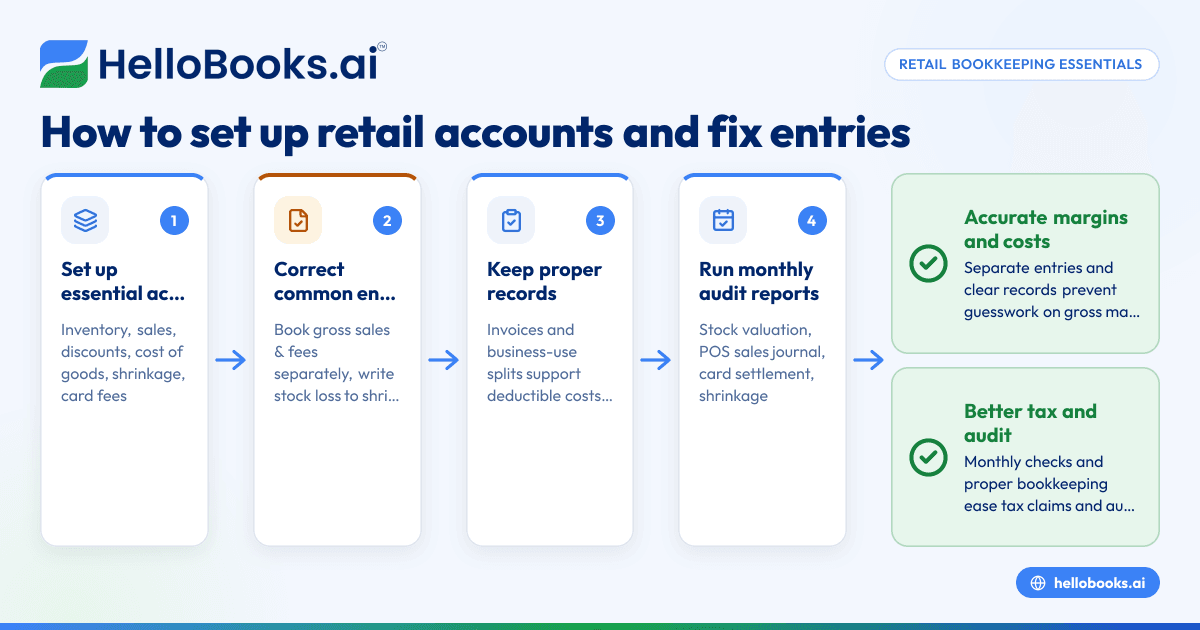
- The chart of accounts an Indian retailer actually needs
- Sales entries that go wrong in Indian retail
- Inventory accounting is where retail profit is won or lost
- GST is part of retail bookkeeping, not a later compliance task
- A plain worked illustration with invented figures
- E-way bill, logistics and movement records matter to retailers too
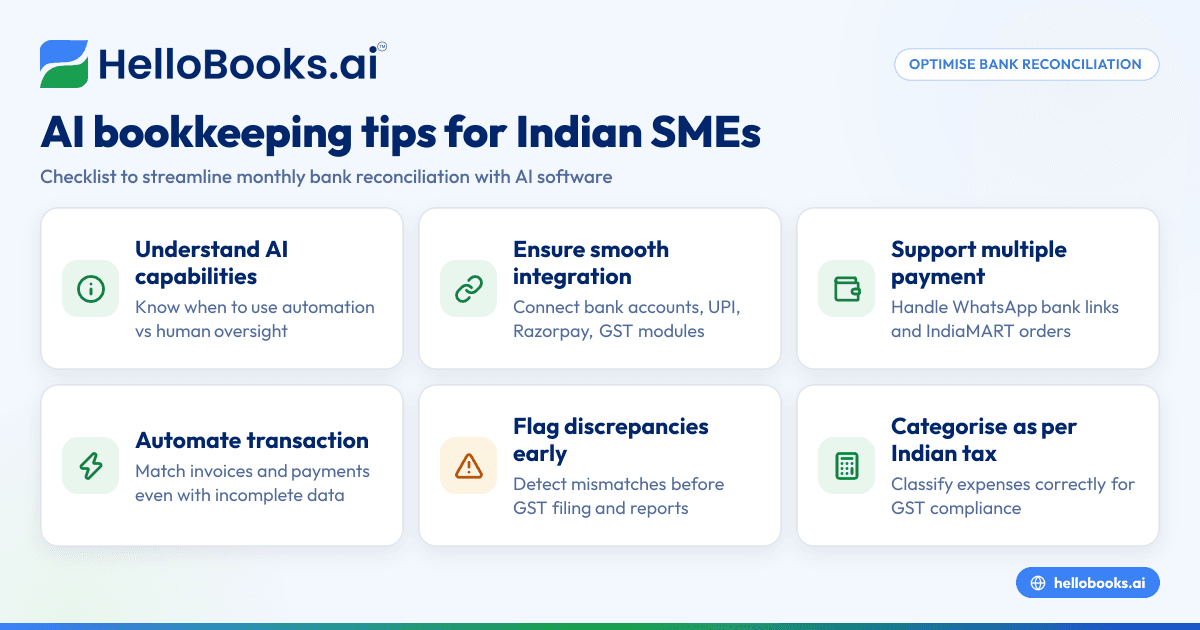
India retail accounting in 2026 starts with one practical rule: your sales, stock, GST and bank deposits must come from the same bookkeeping flow, or your margin will mislead you. For an Indian retailer, the recurring trouble spots are GST invoice treatment, card and UPI settlements that hit the bank net of charges, stock losses that vanish into cost of sales, and supplier bills that do not reconcile to GSTR-2B. This guide shows the chart of accounts, journal logic and monthly checks that make a shop's books usable.
The chart of accounts an Indian retailer actually needs
A retail business in India usually outgrows the default chart of accounts very quickly. A generic setup may be enough to record rupee receipts and supplier payments, but it is rarely enough to answer the questions that come from GST, inventory control, the Companies Act, 2013 where applicable, the Income-tax Act, 1961, or a lender reviewing statements. The goal is not to create hundreds of ledgers. It is to separate the lines that explain what really happened.
Use account codes if you want, but the structure matters more than the numbering. A practical retail chart usually includes these categories:
- Inventory - goods held for resale at cost
- Stock in transit - goods paid for or dispatched by supplier but not yet received
- Purchase returns
- Retail sales - ideally split by major product line if that helps margin analysis
- Sales discounts and promotional discounts
- Staff purchases, if they are allowed
- Output GST ledgers split by CGST, SGST and IGST
- Input GST ledgers split by CGST, SGST and IGST
- Cost of goods sold
- Shrinkage, damage and write-offs
- Card, UPI or marketplace settlement charges
- Freight inward and freight outward
- TDS receivable or payable where relevant under the Income-tax Act, 1961
- Cash in hand
- Bank accounts
- Trade receivables and trade payables
For India, the GST split is not optional housekeeping. The Central Goods and Services Tax Act, 2017, the Integrated Goods and Services Tax Act, 2017 and related rules require the tax treatment to follow the nature of the supply. The current requirements and return formats are published through the GST Council framework and operationally on the GST Portal and GSTN systems, with CBIC publishing rules, notifications and circulars. That is why the books should separate output and input tax heads instead of burying GST inside sales or purchases.
If you invoice through smart invoicing, the sale can carry the correct GSTIN, HSN or SAC, and the right CGST plus SGST or IGST split based on place of supply. For a retailer selling within one state and across India, that reduces the classic error of treating an inter-state sale as local, or the reverse.
Sales entries that go wrong in Indian retail
Retailers often think the sales side is simple because the customer has paid. In practice, the accounting errors begin after the sale is made.
Netting bank deposits against charges
A common issue is a settlement credited by a card acquirer, payment gateway, marketplace or bank after deducting fees. The bank statement shows only the net amount in INR. If you record that net figure as sales, you understate revenue and hide the fee.
The cleaner treatment is:
- record gross sale value as revenue
- record output GST in the correct tax head
- record settlement fee separately as an expense
- match the bank receipt to the gross receivable less the charge
This matters not only for profit reporting but also for GST return consistency. Under Indian GST law as administered by CBIC and implemented through GSTN and the GST Portal, the invoice and outward supply records drive the return data. If the books store only net bank credits, GSTR-1 and the revenue ledger drift apart.
When a retailer uploads a monthly bank statement into bank reconciliation software, the matching process is far quicker than retyping every NEFT, RTGS, IMPS, UPI or card settlement line. For a busy store, that is often the difference between "books updated" and "we will sort it at year end," which usually means never.
Mixing discounts with sales returns
A discount offered at the counter, a festive promotion and a later product return are not the same accounting event. Keeping them together makes gross margin harder to interpret. Discounts reduce the sale value; returns reverse a sale; staff purchases may need their own visibility if management wants to monitor them.
For GST purposes, the treatment of discounts and credit notes follows the CGST Act, 2017 and applicable rules and notifications published by CBIC and reflected on the GST Portal. The current conditions should always be checked at the official source or reviewed by a professional before a period is filed.
Treating all retail receipts as cash sales
Indian retailers may receive money by cash, UPI, card, bank transfer or marketplace settlement. Lumping everything into one "cash sales" bucket breaks bank reconciliation and conceals channel economics. Separate receipt modes help identify delays, charges and disputes.
If your team works partly from phones, accounting software-india and the mobile app can help record invoices, expenses and collections while the sale is fresh, instead of reconstructing it later from WhatsApp chats and bank SMS alerts.
Inventory accounting is where retail profit is won or lost
A retailer can survive untidy expense coding for a while. It cannot survive bad stock accounting for long. In India, many apparent profit problems are really inventory problems wearing an accounting disguise.
Keep shrinkage and write-offs separate from cost of goods sold
If a stock count shows missing units, damaged goods or expired items, posting the entire difference into cost of goods sold hides the operational issue. Your margin then looks weaker, but you still do not know whether the cause is theft, breakage, pilferage, expiry, data entry or pricing.
A distinct shrinkage or write-off account gives management a usable signal. The stock movement should reduce inventory; the corresponding expense should sit outside normal COGS.
Supplier rebates should reduce product cost when appropriate
Retail buying in India often includes year-end incentives, slab discounts, quantity rebates and promotional support. If stock covered by the rebate is still on hand, crediting the rebate to a generic other income account can distort margin by month and by SKU. In many cases, it is more meaningful to reduce inventory cost or purchase cost, depending on the facts and accounting policy.
The exact treatment can depend on the accounting framework followed by the entity, including applicable Indian Accounting Standards or other reporting basis, and should be aligned with professional advice. NEEDS EXPERT REVIEW
Stock in transit deserves its own ledger
If goods have left the supplier but have not reached your godown or shop, a stock-in-transit account keeps purchase accruals and inventory records realistic. This is especially useful where transport documents, e-way bill details and receipt dates differ.
For movement-heavy retailers, inventory linked to purchase and sales entries is more reliable than maintaining a separate stock register in Excel. When stock adjusts automatically with purchases and sales, the closing stock figure is not a year-end guess.
GST is part of retail bookkeeping, not a later compliance task
In India, GST bookkeeping is not something you "do after accounts." The books are the GST data source. If invoices, purchase bills and stock movements are recorded carelessly, return preparation turns into rework.
A retailer should care about four areas in daily accounting:
Correct tax head based on place of supply
For local sales, the invoice may require CGST and SGST; for inter-state supplies, IGST may apply, subject to the law and facts. The governing rules come from the CGST Act, 2017 and IGST Act, 2017, with CBIC notifications and the GST Portal publishing current operational guidance. Getting the place-of-supply logic wrong means the sale is booked, the customer may still pay, and yet the tax liability sits in the wrong ledger.
This is one reason invoice software that determines tax head split from the transaction details is valuable for a retailer with walk-in and out-of-state business.
E-invoicing where applicable
Whether a business falls within e-invoicing applicability is not something to memorize from an old blog post. The current turnover criteria and classes of registered persons are notified by CBIC under the GST law and reflected on the e-invoice system and GST Portal. Check the current notification before acting.
Where e-invoicing applies, generating the IRN and signed QR at invoice creation is cleaner than preparing invoices first and uploading JSON later. That reduces mismatch risk between the commercial invoice and the tax-reported invoice. See e-invoicing software if your retail model includes B2B supply and e-invoice compliance applies.
Purchase bill capture and GSTR-2B checks
Retailers usually focus on sales, but input tax credit can be lost or delayed because purchase bills are incomplete, mis-keyed or missing from supplier reporting. The legal position on ITC conditions sits under the CGST Act, 2017 and rules, with CBIC and the GST Portal publishing current conditions and process material.
Using OCR to capture supplier bills from a photo or PDF reduces manual entry. Reconciling purchases against GSTR-2A and GSTR-2B before filing makes it easier to spot invoices not yet reflected by suppliers. That matters because a retailer's working capital can get squeezed when ITC tracking is weak.
Return filing should come from the books already kept
For most retailers, the sanity check is simple: do the outward supplies in GSTR-1 and the tax liability in GSTR-3B arise directly from the invoices and purchase data already in the ledger, or are they manually rebuilt every month? The latter is slower and easier to break.
With gst return filing software, GSTR-1 and GSTR-3B can be prepared from the invoices and bills already recorded, which is the safer way to keep books and GST aligned.
A plain worked illustration with invented figures
The numbers in this illustration are invented and only meant to show the booking logic. They leave out cess, returns, partial payments, valuation disputes, TCS by e-commerce operators, and any special industry treatment. Do not use these figures as legal guidance.
Suppose an India retailer sells goods with a taxable value of ₹1,00,000 to a business customer in another state. Assume, purely illustratively, that the official IGST rate published for that product on the GST Portal and in CBIC rate notifications would produce tax of ₹18,000. The invoice total would then be ₹1,18,000 in this invented example.
If the payment gateway later remits ₹1,15,640 and withholds ₹2,360 as its invented fee, the books should still show:
- sales at ₹1,00,000
- output IGST at ₹18,000
- gateway or card charge expense at ₹2,360
- bank receipt at ₹1,15,640
If instead you book only the bank receipt as sales, revenue is understated by the invented fee amount, expense disappears, and the GST-ledger tie-out becomes messy.
Now imagine the same retailer does a stock count and finds goods costing an invented ₹7,500 missing. Posting that amount to a shrinkage ledger makes the loss visible. Posting it to cost of goods sold inflates normal trading cost and hides whether the issue was theft, damage or process failure.
E-way bill, logistics and movement records matter to retailers too
Not every retail movement needs an e-way bill, and the current value limits, document rules and exceptions should always be checked in the CGST Rules, relevant state practice where applicable, and guidance published by CBIC and the e-way bill system. Do not rely on a stale summary.
But when goods are moved between warehouse and shop, from supplier to branch, or to a customer, the transport document trail affects both operations and accounting. If logistics teams create one set of details and accounts types another, mismatches are inevitable.
Creating the e-way bill from invoice data reduces duplicate entry and makes quantity, consignee and value details easier to keep consistent. Retailers moving stock between states or to trade customers should look at e-way bill software as part of bookkeeping discipline, not just dispatch compliance.
Monthly reports that keep a retail business honest
A useful month-end for an Indian retailer is not a thick report pack. It is a small set of reports that agree with one another.
Gross margin by category
If margin is dropping, you need to know whether the cause is purchase cost, discounting, write-offs or settlement charges. Category-level visibility helps more than one single sales ledger.
Stock valuation and movement
Closing stock should come from the same records that drove purchases and sales. If stock is maintained in a side register, the financial statements become a negotiation instead of a report.
GST liability and ITC position
Output tax, input tax and purchase reconciliation should be reviewed before filing, not after notices or mismatches appear on the GST Portal.
Receivables and payables ageing
Many retailers think they are fully cash-and-carry until they inspect credit sales to institutions, dealers or repeat customers. Ageing also reveals supplier dependency.
Bank reconciliation
This is where UPI, card settlements, NEFT credits, charges and reversals become visible. Uploading the monthly statement and matching it against invoices and vouchers is faster than manual ticking.
Branch or GSTIN-wise performance
If the business operates in multiple states, separate views by GSTIN matter for filing and management. A multi-GSTIN setup is much easier to control when each registration's books still roll up into one view for the owner.
Accounting software for small business is most useful in retail when sales, stock, GST and banking all feed these reports without extra spreadsheet stitching.
If you are moving from Tally or managing more than one location
A lot of Indian retailers already have years of data in Tally, or their accountant works there while the owner wants more day-to-day visibility. That does not always require a hard switch overnight. A Tally migration path or connector can make trial adoption less risky, especially where multiple shops, godowns or GSTINs are involved.
If your retail business operates across states, each GSTIN needs its own compliance discipline under GST law, while management still needs one combined picture of sales, stock and cash. Multi-GSTIN support and unlimited users are operationally useful here because the store team, accountant and owner can work in parallel instead of passing one login around.
For businesses comparing options, tally alternative and compare/hellobooks-vs-tally are sensible starting points before you decide how much migration you actually need.
Choosing software for India retail accounting
The best setup for a retailer in India is not the one with the longest feature sheet. It is the one that keeps invoice data, GST treatment, stock movement and bank reconciliation in one flow.
That usually means checking whether the software can:
- create GST invoices with the right GSTIN and tax head split
- generate IRN and signed QR where e-invoicing applies
- track inventory with every purchase and sale
- reconcile purchase bills with GSTR-2A and GSTR-2B for ITC visibility
- raise e-way bills from invoice data when goods move
- upload Indian bank statements and reconcile them with ledger entries
- handle TDS, TCS and reverse charge cases where they arise
- support multiple GSTINs if the business has registrations in more than one state
If you want to evaluate the fit in practice rather than in theory, start with the product pages, use the India tools such as the GSTIN validator or GST reconciliation checker, and review pricing or book a demo.
For owners who are not sitting at a desktop all day, a mobile workflow and help over WhatsApp in Hindi, English or Hinglish can matter more than one extra report. That is especially true in retail, where the person who knows what happened is often on the shop floor, not in the accounts room.