
Key takeaways
What this article covers, in order:
- Real estate accounting in India means different books for different business models
- The ledgers that matter most: income, liabilities, taxes, and project tracking
- Rent, deposits, booking advances, and reimbursements should not be treated the same
- GST in Indian real estate accounting is mostly a classification problem
- Purchase bills, ITC tracking, and TDS need discipline, not side spreadsheets
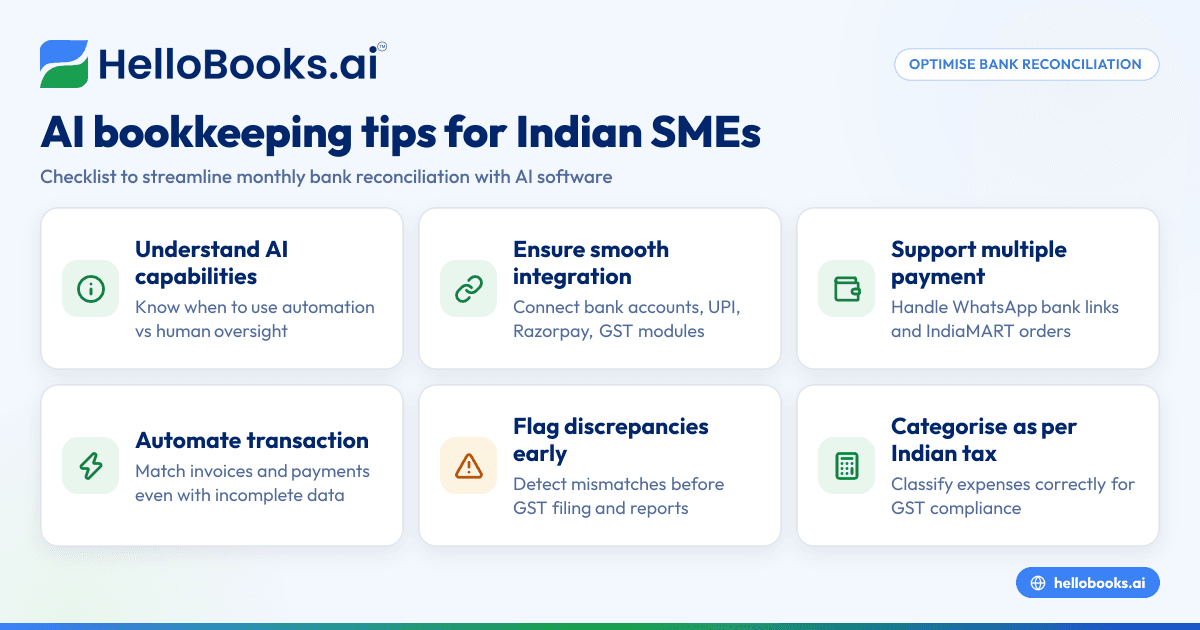
- Bank reconciliation is where Indian real estate books usually break first
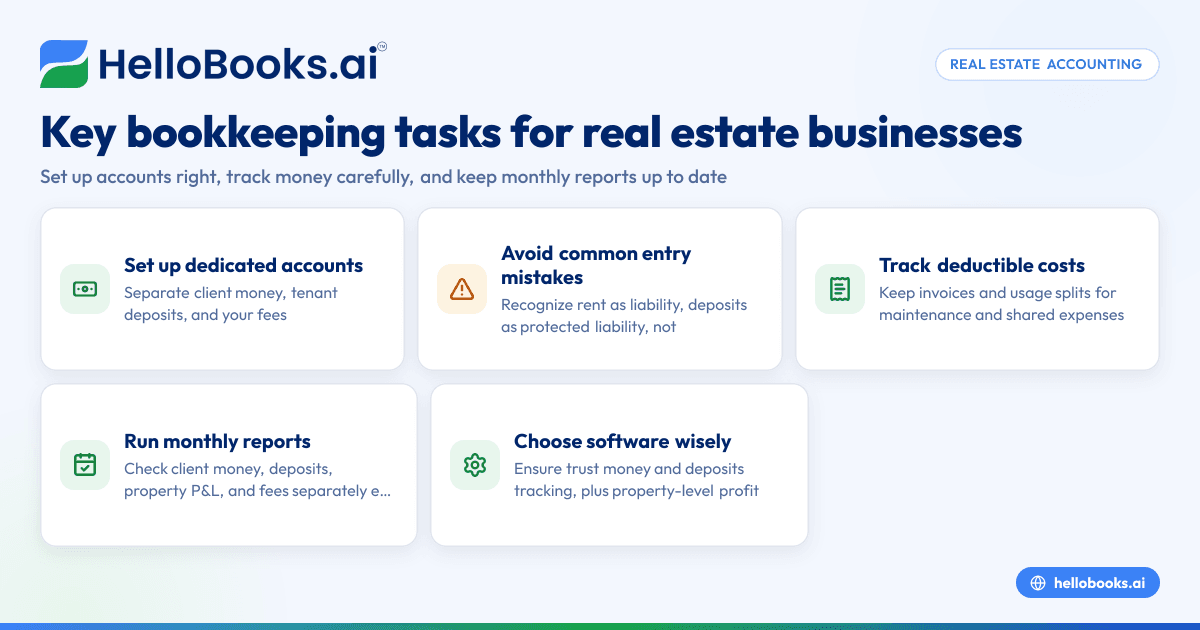
India real estate accounting starts with one rule: money collected is not automatically your revenue. In a broker, property management, developer, or contractor setup, rent for owners, tenant security deposits, customer advances, GST collected, and your own commission or fee should sit in different ledgers from day one. That separation is what keeps your profit report believable, your GST returns consistent with invoices on the GST portal, and your bank reconciliation usable when payments arrive by UPI, NEFT, RTGS, or IMPS.
Real estate accounting in India means different books for different business models
“Real estate” in India covers businesses that behave very differently in the books:
- a broker earning brokerage on sale or lease deals
- a property manager collecting rent and paying owners
- a developer taking booking advances and tracking project costs
- a contractor or fit-out business handling site expenses, subcontractors, retention, and running bills
The accounting treatment changes with the business model, but the Indian compliance pressure is similar across them: GST, TDS, bank reconciliation, entity-level reporting under the Companies Act where relevant through the MCA, and defensible records if a customer, landlord, tenant, lender, or tax professional asks for a statement.
A generic trading-business chart of accounts usually fails here because real estate businesses often hold rupees on behalf of someone else. If you mix those collections with your own income, your turnover, receivables, liabilities, and taxes all become hard to trust.
The ledgers that matter most: income, liabilities, taxes, and project tracking
A useful India-first chart of accounts for real estate usually separates these buckets clearly:
Assets
- bank accounts, ideally separated between operating money and client or owner collections if your model needs that control
- accounts receivable for brokerage, management fees, sales, or contract bills
- advances to vendors and contractors
- input tax ledgers where credit is eligible under the GST law and reflected on GSTN-backed statements such as GSTR-2A/2B
- TDS receivable where tax has been deducted from your income
- work-in-progress or project cost buckets where your accounting policy requires them
Liabilities
- rent payable to owners
- tenant security deposits payable
- customer booking advances
- retention payable
- output GST
- TDS payable
- vendor payables and accrued expenses
Income
- brokerage
- leasing or tenant placement fees
- property management fees
- maintenance or support income where it is truly your supply
- project revenue or contract revenue, under your accounting policy
Expenses
- salaries and incentives
- marketing and channel payouts
- legal and professional fees
- contractor and subcontractor charges
- travel, conveyance, and site costs
- office overheads
- repairs paid on behalf of owners, kept separate if recoverable
The point is not fancy bookkeeping. The point is being able to answer basic questions quickly: what is actually ours, what belongs to clients, what is refundable, what is taxable, what is still receivable, and what project or property absorbed the cost.
Rent, deposits, booking advances, and reimbursements should not be treated the same
This is where many firms in India lose control.
If you manage a property and collect monthly rent on behalf of an owner, that collection may create a liability to the owner, not immediate revenue for your agency. Your fee is your income. A tenant security deposit is generally a liability until adjusted or refunded under the contract. A booking advance from a buyer may be an advance from customer, not revenue at receipt. A reimbursement can be either a pass-through recovery or part of your own taxable value depending on the contract and tax position, which should be checked against the Central Goods and Services Tax Act, 2017, the Integrated Goods and Services Tax Act, 2017, applicable rules, and clarifications published by the CBIC and on the GST portal.
That is why one bank credit line cannot drive the accounting entry by itself.
An illustrative and invented scenario makes the point. Suppose a property manager receives ₹1,20,000 into the bank in one month: ₹90,000 is rent for the landlord, ₹20,000 is a refundable tenant deposit, and ₹10,000 is the manager’s own fee before taxes. This invented illustration leaves out contract disputes, timing differences, and any specific GST or TDS treatment. If the full ₹1,20,000 is posted to income, the profit and loss account is wrong, the amount payable to the owner is hidden, and any later refund of the deposit looks like an expense even though it was never income.
For firms with multiple branches or entities, this becomes even more important. If you operate across more than one GSTIN, books should be segmented GSTIN-wise and often state-wise. HelloBooks is useful here because one login can handle multiple GSTINs and users without forcing everyone into separate spreadsheets, and the invoice can apply the correct place-of-supply logic so local transactions split into CGST and SGST while interstate ones use IGST, based on the transaction details you record.
GST in Indian real estate accounting is mostly a classification problem
In practice, most GST pain in real estate is not arithmetic. It is classification, documentation, and matching.
Questions usually arise around:
- whether the receipt is your supply at all or money collected for another party
- whether the place of supply points to CGST plus SGST or IGST
- whether reverse charge applies in the specific fact pattern
- whether the supplier invoice is available and reflected for input tax credit review
- whether the invoice needs e-invoicing under the current law for your entity category
- whether goods movement connected with the transaction requires an e-way bill
You should not rely on memory for current rates, thresholds, notifications, or due dates. Those figures are published under the GST law by the CBIC and surfaced through the GST portal and GSTN systems, so they must be checked there for the exact supply and date.
For day-to-day accounting, what helps is reducing avoidable classification errors at source. If your invoice software can read the customer GSTIN, place of supply, and service details to produce a tax invoice with the right tax head split, you prevent the common mistake of charging IGST on a local supply or CGST/SGST on an interstate one. HelloBooks does that inside the normal invoicing flow, which is more useful than correcting the return later.
Where e-invoicing applies to your business under current notifications, the IRN and signed QR should be generated according to the rules and portal process published by the CBIC and GSTN. In practice, that matters most when your team is raising many invoices across sites or projects and cannot afford manual JSON uploads and re-entry.
Purchase bills, ITC tracking, and TDS need discipline, not side spreadsheets
Real estate businesses often receive messy purchase documentation: contractor bills on PDF, site expense photos from a phone, vendor invoices with incomplete descriptions, and occasional mismatches between what the supplier sent and what appears in GSTN data.
That directly affects two things:
- your expense recognition and job costing
- your confidence in input tax credit review before filing GSTR-3B
A sensible workflow is to capture supplier bills as they arrive, tag them to the correct property or project, and then review them against GSTR-2A/2B before claiming credit. If you leave this until return week, mismatches turn into a scramble. HelloBooks helps here by pulling data from purchase bill images or PDFs using OCR and then showing reconciliation against GSTR-2A/2B so you can see missing or unmatched invoices before filing GSTR-1 and GSTR-3B.
TDS is another area where real estate firms drift into manual tracking. Contractor payments, professional fees, rent, and other payment types may trigger TDS under the Income-tax Act, 1961 depending on facts, sections, and current thresholds published by the Income Tax Department. The exact rates and limits must be verified from official sources. From an accounting perspective, the key is to post the deduction against the bill or payment correctly so the vendor balance, expense, and TDS payable remain aligned. If the books keep TDS in a separate spreadsheet, vendor ageing and cost reports stop matching reality.
An illustrative and invented case: say a contractor bill is booked at ₹50,000 for a site repair, and an invented TDS amount of ₹5,000 is withheld purely to show the ledger effect. This invented figure is not a statement of the legal rate and leaves out surcharge, cess, section selection, and timing rules. If you pay ₹45,000 but record ₹50,000 as fully paid, your payable is overstated in one place and understated in another. The better entry records the expense, the contractor payable, and the TDS payable separately.
Bank reconciliation is where Indian real estate books usually break first
A real estate firm can appear busy while still having unreliable books if receipts and payouts are not reconciled properly.
India-specific payment behavior makes this harder:
- one customer pays booking money by UPI
- another sends rent by NEFT
- a broker receives a partial commission by IMPS
- a refund to a tenant goes out by bank transfer
- a project expense is paid from the director’s card and reimbursed later
If these transactions are posted manually from memory, the books soon contain duplicate receipts, uncleared invoices, and unexplained suspense balances. That is why bank reconciliation is not a back-office afterthought. It is the control that tells you whether receivables, owner payables, and cash flow are even believable.
HelloBooks fits this part of the workflow well because the team can upload a bank statement and let AI-assisted reconciliation match lines to invoices, bills, and ledger entries instead of retyping each transaction from the statement. For businesses moving off Tally-heavy, Excel-heavy processes, that is often the first place where time is saved without changing the underlying accounting logic. If you are in transition, the Tally alternative path is relevant, and some firms use the connector or migration route while cleaning old ledgers.
Inventory, materials, and e-way bills matter for developers and contractors
Not every real estate business needs inventory control. A pure broker may not. But developers, builders, interior contractors, and project-led businesses often do need it because materials, site transfers, and consumption affect both cost visibility and compliance.
If cement, fittings, electricals, modular items, or other goods move between locations, your accounting should not treat them as a vague expense bucket. You need to know what was purchased, what remains, what was issued to a site, and what was returned or wasted. Otherwise project profitability becomes guesswork.
Where movement of goods triggers e-way bill requirements under the GST regime, the current thresholds and rules must be checked from CBIC publications and the e-way bill system, not from memory. What matters operationally is avoiding double entry. If the invoice already contains the consignee, consignment, and tax details, generating the e-way bill from the transaction record reduces mismatch risk when goods move.
For inventory-heavy firms, stock and accounting should talk to each other. When purchases, issues, and sales sit in separate files, closing stock and project cost are usually wrong at month end. HelloBooks can track inventory and connect the movement to purchase and sales entries, which is more useful for contractors and smaller developers than maintaining a separate register no one updates after the first week.
Reporting should be property-wise, project-wise, and GSTIN-wise
The real test of good accounting is not whether the trial balance tallies. It is whether management can use it.
A real estate owner in India usually wants answers such as:
- Which properties are generating fees and which only consume staff time?
- Which project is over budget on contractor costs?
- How much rent is still payable to owners?
- Which tenants or buyers have outstanding balances?
- Which supplier invoices are missing for ITC review?
- What is the GST exposure by GSTIN or state?
That means reports need dimensions. Entity-wide profit and loss is not enough. You need ageing, property-wise statements, project profitability, tax ledgers, and cash movement that agrees with the bank. Because GST and financial reporting often pull from the same underlying entries, consistency matters more than cosmetic report formatting.
This is where integrated reports help. If your invoices, purchase bills, bank reconciliation, and tax returns all come from one accounting base, monthly reporting is less likely to disagree with GST filings. HelloBooks’ accounting software for small business and smart invoicing setup is relevant here because the invoice that created the receivable can also feed the GST return and later appear in the receivables report without re-entry.
If your team works mostly on phones at sites, the mobile app also matters more than desktop purity. Site expenses, purchase bills, and quick invoices entered at the point of work are usually cleaner than entries recreated days later from WhatsApp messages and memory. And for owners who naturally ask finance questions on WhatsApp in Hindi, English, or Hinglish, Noor can help them query their books without forcing them into accountant-style menus.
A practical monthly close for Indian real estate firms
A strong month-end process is usually simpler than a “full automation” dream. For most firms, this is the rhythm that matters:
- Record all sales invoices, brokerage invoices, management fees, debit notes, and customer advances.
- Record supplier bills with property or project tags and capture GST details correctly.
- Upload the bank statement and reconcile receipts, owner payouts, supplier payments, refunds, and reimbursements.
- Review liabilities: owner payables, tenant deposits, customer advances, retention, GST, and TDS.
- Reconcile purchase data with GSTR-2A/2B before finalising ITC positions.
- Review tax invoices for place of supply, GSTIN, and tax head accuracy.
- File GSTR-1 and GSTR-3B from the books once the underlying transactions are clean.
- Issue management reports: P&L, receivables ageing, payables, project or property performance, and cash summary.
If you are unsure whether your invoice fields are complete or a GSTIN looks valid, HelloBooks also offers India-focused free tools such as the GSTIN validator, GST invoice validator, and GST reconciliation checker. Those are useful even before you change software.
Choosing software for a real estate business in India
The right accounting system for this sector is not the one with the longest feature sheet. It is the one that keeps four Indian realities tied together:
- GST accuracy on invoices and returns
- bank reconciliation from uploaded statements
- project, property, or client-level visibility
- clean handling of liabilities such as deposits, owner balances, advances, TDS, and reverse charge where applicable
If your current process depends on Tally exports, Excel trackers, and manual checking on the GST portal, the risk is not just time spent. The real risk is that income, liabilities, and taxes drift apart. You can explore HelloBooks for India at /in, check fit and pricing at /in/pricing, or book a walkthrough at /demo.
For an India real estate business, good accounting is not about posting every rupee somewhere. It is about posting each rupee to the right owner, liability, tax bucket, project, and GSTIN so that the books answer the same questions your banker, your CA, your client, and the GST portal will ask.