
Key takeaways
What this article covers, in order:
- How insurance agency accounting works in India
- The ledger structure an Indian insurance agency actually needs
- Premium receipts are not the same as agency revenue
- GST treatment needs transaction-level thinking, not a blanket rule
- Carrier statements, clawbacks and TDS are where books drift off course
- GSTR-1, GSTR-3B and ITC control depend on clean source entries
India insurance agencies should treat premium collected from customers as money held for the insurer, not as agency revenue, and keep the agency’s own commission, GST treatment, TDS credits, and bank reconciliation separate from that flow. In practice, the hard part is not theory but bookkeeping: carrier statements arrive net of adjustments, GST classification can differ by transaction, and one wrong posting can distort your receivables, GSTR-1, GSTR-3B, and profit. This guide shows how to structure the books for Indian agencies so the ledger matches business reality.
How insurance agency accounting works in India
An insurance agency in India usually handles at least three different money streams that should not be blurred together:
- premium collected from a policyholder on behalf of an insurer
- commission income earned by the agency from the insurer
- taxes and deductions attached to those transactions, such as GST or TDS where applicable under the Income-tax Act, 1961
That separation matters because different laws and regulators look at different pieces of the same transaction. GST compliance sits within the GST framework administered through the GST Network (GSTN) and overseen by the Central Board of Indirect Taxes and Customs (CBIC). Corporate records and financial statement responsibilities may also be relevant under the Companies Act, 2013 and filings with the Ministry of Corporate Affairs (MCA) for incorporated entities. If customer data is handled digitally, data-governance obligations can also arise under the Digital Personal Data Protection Act, 2023, depending on the facts and how the agency operates.
For bookkeeping, the biggest practical rule is simple: if the agency receives ₹ from a customer that belongs economically to the insurer, do not book the full receipt as sales. If you do, revenue is overstated, GST reporting may become messy, and insurer payables become invisible.
The ledger structure an Indian insurance agency actually needs
A generic small-business chart of accounts is usually too shallow for this sector. An India-ready setup should let you answer four questions quickly: how much premium is held, how much commission is earned, what tax has been charged or deducted, and what remains unreconciled against carrier statements and bank entries.
A workable structure often includes:
- bank accounts separated between operating funds and any account used to receive premium collections
- insurer-wise payable or clearing ledgers
- commission income split between new business, renewals, overrides, and reversals where relevant
- chargeback or clawback ledgers so cancellations are visible
- GST output and input ledgers, including reverse charge where relevant to your actual expenses
- TDS receivable ledgers where insurers or other parties deduct tax at source
- customer receivables only where the agency genuinely bills the customer
- insurer receivables where commission has accrued but not yet settled
This matters even more if the business operates across more than one GSTIN. Multi-state agencies have to get place of supply and tax head split right between CGST, SGST, and IGST, and separate books by registration help keep filings defensible. If your team still works in Tally, moving gradually is realistic; some firms use a tally alternative while keeping historical records aligned during transition.
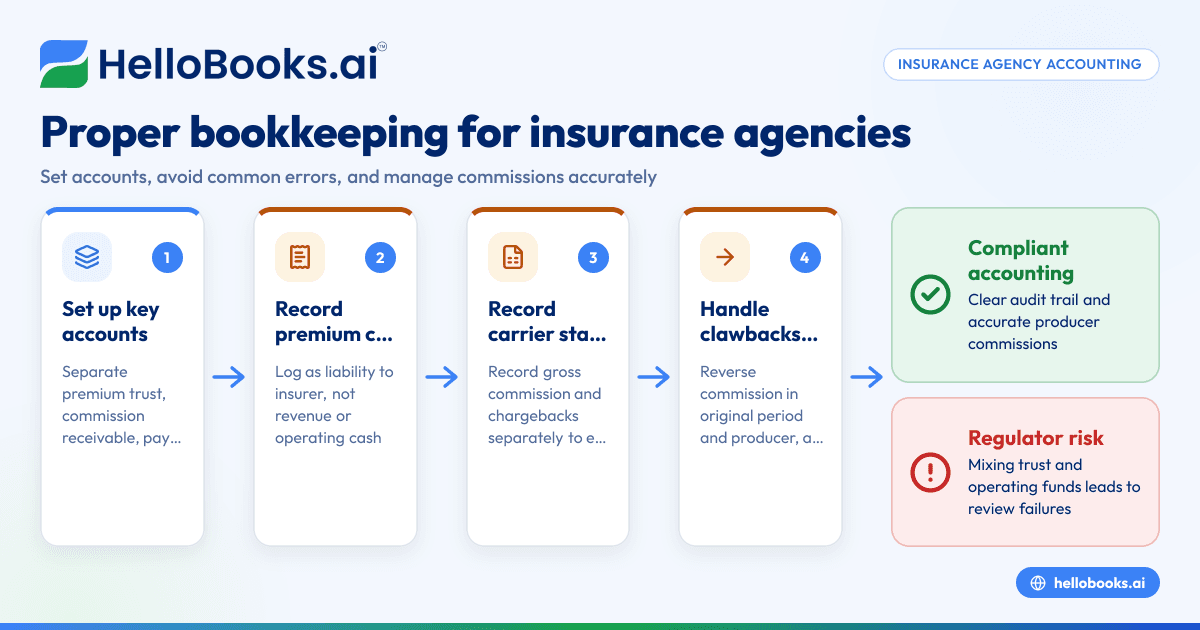
Premium receipts are not the same as agency revenue
This is the posting that most often breaks insurance books.
If a customer pays premium through UPI, NEFT, RTGS, IMPS, cheque, or bank transfer into the agency’s collection account, the receipt does not automatically become income. The first question is: who is the principal for that amount? In many agency arrangements, the premium belongs to the insurer and the agency is only an intermediary.
So the accounting usually needs to show:
- cash or bank increases when money is received
- a liability or insurer clearing balance increases for the amount due onward
- revenue is recognized only when the agency’s commission is earned under the contract and evidenced by statement or other support
That sounds basic, but the operational reality is messy. A carrier statement may arrive later. A cancellation may trigger a clawback. A part of the receipt may relate to policy fees or service charges. TDS may appear later on the commission advice. If you record only the net settlement, you lose the audit trail.
This is where software structure matters more than “accounting software” as a label. If invoices, expenses, tax heads and reconciliations all sit in one system, the agency can trace one transaction from receipt to commission to return filing. HelloBooks is useful here because the same records can feed accounting software India workflows, GST invoicing where a taxable invoice is actually required, and financial reports without exporting everything to side spreadsheets.
GST treatment needs transaction-level thinking, not a blanket rule
Insurance agencies in India often ask: “Do I charge GST on everything I receive?” Usually, that is the wrong question. The right question is: what exactly is the supply made by the agency, who is the recipient, and what is the consideration for that supply under GST law?
The governing law is the Central Goods and Services Tax Act, 2017 together with the Integrated Goods and Services Tax Act, 2017 and related rules. CBIC notifications, circulars and updates on the GST Portal are where current rates, exemptions, threshold positions, invoicing requirements and procedural changes are officially published. If you need the current figure for any threshold or rate, check the CBIC notifications and GST Portal before acting.
For many agencies, the premium amount collected for the insurer is not the same thing as the agency’s taxable turnover. The agency’s own commission or service income may be the relevant figure for GST analysis, subject to the exact arrangement and current law. That distinction is legal, not just bookkeeping.
The practical accounting consequences are:
- do not raise a tax invoice for amounts that are not your own taxable supply merely because cash passed through your bank
- where you do issue a GST invoice for your own services or commission, ensure the GSTIN, SAC details, place of supply and tax split are correct
- if you operate in more than one state, check whether the supply is intra-state or inter-state before choosing CGST plus SGST or IGST
- reconcile invoices and credit notes before filing GSTR-1 and GSTR-3B
HelloBooks is especially relevant if your agency issues taxable invoices of its own, because GST invoicing and place-of-supply logic reduce the risk of charging the wrong tax head. If e-invoicing applies to your business under the law as currently notified by CBIC, the platform can generate the IRN and signed QR within the invoicing flow instead of leaving finance teams to upload JSON separately. The latest applicability threshold is published through official CBIC and GST Portal notifications and should be checked there.
Carrier statements, clawbacks and TDS are where books drift off course
Indian insurance agencies rarely fail because they do not know debits and credits. They fail because statement reconciliation is left too late.
A carrier statement may show:
- gross commission
- tax invoice reference if applicable
- clawback on cancelled policies
- adjustments from prior periods
- TDS deducted under the Income-tax Act, 1961
- net amount remitted to the bank
If you book only the net bank receipt, three things disappear at once: the real commission figure, the clawback history, and the TDS credit. That creates trouble at year-end when Form 26AS or the Annual Information Statement does not match the books, and when producer payouts or branch profitability need review.
A better method is to book the statement components separately. Then the net receipt becomes the consequence of the entries, not the only entry.
To illustrate with invented figures only: suppose an insurer statement shows a gross commission of ₹1,20,000, a clawback of ₹15,000 on cancelled policies, TDS of ₹10,500, and a bank transfer of ₹94,500. This illustration is invented and leaves out surcharge, cess, exact section analysis, and any GST treatment. The point is structural. The ledger should capture gross commission income, the clawback reversal, the TDS receivable asset, and the final bank receipt distinctly. If instead you post only ₹94,500 as income, your rupee revenue is understated, your TDS credit vanishes from the books, and the cancellation trend is no longer measurable. NEEDS EXPERT REVIEW
HelloBooks helps on this part because you can upload a bank statement rather than type every receipt line manually, and AI-assisted reconciliation can match deposits against recorded invoices or ledger entries. For purchase-side records, OCR on bills can reduce manual entry when the agency is also tracking rent, software subscriptions, outsourced processing costs, and other overheads.
GSTR-1, GSTR-3B and ITC control depend on clean source entries
For insurance agencies, GST return filing problems often begin long before the return is opened. They begin when:
- invoices are raised outside the accounting system
- credit notes for reversals are missed
- vendor bills are entered late
- expenses are booked without GST classification
- inter-state and intra-state supplies are mixed up
Because of that, the right objective is not “file the return somehow.” It is to keep books in a state where the return is a by-product of accurate entries.
HelloBooks is directly relevant here because GSTR-1 and GSTR-3B can be filed from the records already captured, rather than retyping turnover into a separate workflow. That is particularly useful for agencies with more than one branch or GSTIN, since one login can handle multiple registrations and unlimited users while keeping reporting separated registration-wise.
Input tax credit also needs discipline. Under the GST system, whether and when ITC can be claimed depends on legal conditions in the CGST Act and rules, supplier reporting, and the agency’s own eligibility. The current position should always be checked on the GST Portal and CBIC guidance. Practically, though, agencies should compare purchase records against GSTR-2A or GSTR-2B and not assume every vendor invoice is safely claimable the moment it is scanned.
That is why reconciliation matters more than raw data entry. HelloBooks can compare purchase records with GSTR-2A/2B and track ITC visibility so finance teams see what is missing before preparing GSTR-3B.
A realistic monthly close for an India insurance agency
A useful month-end process for this business is not long, but it must be consistent.
First, reconcile all bank accounts, including the account that receives premium or insurer settlements. If collections come through UPI and then settle into the bank in batches, make sure the batch receipts are cleared against underlying entries.
Second, reconcile insurer-wise statements. Check whether every commission line, reversal, and remittance has been posted. Do not wait until the quarter or year-end.
Third, review GST invoices issued by the agency itself. Ensure GSTIN, place of supply, and tax split are correct. If e-invoicing applies to your registration, ensure IRN-linked documents have been generated as required by the current CBIC notification.
Fourth, review expense bills and ITC. Scan missing invoices, classify them correctly, and compare purchase data to GSTR-2B before claiming credit.
Fifth, verify TDS balances against the supporting statement or tax credit records under the Income-tax Act.
Sixth, run management reports: monthly P&L, receivables ageing, payables, branch-wise or insurer-wise income, and reversal trends.
HelloBooks supports this cadence well because bank statement upload, OCR for purchase bills, financial reports, and mobile entry all reduce the gap between real activity and the books. For owners who are frequently on the move, the mobile app on iOS and Android is practical for recording expenses or checking reports without waiting to get back to the office. Teams that prefer quick queries in Hindi, English or Hinglish can also use Noor on WhatsApp to ask bookkeeping questions in a more natural way.
When inventory, e-way bills and e-invoice features matter for agencies
Many insurance agencies will never need inventory or an e-way bill for their core commission business. But some agencies also sell add-on goods, kits, devices or printed materials, or run a mixed business under the same entity. In those cases, accounting gets harder because service income and goods movement start interacting.
Where goods are actually supplied, inventory records should move with each sale and purchase so closing stock is not guessed at year-end. If e-way bill obligations arise for movement of goods, the current threshold and rules are prescribed under GST law and published on the e-way bill system and related CBIC/GST notifications; always verify the latest official position there.
If your agency has that mixed model, HelloBooks can keep inventory updated and generate the e-way bill from the invoice when goods movement is involved, which avoids retyping consignment details. For pure insurance commission businesses, these features may not matter much, and that is fine.
Choosing software for an Indian insurance agency
The right setup for India is less about industry branding and more about whether the software handles the compliance texture of the business:
- GST invoices with correct CGST, SGST or IGST logic
- direct GSTR-1 and GSTR-3B filing from books
- GSTR-2A/2B reconciliation for ITC checks
- bank statement upload with sensible matching
- TDS posting and tracking
- support for multiple GSTINs if the agency operates in several states
- reports that tie back to filed numbers
- a practical migration path if the agency has years of data in Tally
That is why many agencies evaluating systems look first at workflow fit instead of feature volume. HelloBooks is strongest where Indian compliance and day-to-day bookkeeping overlap: smart invoicing, e-invoicing software, GST return filing software, bank reconciliation software, and inventory if the business also moves goods. If you are still comparing options or want to see how it fits your office process, the next sensible pages are India, pricing, or a guided demo.
You can also use HelloBooks’ free India tools for specific checks, such as a GSTIN validator, GST calculator, HSN code search, or GST reconciliation checker, before changing your whole accounting setup.
The practical standard to aim for
Good accounting for an insurance agency in India is not about making the trial balance look tidy. It is about preserving the economic truth of each transaction: premium held for insurers, commission earned by the agency, GST reported under the correct law, TDS captured under the Income-tax Act, and bank receipts reconciled to actual statements.
If those pieces are separated properly, year-end work becomes easier, MCA reporting for companies is cleaner, GST filings are less error-prone, and management can see what is really happening insurer by insurer. If they are mixed together, even a profitable agency can lose control of cash, tax credits and reporting.
For this sector, that separation is the whole game.