
Key takeaways
What this article covers, in order:
- Before you start
- What should I watch out for when using AI bookkeeping software?
- Can AI automation handle GST and e-invoicing compliance accurately?
- Step 1: Choose AI bookkeeping software designed for Indian SMEs
- Step 2: Prepare your financial data for AI processing
- Step 3: Train your AI tool and verify its outputs regularly
Common Caveats in AI Bookkeeping for Small Businesses in India
===============================================================
This post is for small business owners and accountants in India exploring AI bookkeeping for small business. By the end, you will understand common pitfalls to avoid when adopting AI-powered bookkeeping and how to choose the right solution for your business needs.
Before you start
- Have your current bookkeeping process and pain points clearly documented.
- Gather sample financial data and invoices to test automation accuracy.
- Understand your GST compliance requirements and deadlines.
- Know your IT infrastructure capabilities, including internet reliability.
What should I watch out for when using AI bookkeeping software?
AI bookkeeping software automates data entry and reconciliation but may misclassify transactions or miss GST nuances. Always review automated entries and keep your chart of accounts updated. Be cautious about relying fully on AI without human oversight, especially for complex transactions.
AI tools speed up bookkeeping by recognising invoice details and matching bank feeds automatically. However, they can struggle with vendor names that vary or handwritten bills, leading to errors. Ensure your AI software allows easy manual corrections and learning from mistakes to improve accuracy over time.
One common mistake is assuming AI is flawless and skipping regular checks. For example, an AI tool might categorise a purchase of office stationery as raw material expense, distorting your cost analysis and tax deductions. Without human review, such errors propagate.
Can AI automation handle GST and e-invoicing compliance accurately?
AI automation can assist in generating GST-compliant invoices and preparing returns, but it depends on the software’s integration with GSTN and e-invoicing portals. Verify that your AI solution supports real-time GST validation and e-invoicing formats mandated by Indian tax authorities to avoid filing errors.
Automated with AI tools, some bookkeeping software offer built-in GST return filing features that reduce manual errors. However, changes in GST rates or rules require prompt software updates. Keep your software current and cross-check filings before submission to prevent penalties.
A pitfall is relying on outdated software that lacks the latest GST rules or e-invoicing formats. For instance, if your software does not support the recent increase in e-invoicing turnover threshold, you might miss compliance requirements and face fines.
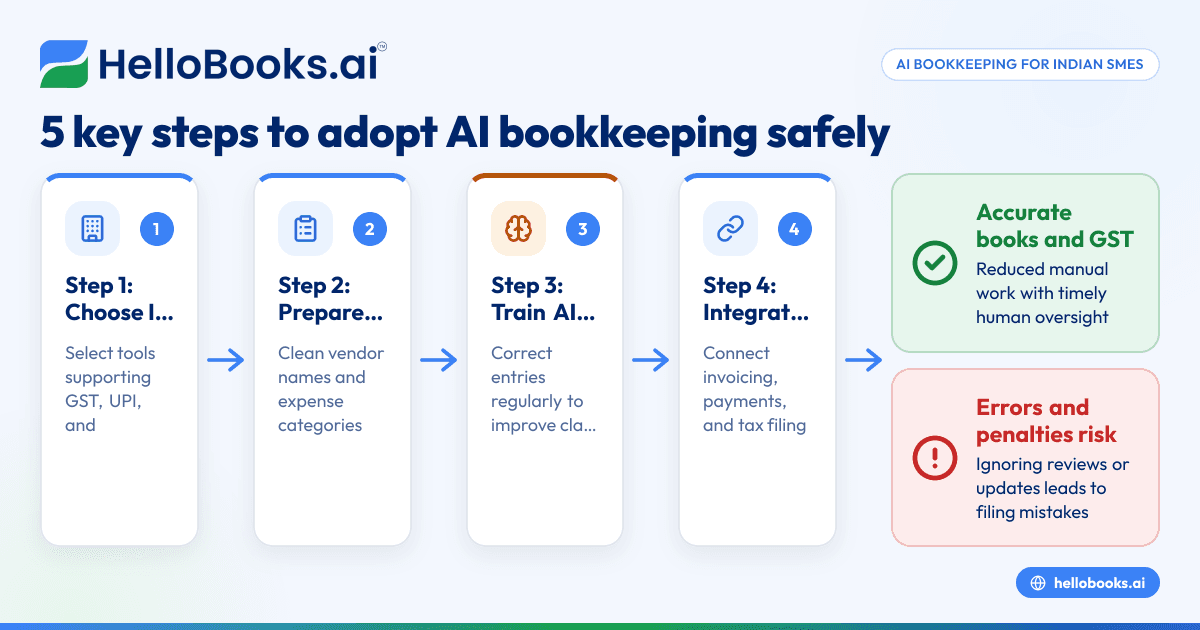
Step 1: Choose AI bookkeeping software designed for Indian SMEs
Select AI accounting software supporting Indian tax laws, GST, and common payment modes like UPI. Verify features such as bank reconciliation automation and expense management tailored for Indian vendors and customers. Using a generic tool can cause compliance issues or missed transactions.
A common mistake is picking software without GST return filing or e-invoicing capabilities, which adds manual work and risk. Look for solutions that automate invoice creation, GST calculations, and integrate with your bank and payment platforms.
For example, a Bengaluru-based service provider should ensure the AI tool can handle GST slab rates at 18% and 28%, and recognise payments via UPI apps popular in the city. This ensures smooth daily operations and compliance.
Step 2: Prepare your financial data for AI processing
Clean and standardise your existing data before importing it into the AI tool. This includes consistent vendor names, invoice formats, and categorised expenses. AI-powered systems learn better from structured data, improving accuracy in transaction classification and report generation.
Failure to prepare data often leads to duplicate entries or wrong ledger accounts. For example, if vendor names are inconsistent — “ABC Traders,” “A B C Traders,” and “ABC Trader” — AI may treat the same supplier as different entities, skewing your expense reports.
To avoid this, create a master vendor list with standardised names and contact details. Similarly, organise your expense heads clearly, such as “Office Supplies,” “Travel Expenses,” and “Raw Materials,” to help AI categorise transactions correctly.
Step 3: Train your AI tool and verify its outputs regularly
Spend time initially correcting AI-generated entries and confirming classifications. Most AI bookkeeping for small business solutions improve with feedback, adapting to your business specifics. Set a routine to review reconciliations, invoices, and GST return drafts before finalising.
Ignoring this step causes errors to compound and reduces trust in automation. Human review ensures that exceptions like advance payments, credit notes, or mixed GST rates are handled correctly.
For example, if a supplier issues a credit note for returned goods, AI might not automatically adjust the GST input credit. Manually verifying such adjustments avoids incorrect tax filings.
Schedule weekly or biweekly audits of AI entries to catch errors early. Use this feedback to train your AI software if the feature is supported, so accuracy improves over time.
Step 4: Integrate AI bookkeeping with your existing workflows
AI bookkeeping works best when integrated with your invoicing, payment, and tax filing processes. For instance, linking your AI tool with UPI or Razorpay payment gateways automates payment matching and cash flow tracking. Use software that supports easy export of reports for your accountant or GST filing.
A common error is treating AI bookkeeping as a standalone task. This fragments data and wastes time reconciling multiple systems manually.
In Pune, many SMEs receive orders from platforms like IndiaMART or JustDial. Ensure your AI bookkeeping tool can import sales data from these sources or your invoicing software, reducing duplicate data entry.
Also, connect your expense management software to capture bills and receipts from WhatsApp or email directly into the AI system, improving data completeness and accuracy.
Step 5: Keep your software updated and comply with regulatory changes
Indian tax laws and compliance requirements evolve, such as updates to GST rates or e-invoicing thresholds. Ensure your AI software provider delivers timely updates and support. Monitor notifications from GSTN and adjust your processes accordingly.
Failure to keep software current risks incorrect filings and penalties. Regularly check your AI tool’s version and features, especially before GST return deadlines.
For example, in FY 2023-24, if the e-invoicing threshold was raised or changed, confirm your software reflects this to avoid missing mandatory e-invoice generation for applicable transactions.
Worked example: Using AI bookkeeping for a Mumbai-based apparel retailer
Consider a Mumbai apparel SME with ₹50 lakh annual turnover, using an AI-powered bookkeeping software. They prepare their data by standardising vendor names from markets like Crawford and linking bank statements with UPI payment data.
The AI tool automates invoice creation with GST rates of 5% on certain apparel items and 12% on accessories, as per applicable slabs. It recognises payments received via Razorpay and UPI, automatically matching them to invoices.
Each week, the owner reviews AI classifications. Initially, some textile raw material purchases were misclassified as office expenses. These are corrected manually, and the AI learns from feedback to reduce future errors.
Integration with Razorpay automates payment reconciliation, reducing manual data entry by 70%. The system also generates GST return drafts (GSTR-1 and GSTR-3B) for review before filing.
Before submission, the owner cross-checks the AI-generated GST return against purchase and sales registers, ensuring input tax credits and output GST are correctly reported.
This process saves time while maintaining compliance, but human oversight ensures accuracy and timely filings.
What’s the next step for adopting AI bookkeeping?
Start by reviewing your current bookkeeping challenges and the features you need from AI software. Test your sample data with shortlisted tools to check accuracy, especially for GST and bank reconciliation.
Remember, AI bookkeeping is a tool to reduce manual work and errors but does not replace the need for human review and understanding of your financials.
If you want to see how AI bookkeeping can work for your business, you can book a demo or compare plans at pricing. This will help you choose the right accounting software for small business tailored to Indian SMEs’ needs.
Related reading
- AI bookkeeping
- How AI Bookkeeping Supports Small Businesses While Highlighting Limitations in India
- How Small Businesses Can Use AI Bookkeeping Tools Without Losing Control, Supported with Caveats
Read next
This article covers one part of a bigger topic. For the complete picture, read our guide to supported with caveat.