
Key takeaways
What this article covers, in order:
- Why this comes up / what goes wrong
- Step-by-step
- Example (fictional figures)
- Common mistakes
- Doing this in HelloBooks
- Frequently asked questions
Supermarkets in India manage large volumes of daily sales, purchases, and inventory. Manual bookkeeping using spreadsheets, Tally, or physical bill books often leads to mistakes, delays in GST compliance, and wasted time. The right accounting software automates these processes, improves accuracy, and helps meet GST deadlines.
Why this comes up / what goes wrong
Supermarket owners or accountants typically face challenges like frequent billing, multiple suppliers, high stock turnover, and complex GST filing requirements. Many still rely on manual data entry, which is slow and error-prone. Without software tailored for retail, supermarkets risk incorrect GST returns, stock mismatches, and cash flow issues. Managing multiple outlets adds to the complexity. These problems create a need for software that simplifies GST invoicing, purchase bill entry, inventory tracking, bank reconciliation, and GST return filing.
Step-by-step
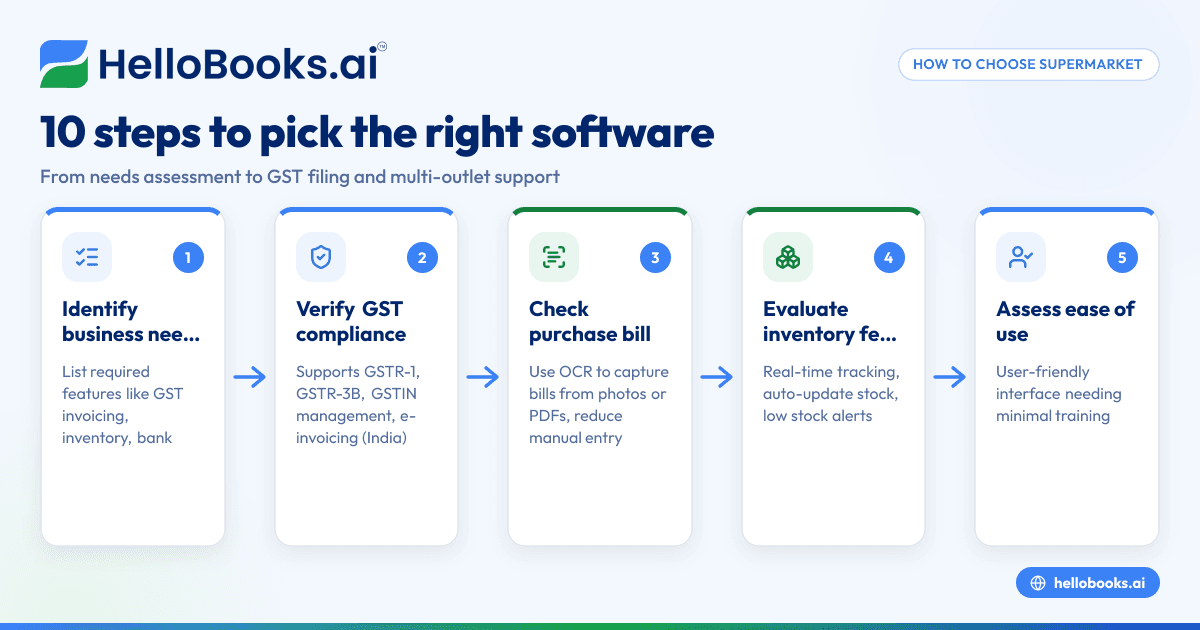
- Identify your business needs: Determine if your supermarket requires features such as GST invoicing, inventory management, purchase bill entry, bank reconciliation, multi-outlet support, and GST return filing.
- Verify GST compliance: Ensure the software supports filing GSTR-1 and GSTR-3B, manages your GSTINs, and handles e-invoicing if your turnover requires it.
- Check purchase bill management: Look for software that can capture supplier bills efficiently. OCR (Optical Character Recognition) technology helps by reading bills from photos or PDFs, reducing manual entry.
- Evaluate inventory features: The software should track stock movement in real-time, update inventory automatically with each purchase or sale, and alert you to low stock.
- Assess ease of use: The interface must be user-friendly for you or your accountant, requiring minimal training.
- Look for bank reconciliation: The software should help reconcile bank statements with your recorded transactions to maintain accurate cash flow records.
- Consider multi-outlet capabilities: If you operate more than one supermarket outlet, check if the software consolidates accounts and inventory across locations.
- Review reporting and analytics: Financial reports, GST summaries, and inventory reports should be easy to generate for decision-making and audits.
- Check support and software updates: GST rules can change frequently; ensure the provider offers timely updates and customer support.
- Compare pricing and plans: Match the software cost with your budget and feature needs.
For more insights on software options, see accounting software in India and accounting software for small business.
Example (fictional figures)
A kirana store in Indore buys goods worth ₹1,00,000 from a supplier on 10/03/2024. Assume a GST rate of 12% for illustration.
Purchase value = ₹1,00,000
GST @ 12% = ₹1,00,000 × 12% = ₹12,000
Total bill amount = ₹1,00,000 + ₹12,000 = ₹1,12,000
The store uploads the purchase bill photo to the accounting software with OCR.
The software reads the bill, auto-matches items to existing inventory, and updates stock levels.
At month-end, the store files GSTR-1 with sales details and GSTR-3B with tax payments.
The software assists in reconciling Input Tax Credit (ITC) from GSTR-2B.
This process saves time compared to manual entry and reduces errors in GST filings.
Common mistakes
- Ignoring GST compliance features: Using software without built-in GSTR-1 and GSTR-3B filing support leads to manual errors and penalties. Always verify GST return filing capabilities.
- Manual purchase bill entry: Typing bills manually wastes time and increases mistakes. Use software with OCR to capture bills from photos or PDFs.
- Neglecting inventory reconciliation: Not updating stock regularly causes mismatches and financial discrepancies. Choose software that tracks inventory in real-time.
- Skipping bank reconciliation: Without matching bank statements to recorded transactions, cash flow management suffers. Ensure the software supports bank statement reconciliation.
- Overlooking multi-outlet management: Supermarkets with multiple outlets need consolidated accounting. Confirm the software handles multiple locations.
- Ignoring software updates and support: GST regulations change often. Lack of timely updates risks non-compliance.
For retail-specific software needs, see Retail shops.
Doing this in HelloBooks
HelloBooks offers OCR for purchase bills, allowing supermarket owners to capture supplier bills from photos or PDFs instead of manual entry. The line items are auto-matched to existing inventory, reducing errors and saving time. This feature helps supermarkets maintain accurate books and speeds up GST compliance tasks. Learn more about OCR scanning at /ocr-scanning.
Frequently asked questions
What features should supermarket accounting software have?
Supermarket accounting software should include GST invoicing, purchase bill entry with OCR, inventory tracking, bank reconciliation, and GST return filing such as GSTR-1 and GSTR-3B.
Can I use Excel or Tally for supermarket accounting?
While Excel and Tally are possible options, they require manual data entry and are time-consuming. Dedicated software with automation features reduces errors and saves significant time.
How does OCR help in supermarket accounting?
OCR technology scans purchase bills from photos or PDFs, automatically extracting line items and matching them to inventory. This reduces manual entry and improves accuracy.
Is multi-outlet management important for supermarkets?
Yes, supermarkets with multiple outlets benefit from software that consolidates accounting and inventory management across locations, simplifying operations.
How does accounting software help with GST compliance?
Software generates GST invoices, prepares and files GSTR-1 and GSTR-3B returns, reconciles Input Tax Credit from GSTR-2B, and keeps records ready for audits.
For more FAQs and guidance, see accounting software for small business.
Key takeaways
- Choose accounting software with GST invoicing and filing features tailored for supermarkets.
- OCR for purchase bills significantly reduces manual data entry and errors.
- Inventory management and bank reconciliation are essential for accurate financial records.
- Multi-outlet support is important for supermarkets operating more than one store.
- Regular software updates ensure compliance with changing GST rules.
Start managing your supermarket accounts efficiently with HelloBooks. Start on the Free plan (200 transactions a year, GSTR-1 and 3B filing for one GSTIN).