
Key takeaways
What this article covers, in order:
- Why this comes up / what goes wrong
- Step-by-step
- Example (fictional figures)
- Common mistakes
- Frequently asked questions
- Key takeaways
Accounting software implementation services assist service business owners and accountants in India to transition from manual bookkeeping methods or basic tools like Excel and bill books to efficient accounting software. These services include selecting the right software, migrating data, configuring GST compliance settings, training users, and providing ongoing support to ensure accurate financial management.
Why this comes up / what goes wrong
Service business owners and accountants in India often look for accounting software implementation services because manual bookkeeping or using simple tools like Tally or spreadsheets can be time-consuming and prone to errors. Local service businesses such as salon chains in Chandigarh, gyms in Bhopal, and event planners in Jaipur face challenges managing GST invoicing, reconciliation, and compliance. Without proper implementation, businesses risk inaccurate records, missed GST filing deadlines, and inefficient financial monitoring, which can lead to penalties or cash flow problems.
Step-by-step
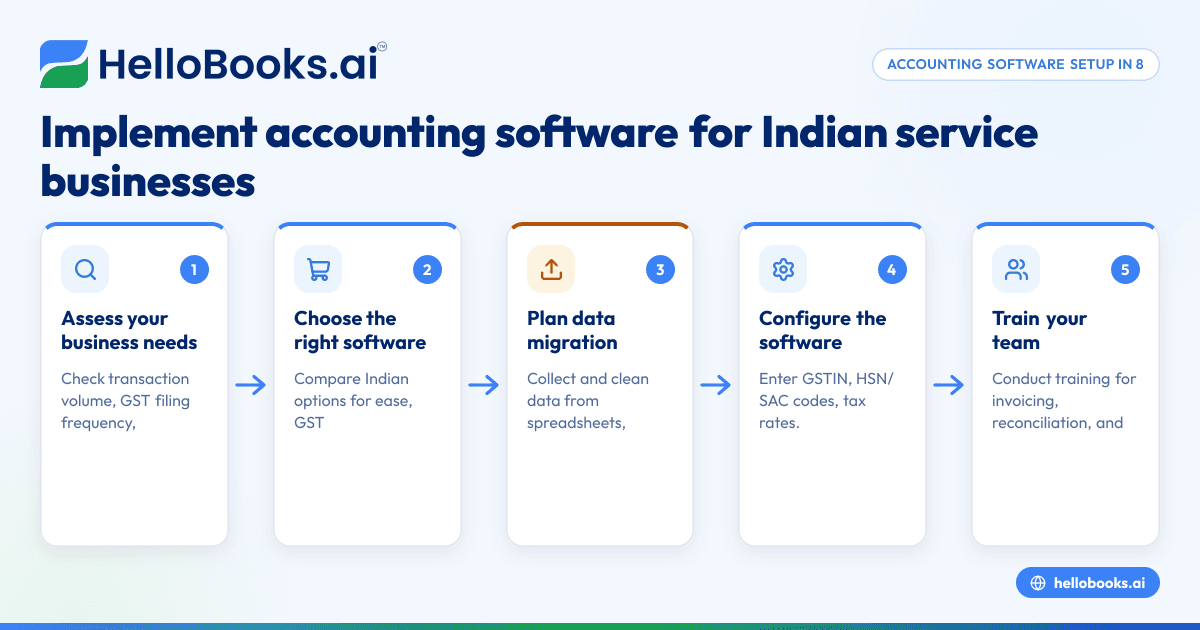
- Assess your business needs: Determine your transaction volume, GST filing frequency, and features required such as invoicing, expense tracking, or inventory management. Verify the software supports your GSTIN and suits your service sector. For more on software options, see accounting software for small business.
- Choose the right software: Compare Indian accounting software based on ease of use, GST compliance features, support for e-invoicing if applicable, and integration with your existing tools. Look at options listed under accounting software in India.
- Plan data migration: Collect your existing financial data from spreadsheets, bill books, or Tally. Clean and organise this data to avoid errors during import.
- Configure the software: Enter company details including GSTIN, HSN/SAC codes, and applicable tax rates. Ensure the software generates GST-compliant invoices containing all required particulars such as supplier and recipient details, invoice number, date, tax amounts, and place of supply as mandated by Rule 46 [cgst-rule-46/rule46-particulars].
- Train your team: Conduct training sessions for staff responsible for data entry, invoicing, reconciliation, and GST filing to reduce errors.
- Test with sample transactions: Enter a few transactions and generate reports to verify data accuracy and GST calculations.
- Go live and monitor: Begin daily accounting and GST compliance using the software. Monitor for issues and seek support promptly.
- Review periodically: Regularly check financial reports and GST returns for accuracy and compliance.
Example (fictional figures)
A salon chain in Chandigarh begins implementing accounting software on 01/08/2023. Monthly sales are ₹4,50,000, and monthly expenses are ₹1,50,000.
- Monthly sales = ₹4,50,000
- GST rate assumed = 18%
- GST on sales = ₹4,50,000 × 18% = ₹81,000
- Monthly expenses = ₹1,50,000
- GST on expenses (input tax credit) = ₹1,50,000 × 18% = ₹27,000
- Net GST payable = ₹81,000 - ₹27,000 = ₹54,000
The salon configures the software with their GSTIN, HSN/SAC codes for services, and tax rates. They migrate past invoices from Excel and Tally after cleaning the data. After training staff, they enter sample sales and expense transactions to verify the calculations. Confirmed accurate, they start using the software for all accounting and GST filing.
Common mistakes
- Choosing software without GST compliance: Prevent by checking that the software supports GST invoicing, GSTR-1, and GSTR-3B filing.
- Ignoring data cleanup before migration: Prevent by reviewing and correcting your existing records before import.
- Skipping user training: Prevent by scheduling training sessions to avoid errors in data entry and filing.
- Incorrect tax configuration: Prevent by carefully entering GSTIN, HSN/SAC codes, and tax rates as per your business.
- Neglecting periodic review: Prevent by regularly checking reports and GST returns to catch discrepancies early.
- Overlooking integration needs: Prevent by choosing software that works well with your existing tools or accounting processes.
For more on accounting in local service sectors, see Local service businesses.
Frequently asked questions
What are accounting services for software companies?
Accounting services for software companies include bookkeeping, invoicing, payroll, GST compliance, and financial reporting tailored to software development lifecycles and revenue recognition. These services ensure accurate tax filing and financial management.
How do software development accounting services differ?
Software development accounting services focus on managing project costs, revenue recognition from contracts, and compliance with GST rules specific to software services. They help track expenses and revenues linked to software projects.
Can I implement accounting software myself?
Yes, small businesses with basic needs can implement accounting software themselves by following setup guides and tutorials. However, professional implementation services help avoid errors and ensure GST compliance.
How do I choose the best accounting software for my service business?
Consider transaction volume, GST filing needs, ease of use, customer support, and integration capabilities. Reviewing options under accounting software for small business and accounting software in India can help.
What if my business grows and needs more features?
Most software solutions offer scalable plans or add-ons. Regularly review your needs and upgrade or switch software accordingly.
Key takeaways
- Assess your service business needs before selecting accounting software.
- Choose software that supports GST compliance and invoicing as per Rule 46.
- Clean and organise your existing data before migration.
- Train your team and test the software with sample transactions.
- Avoid common mistakes like skipping training or ignoring tax configuration.
- Review your accounting and GST reports regularly to maintain accuracy.
Start on the Free plan (200 transactions a year, GSTR-1 and 3B filing for one GSTIN) at HelloBooks pricing to begin your accounting software journey.