
Key takeaways
What this article covers, in order:
- Before you start
- Step 1: What is bank reconciliation, and why do you need it?
- Step 2: How do I prepare for reconciliation?
- Step 3: How does AI bank reconciliation work in practice?
- Step 4: What are the main bank reconciliation steps?
- Step 5: Can AI bank reconciliation handle GST and e-invoicing data?
Step-by-Step Bank Reconciliation Process for Small Businesses in India Using AI Software
This post is for small business owners, finance leads, and accountants in India who want to learn the bank reconciliation steps to ensure accurate books. By the end, you will know how to use AI to make bank reconciliation faster, error-free, and compliant with Indian business needs.
Before you start
- A bank statement in digital form (e.g., PDF or Excel from netbanking) for the period you want to reconcile.
- Your business’s accounting records, either in spreadsheets, Tally, or any accounting software.
- Basic knowledge of how your business records payments, receipts, bank charges, and taxes.
- Access to AI bank reconciliation software connected to your bank and accounting system for automation.
Step 1: What is bank reconciliation, and why do you need it?
Bank reconciliation is the process of matching your business’s accounting records of transactions to the bank statement to ensure both show the same balance. This is essential for detecting errors, spotting fraud, managing cash flow, and filing accurate GST returns.
Mistake people make: Skipping reconciliation regularly can lead to delayed identification of missing payments, duplicate entries, or fraudulent transactions, leading to inaccurate financial reports.
Using AI bank reconciliation software can automate the transaction matching process, save hours of manual work, and reduce errors commonly seen in manual reconciliations.
Step 2: How do I prepare for reconciliation?
First, collect the bank statement and your accounting entries for the period (usually monthly). Ensure your accounting data includes all invoices, payments received, expenses paid, bank charges, and interest.
Why? If your data is incomplete or wrong, reconciliation will take longer and may show disputes that are actually errors in data entry.
Mistake people make: Trying to reconcile with outdated or incomplete records, which causes confusion and wastes time.
Step 3: How does AI bank reconciliation work in practice?
AI software automatically imports your bank statements and accounting transactions, then uses rules and algorithms to match them. It flags transactions that have not been matched yet or shows discrepancies like amounts or dates that don’t line up.
Why? This speeds up reconciliation dramatically and highlights differences you need to investigate instead of searching blindly.
Mistake people make: Relying on manual matching when automated tools can free up your time and improve accuracy.
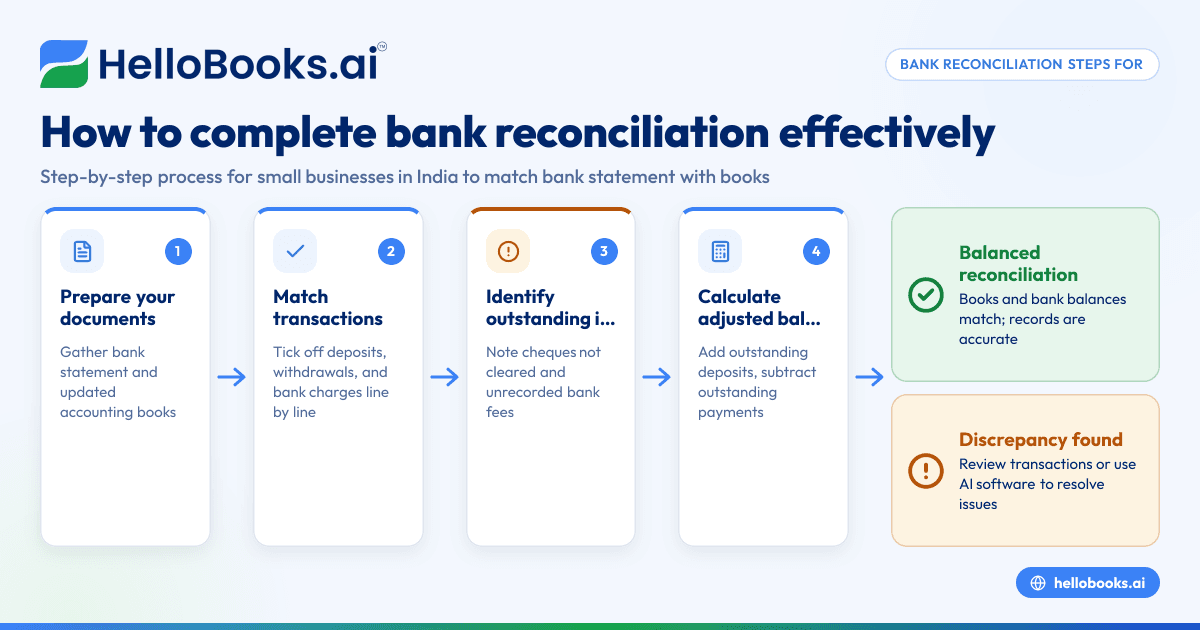
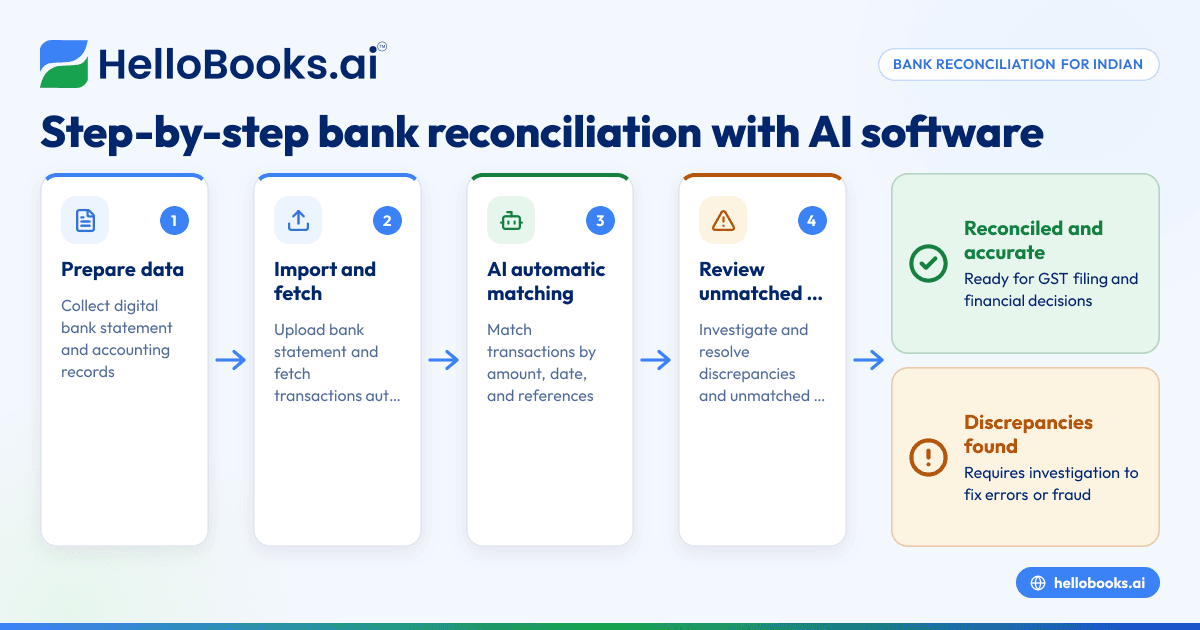
Step 4: What are the main bank reconciliation steps?
- Import bank statement: Upload or sync your bank statement into the software automatically via bank APIs or upload options.
- Fetch accounting data: The software pulls transaction data from your accounting records or spreadsheets.
- Automatic matching: AI matches transactions based on amount, date, invoice number, or payment reference.
- Identify unmatched items: Review transactions that did not automatically match and investigate reasons.
- Record adjustments: Note bank charges, interest, or corrections in your books if missing.
- Resolve discrepancies: Check for duplicate entries, delayed payments, or errors, and fix your accounting or contact bank if needed.
- Confirm closing balance: Verify that after adjustments your books’ balance matches the bank closing balance.
Mistake people make: Not investigating unmatched transactions or ignoring small differences, which can accumulate.
Step 5: Can AI bank reconciliation handle GST and e-invoicing data?
Yes, advanced AI reconciliation software integrates with your GST return filing software and can link payment data to GST-compliant e-invoices. This helps ensure input tax credits claimed match payments and invoices recorded.
Mistake people make: Doing bank reconciliation separately from GST compliance, causing more mistakes in returns.
Worked example of bank reconciliation steps with AI software
Suppose your Pune-based small business has a bank statement for March showing a closing balance of ₹5,50,000. Your accounting data shows ₹5,40,000 as of 31/03/2024. You upload your bank statement PDF and fetch your accounting transactions into the AI bank reconciliation tool.
- The software matches ₹4,80,000 worth of sales receipts with bank credits.
- It finds ₹50,000 expenses recorded in accounting but missing from bank statement (likely pending payments).
- It detects ₹10,000 bank charges not recorded in books.
- You note ₹3,000 interest credited by the bank but missing in accounts.
After correcting the ₹10,000 bank charge and ₹3,000 interest entries in your books, and waiting for pending ₹50,000 expenses to clear from the bank, your reconciled books match the bank closing balance of ₹5,50,000 exactly.
You have now confirmed your accounts are accurate, ready for GST return filing confidently and for management decisions.
Should I continue manual reconciliation or switch fully to automated AI solutions?
Manual reconciliation is error-prone and time-consuming. AI solutions automate importing, matching, and flag discrepancies, saving up to 80% time.
Automated software helps scale your business, especially if you handle multiple bank accounts or numerous transactions monthly. It ensures timely GST compliance by accurately capturing payment details linked to invoices.
Consider transitioning to AI bank reconciliation soon to reduce stress and errors.
How do I get started with AI bank reconciliation software for my Indian small business?
Start by choosing AI accounting software that supports bank reconciliation and connects easily with your bank and accounting records. Many offer free trials or demos.
Make sure it supports relevant Indian banking formats, GST filing integration, and handles e-invoicing data.
If you want to explore options, you can compare plans or book a demo at HelloBooks AI to see how bank reconciliation can become faster, smarter, and less tiresome.
Bank reconciliation is a critical accounting task that keeps your business’s cash flow transparent and compliance smooth. Using AI-powered tools shifts this from a tedious monthly chore to a streamlined process, letting you focus on growing your business.
Get started today by gathering your bank statements and accounting data, then trying AI bank reconciliation software designed for Indian small businesses. With accuracy and efficiency on your side, your books will always be up to date and GST-ready.
Related reading
- accounting software for small business
- How AI Bookkeeping Software Can Simplify Bank Reconciliation for Small Businesses in the United States
- How Delaware Small-Business Owners Can Choose AI Accounting Software to Simplify Sales Tax and Bank Reconciliation
Read next
This article covers one part of a bigger topic. For the complete picture, read our guide to fully supported.