
Key takeaways
What this article covers, in order:
- Why this comes up / what goes wrong
- Step-by-step
- Example (fictional figures)
- Common mistakes
- Frequently asked questions
- Key takeaways
Software company accounting involves managing specific financial activities such as recognising revenue from software sales or services, maintaining GST-compliant invoicing, tracking expenses related to product development and operations, and handling payroll. Software startups must keep accurate books to comply with GST and company law and to make informed financial decisions.
Why this comes up / what goes wrong
Owners and accountants of software companies often face challenges because their accounting needs differ from traditional businesses. For example, a 12-person SaaS startup in Bengaluru, a services startup in Hyderabad, or a fintech company in Gurugram may have recurring revenue models, multiple service offerings, and complex GST scenarios. Using manual bookkeeping methods like Excel or Tally can cause errors in revenue recognition, incorrect GST filings, and difficulties in reconciliation. Additionally, managing payroll for technical staff and tracking capitalised expenses can be complicated.
Step-by-step
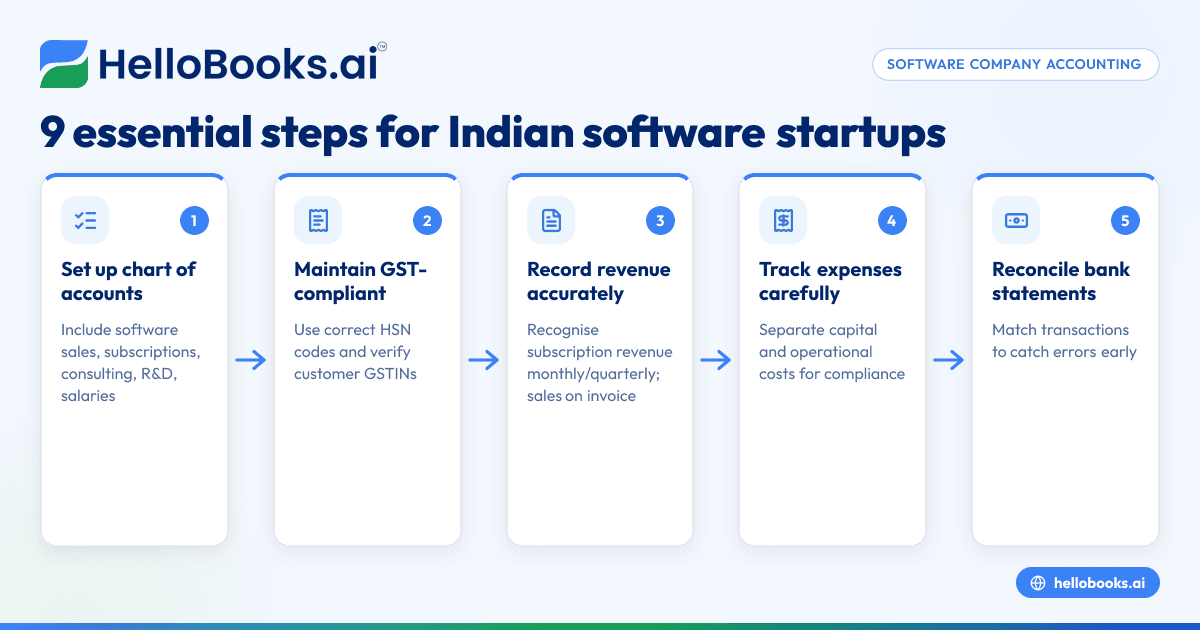
- Set up your chart of accounts tailored to software business: Include revenue streams such as software sales, subscriptions, and consulting services. Create expense categories for research and development (R&D), software licenses, salaries, marketing, and office expenses.
- Maintain GST-compliant invoicing: Issue GST invoices with correct HSN codes for software products and services. Verify the GSTIN details of your customers, especially for B2B sales, to ensure compliance.
- Record revenue accurately: For subscription-based models, recognise revenue monthly or quarterly as per contract terms. For one-time sales or consulting services, record revenue on the invoice date.
- Track expenses carefully: Record expenses related to software development, cloud services, office rent, salaries, and other overheads. Separate capital expenses from operational costs to comply with accounting standards.
- Reconcile bank statements monthly: Match your bank transactions with recorded sales and expenses to identify discrepancies early and correct errors promptly.
- Prepare and file GST returns: Compile your GSTR-1 and GSTR-3B returns with accurate invoice and tax details. Use GSTR-2B for input tax credit (ITC) reconciliation to ensure you claim the correct credits.
- Manage payroll accounting: Calculate salaries, provident fund (PF), professional tax, and other statutory deductions accurately. Record these transactions monthly to maintain compliance.
- Generate financial reports regularly: Review profit and loss statements, balance sheets, and cash flow reports to assess the financial health of your company.
- Conduct audits and compliance checks: Perform periodic internal audits to verify that your books comply with GST regulations and company law.
For more on software suited to your business needs, see accounting software for small business and accounting software in India.
Example (fictional figures)
Consider a SaaS startup in Bengaluru with 12 employees. In April 2024, it earned ₹5,00,000 from subscriptions and ₹2,00,000 from consulting services. Expenses include ₹1,50,000 for salaries, ₹50,000 for cloud services, and ₹30,000 for office rent.
- Subscription revenue = ₹5,00,000
- Consulting revenue = ₹2,00,000
- Total revenue = ₹5,00,000 + ₹2,00,000 = ₹7,00,000
- Salaries expense = ₹1,50,000
- Cloud services expense = ₹50,000
- Office rent expense = ₹30,000
- Total expenses = ₹1,50,000 + ₹50,000 + ₹30,000 = ₹2,30,000
- Gross profit = ₹7,00,000 - ₹2,30,000 = ₹4,70,000
Assuming an illustrative GST rate of 18%:
- GST collected on revenue = ₹7,00,000 × 18% = ₹1,26,000
- GST paid on expenses = ₹2,30,000 × 18% = ₹41,400
- Net GST payable = ₹1,26,000 - ₹41,400 = ₹84,600
This example highlights the importance of tracking revenue and expenses separately and calculating GST correctly.
Common mistakes
- Mixing revenue streams: Combining subscription and consulting revenues in one account can cause misreporting. Prevent this by using distinct ledger accounts for each revenue type.
- Incorrect GST classification: Using wrong HSN codes for software products and services leads to GST filing errors. Always verify and apply the correct HSN codes.
- Neglecting ITC reconciliation: Failing to reconcile GSTR-2B input tax credit can result in loss of eligible credits. Regularly check and reconcile ITC claims.
- Delayed bank reconciliation: Not reconciling bank statements monthly allows errors to accumulate. Schedule monthly reconciliations to catch discrepancies early.
- Ignoring payroll deductions: Omitting PF, professional tax, or other statutory deductions causes compliance issues. Ensure all deductions are calculated and recorded accurately.
- Manual data entry errors: Relying solely on Excel or manual methods increases the chance of mistakes. Consider software solutions tailored for startups as described in Startups and technology companies.
Frequently asked questions
What accounting software is best for software companies in India?
Software companies should use accounting software that handles GST compliance, invoicing, bank reconciliation, and payroll efficiently. Choose software designed for Indian tax laws and the specific needs of startups. Explore options in accounting software in India.
How should a software startup handle GST on subscription revenue?
Subscription revenue is treated as supply of services under GST. Issue GST-compliant invoices with the correct HSN code and file returns accurately. Your filing frequency depends on your GST scheme.
Can I manage software company accounting manually with Excel or Tally?
Yes, but manual methods require careful data entry and reconciliation to avoid errors. This can be time-consuming and prone to mistakes, especially for GST compliance. Software designed for startups can simplify these tasks.
What are the key reports a software company should generate?
Essential reports include profit and loss statements, balance sheets, cash flow statements, and GST reports. These help monitor financial health and ensure compliance.
Is payroll accounting different for software companies?
Payroll accounting involves standard salary calculations plus statutory deductions like PF and professional tax. Software companies may also track employee benefits or stock options separately.
Key takeaways
- Software company accounting requires tracking multiple revenue streams and GST compliance.
- Accurate invoicing with correct HSN codes is essential for GST filings.
- Regular bank reconciliation and ITC reconciliation prevent errors and loss of credits.
- Payroll accounting must include all statutory deductions.
- Manual accounting can be error-prone; consider software solutions suited for startups.
- Generate regular financial reports to monitor business performance.
Start managing your software company accounting efficiently by exploring options and starting on the Free plan (200 transactions a year, GSTR-1 and 3B filing for one GSTIN) at HelloBooks pricing.