


Key takeaways
What this article covers, in order:
- Why this comes up / what goes wrong
- Step-by-step
- Example (fictional figures)
- Common mistakes
- Frequently asked questions
- Key takeaways
Small and medium businesses (SMBs) in NC face challenges managing their accounting tasks like invoicing, GST filing, bank reconciliation, and expense tracking. Choosing the right accounting software can save time, reduce errors, and improve financial control. This article explains why SMB owners search for accounting software in NC, the step-by-step approach to selecting the right product, an example with Indian figures, common mistakes to avoid, and answers to frequently asked questions.
Why this comes up / what goes wrong
Many SMB owners in NC start with manual bookkeeping using spreadsheets, Tally, or physical bill books. This approach often leads to: frequent data entry errors, difficulty in reconciling bank statements and GST returns, delays in filing GSTR-1 and GSTR-3B, and lack of clear financial reports. As businesses grow, these issues become more time-consuming and costly. The search for SMB accounting software in NC arises to find a solution that automates repetitive tasks, ensures GST compliance, and provides accurate financial insights.
Step-by-step
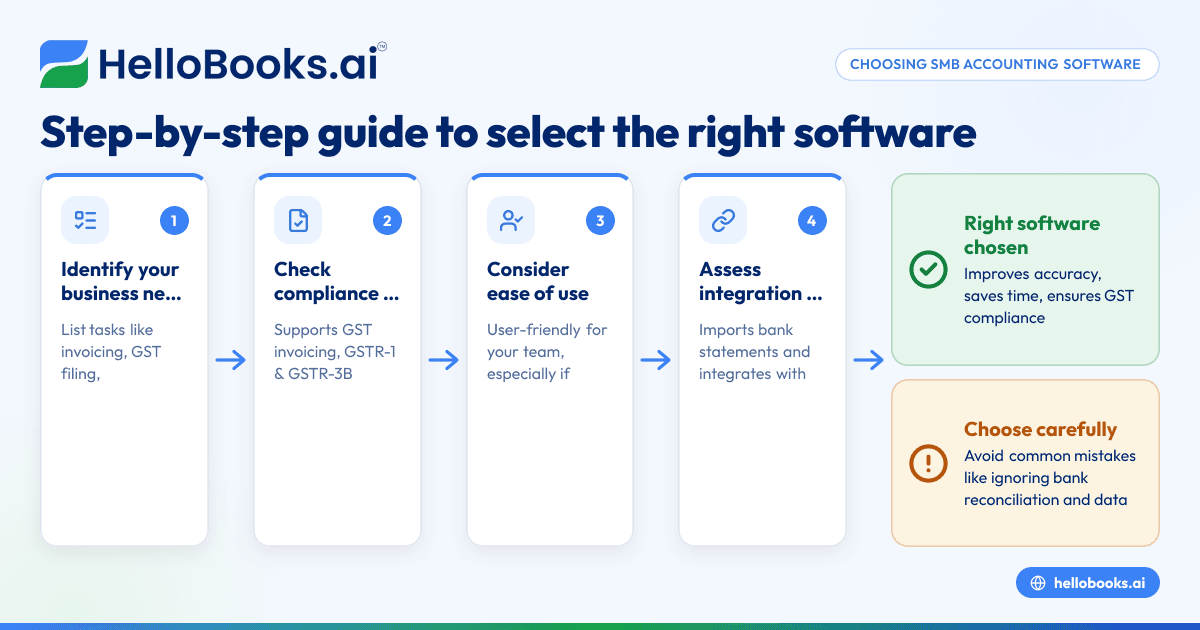
- Identify Your Business Needs: List your accounting tasks such as invoicing, GST filing, bank reconciliation, inventory tracking, and report generation. Check if you need multi-GSTIN support or e-invoicing features.
- Check Compliance Features: Ensure the software supports GST invoicing rules, GSTR-1 and GSTR-3B filing, and bank statement reconciliation. For example, a tax invoice must contain supplier and recipient details, HSN/SAC codes, tax rates, and signatures as per Rule 46 [cgst-rule-46/rule46-particulars].
- Consider Ease of Use: Evaluate if the software is user-friendly for your team, especially if you currently use spreadsheets or Tally.
- Assess Integration Options: Check if the software can import bank statements or integrate with your existing tools.
- Evaluate Support and Training: Look for vendors offering prompt customer support and training resources.
- Compare Pricing and Plans: Review subscription costs, transaction limits, and additional charges.
- Test with a Trial or Demo: Use trial versions to test key features and user experience.
- Verify Data Security: Confirm how your financial data is protected.
For more details on accounting software tailored for small businesses in India, see accounting software for small business and accounting software in India.
Example (fictional figures)
Consider "ABC Traders," a small business in NC, selling goods with an aggregate turnover of ₹4,50,00,000 in FY 2023-24. They want software to manage GST invoicing and filing.
- Invoice value: ₹1,00,000 (assumed GST rate 18%)
- CGST @ 9% = ₹1,00,000 × 9% = ₹9,000
- SGST @ 9% = ₹1,00,000 × 9% = ₹9,000
- Total tax = ₹9,000 + ₹9,000 = ₹18,000
- Total invoice value = ₹1,00,000 + ₹18,000 = ₹1,18,000
ABC Traders needs software that can generate invoices with all mandatory details, track these taxes accurately, and prepare GSTR-1 and GSTR-3B returns for filing. Since their turnover is below ₹5 crore, e-invoicing is not mandatory yet.
Common mistakes
- Ignoring GST Compliance Requirements: Not verifying if software supports all GST rules can lead to incorrect invoices or filing errors. Prevent by checking for mandatory invoice fields and filing features.
- Choosing Software Without Bank Reconciliation: Manual reconciliation is error-prone. Avoid this by selecting software that supports bank statement import and reconciliation.
- Overlooking User-Friendliness: Complex software can slow down your team. Test usability with demos before deciding.
- Not Considering Future Growth: Software that fits today may not scale. Choose a product that can handle multiple GSTINs and higher transaction volumes.
- Ignoring Data Security: Financial data is sensitive. Confirm encryption and backup policies.
- Skipping Support Checks: Lack of vendor support can delay issue resolution. Ensure help is available when needed.
For more on avoiding such errors, see HelloBooks for India.
Frequently asked questions
What is the best financial accounting software in NC for SMBs?
The best software depends on your specific needs like GST compliance, invoicing, and bank reconciliation. Look for products that offer ease of use, GST filing support, and integration with your bank statements. Trial versions can help you decide.
Can corporate accounting software be used by small businesses in NC?
Corporate accounting software often has advanced features and higher costs. Small businesses may find simpler SMB-focused software more suitable and affordable.
What accounting systems software options exist for NC businesses?
Options range from spreadsheet-based manual systems to dedicated accounting software with GST compliance, invoicing, and reporting features. Cloud-based software is popular for accessibility and automated updates.
Do I need e-invoicing if my turnover is below ₹5 crore?
As per current rules, e-invoicing is mandatory only if aggregate turnover exceeds ₹5 crore in any financial year [einvoice-threshold-5cr/einv-5cr-from-2023-08-01]. Below this, traditional GST invoices suffice.
How can I ensure my chosen software meets GST invoice rules?
Verify that the software generates invoices containing all details required by Rule 46, including supplier and recipient GSTIN, HSN/SAC codes, tax rates, and signatures [cgst-rule-46/rule46-particulars].
Key takeaways
- Identify your business needs and GST compliance requirements before choosing software.
- Check for mandatory GST invoice fields and filing capabilities.
- Test software usability and support options through demos or trials.
- Avoid common mistakes like ignoring bank reconciliation and data security.
- Consider scalability to accommodate future business growth.
- Use trusted sources to verify GST rules and e-invoicing thresholds.
Choosing the right SMB accounting software in NC can streamline your bookkeeping and GST compliance. Start your search by evaluating features against your needs and testing software with trials.
To begin, you can Start on the Free plan (200 transactions a year, GSTR-1 and 3B filing for one GSTIN).


