


Key takeaways
What this article covers, in order:
- Why this comes up / what goes wrong
- Step-by-step
- Example (fictional figures)
- Common mistakes
- Frequently asked questions
- Key takeaways
Retail finance software with built-in audit automation is designed to help retail businesses manage their finances with less manual effort and greater accuracy. This software automates key audit tasks such as transaction verification, reconciliation, and compliance checks, which are critical for retail shops handling numerous daily transactions. This article covers why retail businesses need this software, the steps to choose the right solution, a fictional example, common mistakes, and frequently asked questions.
Why this comes up / what goes wrong
Retail business owners and accountants in India often manage large volumes of daily sales, expenses, and GST compliance tasks. Many still use spreadsheets, Tally, or manual bill books, which can lead to errors, missed deadlines, and time-consuming reconciliations. Retail shops like kirana stores, mobile accessories outlets, or apparel stores face challenges such as:
- Managing multiple sales channels and outlets.
- Ensuring GST invoices and returns are accurate and timely.
- Reconciling bank statements and supplier payments.
- Detecting discrepancies before audits.
Without automation, these tasks involve repetitive data entry and manual checks, increasing the risk of errors and penalties. Retail finance software with built-in audit automation addresses these pain points by streamlining data entry, automatically verifying transactions against GST returns, and flagging mismatches early.
Step-by-step
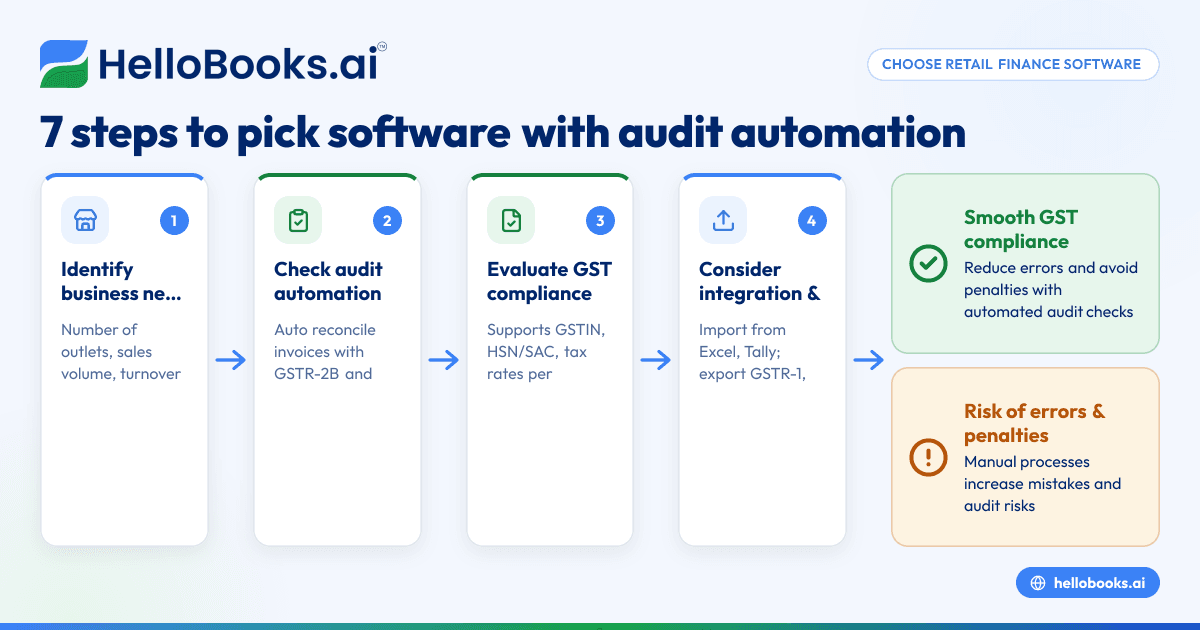
- Identify your retail business needs
- Determine the number of outlets, sales volume, and complexity of inventory.
- Check if your turnover requires e-invoicing compliance (₹5 crore+ turnover) or if you qualify for QRMP scheme for GST filing.
- Check for audit automation features
- Look for software that automatically reconciles sales invoices with GSTR-2B and bank statements.
- Ensure it flags discrepancies and missing invoices to reduce manual audit preparation.
- Evaluate GST compliance support
- Confirm the software supports GST invoicing with mandatory details like GSTIN, HSN/SAC codes, and tax rates as per Rule 46 [cgst-rule-46/rule46-particulars].
- Check if it supports e-invoicing with IRN and QR code generation for eligible businesses [cgst-rule-46/rule46-qr-irn].
- Consider integration and usability
- Assess if the software can import data from your current systems (Excel, Tally, bill books).
- Check for easy export of GST returns (GSTR-1, GSTR-3B) and reports.
- Review security and data backup
- Ensure data security measures and regular backups to protect your financial data.
- Request demos and trial periods
- Test the software with your business data to see how audit automation works in practice.
- Compare pricing and support
- Balance cost against features and customer support availability.
For more on retail business needs, see Retail shops. For GST invoicing details, visit GST invoicing.
Example (fictional figures)
Consider a kirana store in Indore with a monthly turnover of ₹12,00,000. The store issues GST invoices for B2B sales and files monthly GSTR-1 and GSTR-3B.
- Total sales value (taxable): ₹12,00,000
- GST rate assumed: 12% (6% CGST + 6% SGST)
Calculate GST amount:
₹12,00,000 × 12% = ₹1,44,000
Total invoice value including GST:
₹12,00,000 + ₹1,44,000 = ₹13,44,000
The software automatically generates invoices with all mandatory details and a unique serial number as per Rule 46 [cgst-rule-46/rule46-particulars]. It cross-checks invoices against bank deposits and supplier bills to identify discrepancies.
If the store misses an invoice in GSTR-1, the audit automation flags this by comparing with GSTR-2B data, helping prevent GST notice risks.
Common mistakes
- Ignoring audit automation in software selection
- Prevent by prioritizing software with automatic reconciliation and discrepancy alerts.
- Not verifying e-invoice compliance requirements
- Prevent by checking if your turnover exceeds ₹5 crore and ensuring software supports IRN and QR codes [cgst-rule-46/rule46-qr-irn], [einvoice-threshold-5cr/einv-5cr-from-2023-08-01].
- Failing to update GST rates and HSN/SAC codes
- Prevent by choosing software with regular tax updates and HSN/SAC code management.
- Relying solely on manual data entry
- Prevent by importing data from sales systems and bank statements to reduce errors.
- Skipping regular audits and reconciliations
- Prevent by scheduling periodic automated checks and reviewing flagged issues.
- Overlooking multi-outlet consolidation
- Prevent by selecting software that supports multiple outlets and consolidated reports.
Frequently asked questions
What is audit automation in retail finance software?
Audit automation refers to software features that automatically verify transactions, reconcile invoices with GST returns and bank statements, and highlight inconsistencies, reducing manual effort and errors.
Can retail finance software handle GST e-invoicing?
Yes, software designed for Indian retail businesses supports GST e-invoicing for businesses with turnover over ₹5 crore, generating IRN and QR codes as per government rules [einvoice-threshold-5cr/einv-5cr-from-2023-08-01].
How does audit automation help with GST compliance?
It ensures invoices contain all mandatory details like GSTIN, HSN/SAC codes, and tax rates [cgst-rule-46/rule46-particulars], and reconciles supplier and buyer data to prevent mismatches before filing GSTR-1 and GSTR-3B.
Is audit automation useful for small kirana stores?
Yes, even small retail shops benefit by saving time on data entry and reducing errors, especially if they file monthly GST returns and want to avoid penalties.
What should I ask before choosing retail finance software?
Ask about audit automation capabilities, GST compliance features, ease of use, data import/export options, and support for multiple outlets. Also, check if it supports your filing scheme, like QRMP for turnover under ₹5 crore [qrmp-scheme/qrmp-eligibility-5cr].
Key takeaways
- Retail finance software with built-in audit automation reduces manual errors and speeds up GST compliance.
- Check for automatic invoice reconciliation with GSTR-2B and bank statements.
- Ensure software supports GST invoicing rules, e-invoicing, and updates tax rates regularly.
- Avoid manual data entry by importing sales and bank data.
- Audit automation helps retail shops of all sizes, from kirana stores to multi-outlet apparel shops.
- Ask about multi-outlet support, compliance features, and ease of use before choosing software.
Choosing the right retail finance software with built-in audit automation can save time and reduce risks for your retail business. For detailed pricing and plans tailored for Indian retail businesses, visit Compare plans for India.
This article is general information, not tax or legal advice. Rules change; confirm the current position on gst.gov.in or with your chartered accountant before acting.


