
Key takeaways
What this article covers, in order:
- Why this comes up / what goes wrong
- Step-by-step
- Example (fictional figures)
- Common mistakes
- Frequently asked questions
- Key takeaways
Retail finance software is designed to help retail businesses such as kirana stores, mobile accessories shops, and apparel outlets manage their finances, GST filing, invoicing, and stock tracking more efficiently. Retailers often struggle with manual bookkeeping, errors in GST returns, and time-consuming reconciliation. This guide covers why retail finance software is essential, the steps to choose one, a practical example for a kirana store in Indore, common pitfalls, and answers to frequently asked questions.
Why this comes up / what goes wrong
Retail business owners and accountants, especially in small and growing shops, often keep their books in spreadsheets, Tally, or manual bill books. This leads to problems such as:
- Time-consuming data entry and reconciliation that takes away from focusing on sales and customer service.
- Errors in GST invoicing and filing, especially with forms like GSTR-1 and GSTR-3B, causing compliance risks.
- Difficulty managing inventory alongside finance records, leading to stock mismatches and loss.
- Lack of integration between sales, purchases, and GST compliance, resulting in duplicate work.
- Challenges in tracking input tax credit (ITC) due to mismatched invoices and delayed reconciliation with GSTR-2B.
For instance, a kirana store in Indore manually records daily sales and purchases, which causes delays in GST filing and errors in tax calculations. Without automation, the owner spends hours reconciling bank statements and matching invoices with GSTR-2B, increasing the chance of mistakes and penalties.
Selecting the right retail finance software can reduce these issues by automating invoicing, GST filing, bank reconciliation, and inventory tracking. It also helps ensure compliance and saves time, allowing shop owners to focus on growing their business.
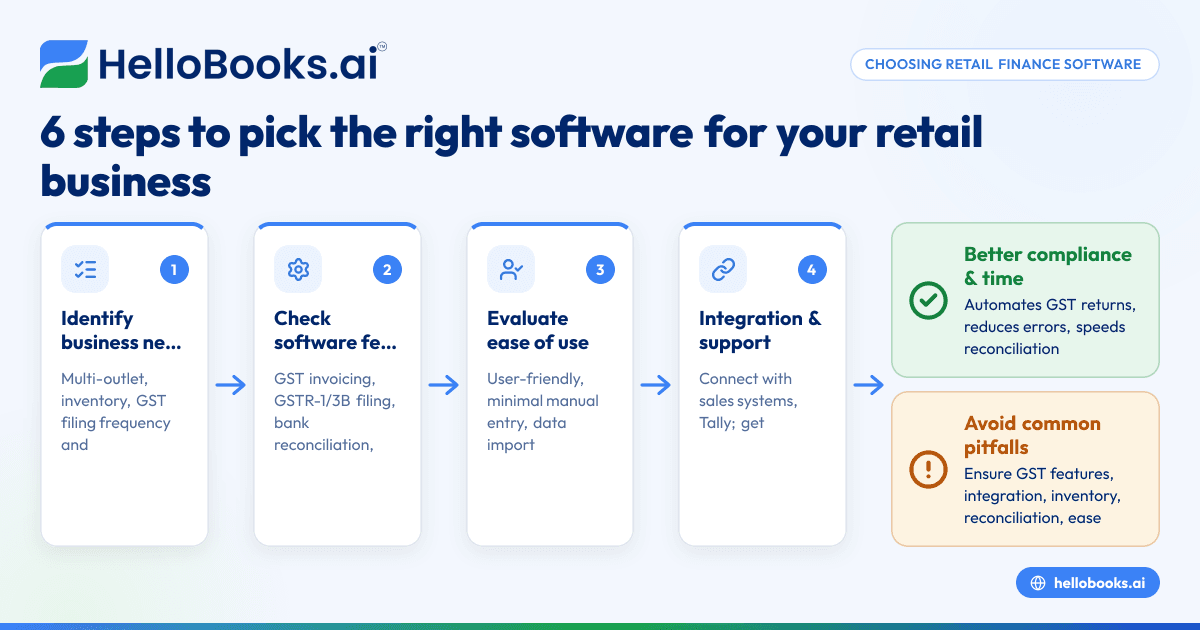
Step-by-step
- Identify your business needs:
- Check if you need multi-outlet management (for example, an apparel store with two outlets in Lucknow).
- Determine if you require inventory tracking alongside finance, crucial for retail items with HSN/SAC codes.
- Assess your GST filing complexity, whether monthly or quarterly, and the types of returns you must file.
- Check software features:
- Must support GST invoicing and e-invoicing, to comply with legal requirements.
- Should handle GSTR-1, GSTR-3B filing and GSTR-2B reconciliation automatically.
- Look for bank statement reconciliation capabilities to simplify month-end closing.
- Verify inventory management suited for retail items, including stock alerts and HSN/SAC code support.
- Evaluate ease of use:
- User-friendly interface for shop owners or accountants who may not be tech-savvy.
- Minimal manual data entry; support for uploading bank statements or importing data from existing tools like Tally or Excel.
- Integration and support:
- Check if the software integrates with your existing sales system or Tally to avoid duplicate data entry.
- Look for customer support and help with GST compliance queries.
- Cost and scalability:
- Consider the pricing plans based on your business size and growth plans.
- Ensure the software can scale as your business expands or adds outlets.
- Trial and feedback:
- Use trial versions or demos to assess suitability.
- Get feedback from your accounting team or external accountant to confirm it meets your needs.
For more details on retail business accounting and GST invoicing, see Retail shops and GST invoicing.
Example (fictional figures)
Consider a kirana store in Indore with the following monthly transactions for March 2024:
- Sales (taxable): ₹1,50,000
- Purchases (taxable): ₹90,000
- GST rate assumed: 12%
Calculations:
GST on Sales = ₹1,50,000 × 12% = ₹18,000
GST on Purchases = ₹90,000 × 12% = ₹10,800
Net GST payable = GST on Sales - GST on Purchases = ₹18,000 - ₹10,800 = ₹7,200
The store owner uses finance software to generate GSTR-1 and GSTR-3B returns automatically, upload bank statements for reconciliation, and track inventory movement.
This reduces manual errors and speeds up GST filing, helping the kirana store stay compliant and save time.
Common mistakes
- Ignoring GST compliance features:
- Prevent by choosing software with built-in GST invoicing and filing to avoid penalties.
- Not checking software compatibility with existing systems:
- Prevent by verifying integration options with tools like Tally or Excel to maintain workflow continuity.
- Overlooking inventory management needs:
- Prevent by selecting software that supports HSN/SAC coding and stock tracking to avoid stockouts or excess inventory.
- Choosing software without bank reconciliation:
- Prevent by ensuring bank statement upload and reconciliation features are included to simplify month-end closing.
- Not considering the learning curve:
- Prevent by opting for user-friendly software or providing proper training to staff.
- Ignoring multi-outlet management needs:
- Prevent by selecting software that consolidates accounts and inventory across locations, important for shops like apparel outlets with multiple branches.
See more on GST invoicing and Retail shops for retail business accounting.
Frequently asked questions
What is the best finance automation software for retail?
The best software depends on your specific needs, such as GST compliance, inventory management, and ease of use. Look for software that automates GST invoicing, filing, and bank reconciliation to save time and reduce errors.
Can retail finance software handle multi-outlet stores?
Yes, many retail finance software options support multiple outlets and help consolidate accounts and inventory across locations, useful for apparel stores with two or more outlets.
How does retail finance software help with GST filing?
It automates the generation of GSTR-1 and GSTR-3B returns, reconciles GSTR-2B input tax credit, and reduces manual errors, ensuring timely and accurate GST compliance.
Is it necessary to switch from Tally or Excel to retail finance software?
While Tally and Excel can work, dedicated retail finance software offers automation, integration, and features tailored for retail GST invoicing and inventory, saving time and improving accuracy.
How can I ensure my retail finance software is secure?
Choose software with secure data handling, regular backups, and user access controls. Verify the provider’s security policies and compliance standards.
See also Retail shops for more on retail accounting.
Key takeaways
- Retail finance software automates accounting, GST invoicing, filing, and inventory management.
- Evaluate software based on GST compliance features, integration, ease of use, and cost.
- Avoid common mistakes like ignoring GST features or lacking bank reconciliation.
- Multi-outlet retail businesses need software that consolidates accounts and inventory.
- Testing software before purchase helps ensure it fits your business needs.
- Integration with existing systems like Tally or Excel can ease transition.
Choosing the right retail finance software can simplify your accounting and GST compliance tasks. For detailed pricing and plans suitable for Indian retail businesses, visit Compare plans for India.