
Key takeaways
What this article covers, in order:
- Why this comes up / what goes wrong
- Step-by-step
- Example (fictional figures)
- Common mistakes
- Doing this in HelloBooks
- Frequently asked questions
Restaurant billing software is essential for Indian restaurants, cloud kitchens, and bakeries to streamline billing, comply with GST rules, and manage customer orders efficiently. This article covers why restaurant owners and accountants search for such software, step-by-step guidance on choosing the right solution, a worked example with figures, common mistakes to avoid, and how HelloBooks supports GST invoicing and e-invoicing.
Why this comes up / what goes wrong
Restaurant owners and accountants often struggle with manual billing using spreadsheets, bill books, or Tally because these methods are time-consuming and prone to errors. They need billing software that handles GST compliance, including correct CGST/SGST/IGST tax splits, HSN/SAC codes, and e-invoicing if applicable. For cloud kitchens on platforms like Swiggy and Zomato, managing multiple orders and generating invoices quickly is crucial. Without proper software, reconciling payments, tracking inventory, and filing GST returns become difficult, leading to lost revenue and penalties.
Step-by-step
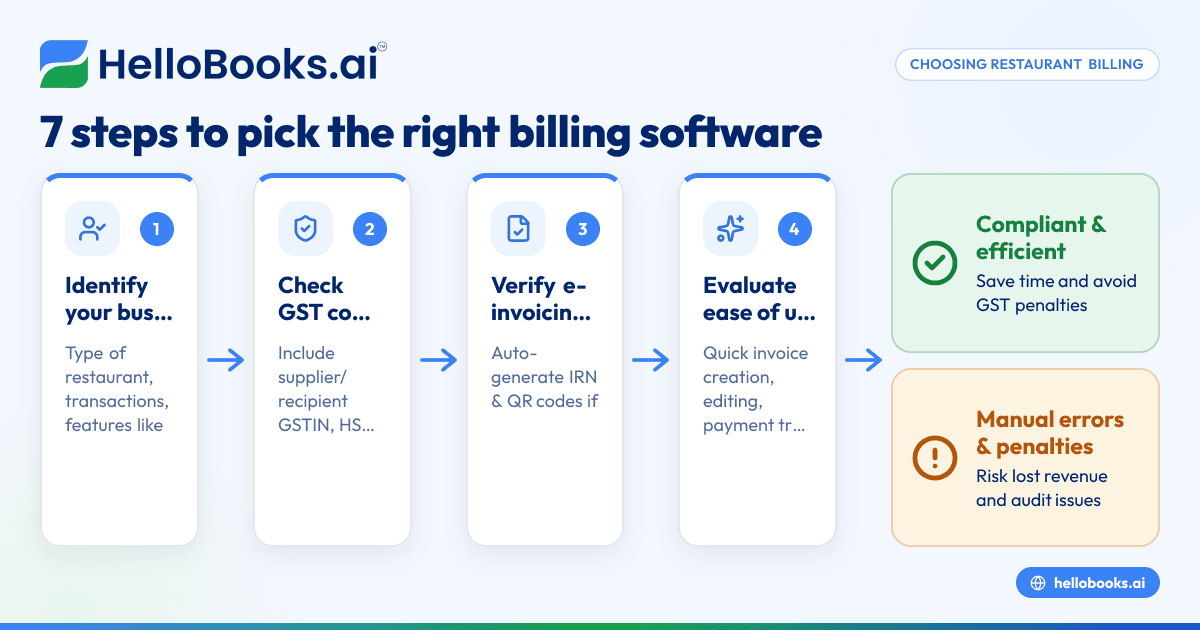
- Identify your business needs: Consider your restaurant type (dine-in, cloud kitchen, bakery), number of daily transactions, and whether you need features like table management or online ordering integration.
- Check GST compliance features: Ensure the software generates tax invoices with all Rule 46 particulars: supplier and recipient GSTIN, HSN/SAC codes, tax amounts, and place of supply. For invoices above ₹50,000 to unregistered recipients, recipient details and delivery address must be included. See GST invoicing.
- Verify e-invoicing support: If your aggregate turnover exceeded ₹5 crore in any financial year from 2017-18 onwards, the software must generate e-invoices with IRN and QR codes automatically. This saves time compared to manual JSON uploads. Learn more about e-invoicing software.
- Evaluate ease of use: The software should allow quick invoice creation, easy editing, and clear payment tracking. It should support printing or emailing invoices in PDF format.
- Consider integration options: Check if the software can integrate with your accounting system or bank statement uploads to help with reconciliation.
- Compare pricing and plans: Look for plans that suit your transaction volume and GSTIN count without hidden costs.
- Test customer support and updates: Reliable support and compliance updates are essential for smooth operation.
Example (fictional figures)
A 40-seat restaurant in Pune generates the following bill on 15/04/2024:
- Food items total: ₹4,00,000
- GST rate assumed: 5% CGST and 5% SGST
Calculations:
Taxable value = ₹4,00,000
CGST = ₹4,00,000 × 5% = ₹20,000
SGST = ₹4,00,000 × 5% = ₹20,000
Total invoice value = ₹4,00,000 + ₹20,000 + ₹20,000 = ₹4,40,000
The invoice includes:
- Supplier name, address, GSTIN
- Recipient name, address, GSTIN
- Invoice date and unique serial number
- HSN codes for food items
- Taxable value and tax amounts
- Place of supply (Maharashtra)
- Signature or digital signature
If the turnover exceeds ₹5 crore, the software would generate an IRN and QR code embedded in the invoice PDF.
Common mistakes
- Ignoring GST invoice particulars: Missing details like recipient GSTIN or HSN codes can lead to non-compliance. Use software that auto-fills these fields based on customer data. Prevent by verifying invoice fields before saving.
- Not enabling e-invoicing when required: Businesses with turnover above ₹5 crore must generate e-invoices for B2B sales. Missing this leads to penalties. Prevent by checking turnover thresholds and enabling e-invoicing features.
- Using generic billing software: Software not tailored for restaurants may lack features like order management or fast billing. Prevent by choosing industry-specific solutions like those for restaurants, cafes and cloud kitchens.
- Manual data entry errors: Re-entering data from orders or payments causes mistakes and wastes time. Prevent by using software with import or API options.
- Neglecting invoice numbering rules: GST Rule 46 requires unique serial numbers per financial year. Prevent by using software that auto-generates compliant serial numbers.
- Skipping recipient details for unregistered buyers above ₹50,000: This is mandatory and often overlooked. Prevent by ensuring the software prompts for these details as per Rule 46.
Doing this in HelloBooks
HelloBooks offers GST invoicing that creates compliant tax invoices with the correct CGST/SGST or IGST split and HSN/SAC codes from the customer's GSTIN, ensuring all Rule 46 fields are filled consistently. For businesses above the ₹5 crore e-invoicing threshold, it automatically generates the Invoice Reference Number (IRN) and signed QR code on saving a B2B invoice, saving time compared to manual uploads. This integration helps restaurants maintain compliance easily and focus on their core operations. Learn more about GST invoicing.
Frequently asked questions
What features should restaurant billing software have?
Look for GST-compliant invoicing with CGST/SGST/IGST splits, HSN/SAC code support, e-invoicing if your turnover exceeds ₹5 crore, quick invoice generation, payment tracking, and easy editing. Integration with accounting and order management systems is a plus.
Is e-invoicing mandatory for restaurants?
If your aggregate turnover exceeds ₹5 crore in any financial year from 2017-18 onwards, you must issue e-invoices for B2B supplies with effect from 1 August 2023. This includes generating an IRN and QR code on each invoice.
Can cloud kitchens use restaurant billing software?
Yes, cloud kitchens benefit from billing software that manages multiple delivery orders, integrates with platforms like Swiggy and Zomato, and generates GST-compliant invoices quickly.
How does GST invoicing software help with compliance?
It ensures all invoice particulars required by Rule 46 are included, such as supplier and recipient GSTIN, HSN/SAC codes, tax amounts, and invoice numbering. This reduces errors and audit risks.
Can I use HelloBooks for restaurant billing?
HelloBooks supports GST invoicing with all compliance features and e-invoicing for eligible businesses. It automates tax calculations and helps generate compliant invoices efficiently.
Key takeaways
- Choose billing software that generates GST-compliant invoices with correct tax splits and HSN/SAC codes.
- Enable e-invoicing if your turnover exceeds ₹5 crore to comply with the latest GST rules.
- Avoid manual data entry errors by using software with import and integration features.
- Use industry-specific software tailored for restaurants, cloud kitchens, or bakeries.
- Verify invoice particulars as per Rule 46 to prevent compliance issues.
Selecting the right restaurant billing software simplifies your billing, improves compliance, and saves time. Explore HelloBooks for India to see how it can help your business. For pricing details, Compare plans for India.