
Key takeaways
What this article covers, in order:
- Why this comes up / what goes wrong
- Step-by-step
- Example (fictional figures)
- Common mistakes
- Doing this in HelloBooks
- Frequently asked questions
Project accounting software for media and production agencies must focus on tracking costs and revenues per project, managing budgets, and simplifying GST compliance. Media and production businesses often juggle multiple projects with complex billing and expense tracking needs.
Why this comes up / what goes wrong
Media and production agencies face challenges managing multiple projects simultaneously. Each project has unique expenses like equipment rental, talent fees, location costs, and post-production charges. Without dedicated software, owners or accountants struggle with:
- Tracking actual costs versus budgets per project.
- Managing invoices and payments linked to specific projects.
- Reconciling GST input tax credit (ITC) and filing returns accurately.
- Avoiding manual errors in spreadsheets or Tally.
These issues lead to delayed billing, missed ITC claims, and inaccurate financial reports, which hurt profitability and compliance.
Step-by-step
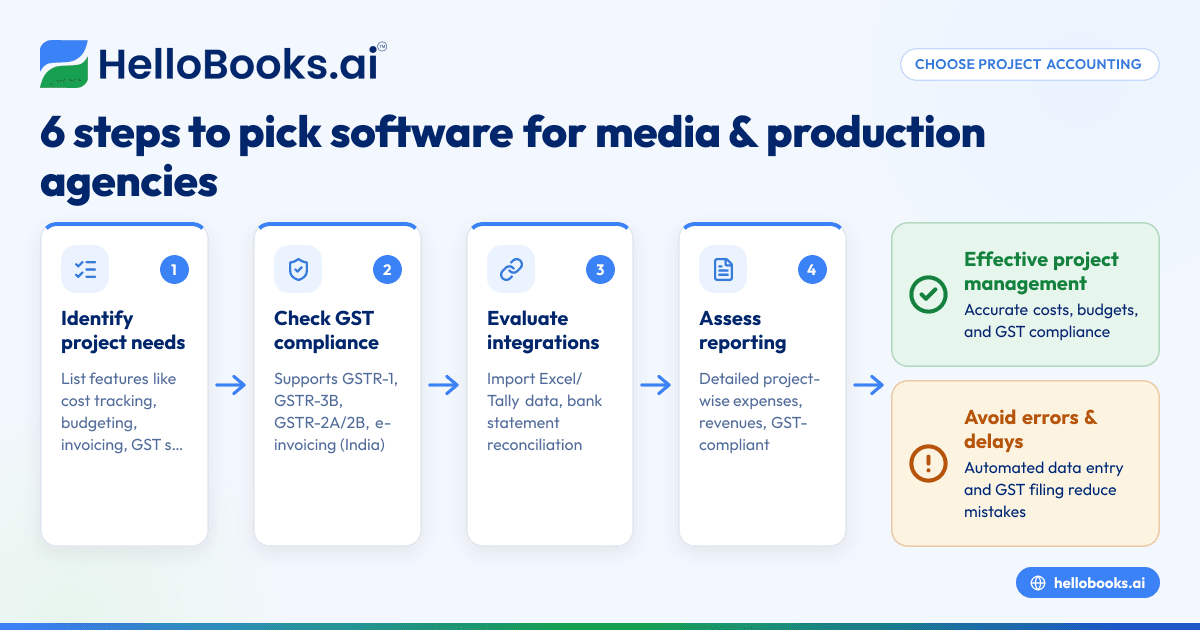
- Identify your project accounting needs:
- List key features such as project cost tracking, budget management, invoicing, and GST compliance.
- Check if the software supports multiple projects and cost centres.
- Check GST compliance features:
- Ensure the software supports GSTR-1 and GSTR-3B filing.
- Look for GSTR-2A/2B reconciliation to track supplier invoices and ITC.
- Verify if e-invoicing with IRN and QR code generation is available for businesses over ₹5 crore turnover.
- Evaluate integration with existing tools:
- Confirm if the software can import data from Excel or Tally.
- Check for bank statement upload and reconciliation features.
- Assess reporting capabilities:
- Look for detailed project-wise expense and revenue reports.
- Ensure financial reports are GST-compliant and easy to generate.
- Consider ease of use and support:
- Choose software with a simple interface.
- Check customer support availability and training resources.
- Compare pricing and scalability:
- Review plans and transaction limits.
- Ensure the software can grow with your business.
For more on choosing software for small businesses, see accounting software for small business and accounting software in India.
Example (fictional figures)
Consider an auto-components MSME in Pune managing a project for ₹12,00,000 with expenses and GST as follows:
- Project revenue: ₹12,00,000
- Expenses:
- Raw materials: ₹5,00,000 + CGST 9% + SGST 9%
- Labour: ₹2,00,000 + IGST 18%
- Equipment rental: ₹1,00,000 + CGST 9% + SGST 9%
Calculate GST on expenses:
Raw materials CGST = ₹5,00,000 × 9% = ₹45,000
Raw materials SGST = ₹5,00,000 × 9% = ₹45,000
Labour IGST = ₹2,00,000 × 18% = ₹36,000
Equipment rental CGST = ₹1,00,000 × 9% = ₹9,000
Equipment rental SGST = ₹1,00,000 × 9% = ₹9,000
Total GST on expenses = ₹45,000 + ₹45,000 + ₹36,000 + ₹9,000 + ₹9,000 = ₹1,44,000
Total expenses including GST = ₹5,00,000 + ₹2,00,000 + ₹1,00,000 + ₹1,44,000 = ₹9,44,000
Project profit before other costs = ₹12,00,000 - ₹9,44,000 = ₹2,56,000
This example shows how detailed tracking helps calculate project profitability and GST input tax credit.
Common mistakes
- Not tracking costs at the project level: Leads to inaccurate profitability analysis. Prevent by setting up projects and cost centres in software.
- Ignoring GST reconciliation: Missing supplier invoices can cause ITC denial. Use GSTR-2B reconciliation tools.
- Manual data entry errors: Cause mismatches in returns. Prevent by automating invoice and expense entry.
- Using software without e-invoicing when required: For businesses over ₹5 crore turnover, missing e-invoicing leads to non-compliance. Choose software with IRN and QR code generation.
- Overlooking report customization: Generic reports may not show project-wise data. Ensure software offers detailed project reports.
- Not verifying software scalability: Leads to switching costs later. Pick software that supports multiple GSTINs and grows with your business.
See Manufacturing for industry-specific needs.
Doing this in HelloBooks
HelloBooks supports project accounting needs relevant to media and production agencies by offering:
- E-invoicing (IRN and signed QR): For businesses over ₹5 crore turnover, HelloBooks generates IRN and signed QR codes at invoice save, embedding them in PDFs and handling NIC rejections.
- GSTR-1 and GSTR-3B direct filing: Returns are built from recorded invoices, ensuring figures match issued invoices without manual JSON uploads.
- GSTR-2A/2B reconciliation and ITC tracking: Automatically flags missing or mismatched supplier invoices before claiming ITC in GSTR-3B.
Learn more at HelloBooks for India.
Frequently asked questions
What features should media and production agencies look for in project accounting software?
Look for project cost tracking, budget management, GST compliance (GSTR-1/3B filing, e-invoicing), invoice and expense management, and detailed reporting.
Can I use HelloBooks if my turnover is below ₹5 crore?
Yes, HelloBooks offers GSTR-1 and GSTR-3B filing for one GSTIN on the Free plan, but e-invoicing with IRN is for businesses above the ₹5 crore threshold.
How does GSTR-2B reconciliation help my business?
It helps identify missing or mismatched supplier invoices before claiming ITC, reducing errors and avoiding GST penalties.
Is it possible to import data from Excel or Tally into HelloBooks?
HelloBooks supports uploading invoices and expenses, which can ease migration from Excel or Tally, reducing manual entry.
How do I handle multiple projects in HelloBooks?
While HelloBooks focuses on GST compliance and invoicing, you can tag invoices and expenses to projects using cost centres or categories to track project-wise finances.
Key takeaways
- Project accounting software must track costs, budgets, invoices, and GST compliance per project.
- Check for GSTR-1/3B filing, e-invoicing, and GSTR-2B reconciliation features.
- Avoid manual errors by automating data entry and GST return filing.
- Use detailed reports to analyse project profitability.
- Choose scalable software that supports multiple GSTINs and integrates with existing tools.
Start managing your media or production projects with software that simplifies GST compliance. Start on the Free plan (200 transactions a year, GSTR-1 and 3B filing for one GSTIN).