
Key takeaways
What this article covers, in order:
- What documents and data should I gather first?
- How do I review my books for accuracy before the audit?
- What are common questions auditors ask, and how should I prepare?
- How does AI preparing books simplify the audit process?
- What compliance checks should I complete before submitting for audit?
- Common gaps we see small businesses miss
Preparing Books for a Statutory Audit in India: A Practical Guide for Small Businesses
======================================================================================
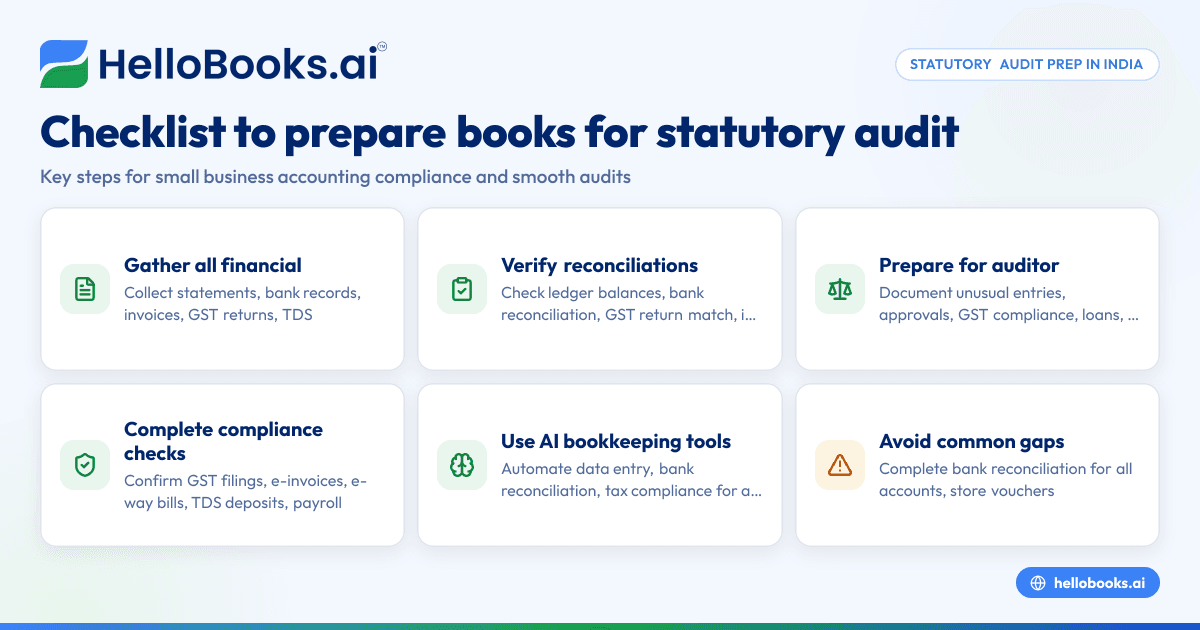
If you run a small business in India, preparing books for a statutory audit can feel overwhelming. This checklist helps you tackle the essential steps and avoid last-minute stress. Following it ensures your accounting records are complete, accurate, and compliant with the Companies Act and other regulations. It also sets you up for a smooth audit experience.
Why should you use this checklist? Because statutory audits require reconciling financial statements, verifying compliance, and demonstrating transparency. Many small businesses lose time fixing avoidable gaps. This guide addresses those by highlighting practical tasks, common pitfalls, and how technology can assist you.
What documents and data should I gather first?
Start by collecting all your core financial statements and source documents that back your accounting records. This sets a strong foundation for audit verification.
- [ ] Collect all financial statements including trial balance, profit & loss account, and balance sheet. These form the basis for audit verification.
- [ ] Gather bank statements for all business accounts for the financial year under audit. Bank reconciliation confirms financial accuracy.
- [ ] Assemble purchase bills, sales invoices, and expense vouchers. Supporting documents prove the authenticity of ledger entries.
- [ ] Compile GST returns filed during the year and associated e-way bills. These records are mandatory for tax compliance verification.
- [ ] Retrieve TDS certificates and challans if applicable. Auditors verify tax deduction and deposit compliance with Income Tax rules.
- [ ] Ensure the fixed asset register is up to date with additions, disposals, and depreciation details. Auditors check fixed asset management.
- [ ] Prepare a list of loans and advances given or taken, with agreements and interest schedules. Clarity here reduces audit queries.
Good organisation of these documents speeds up auditors’ work and reduces repeated follow-ups.
How do I review my books for accuracy before the audit?
Begin by verifying key reconciliations and consistency across your ledgers, bank statements, and GST returns to spot discrepancies early.
- [ ] Verify that your ledger accounts balance exactly with sub-ledgers such as creditors, debtors, or inventory. This consistency is crucial.
- [ ] Perform bank reconciliations to detect any mismatches between bank statements and cash book recordings. This reduces audit discrepancies.
- [ ] Confirm GST returns reconcile with the sales and purchase registers. Mismatches can lead to tax scrutiny.
- [ ] Check that all invoices meet e-invoicing requirements if your turnover passes the threshold. Compliance here helps avoid penalties.
- [ ] Review expense claims and supporting bills for completeness and correct accounting heads.
- [ ] Verify depreciation calculations align with the Companies Act or Income Tax Act provisions applicable for the business.
- [ ] Confirm inventory records reflect physical stock counts or valuations accurately.
AI-based bookkeeping tools can help automate many of these verification steps, saving hours usually spent on manual cross-checking. For example, you can consider AI bookkeeping software tailored for Indian small businesses.
What are common questions auditors ask, and how should I prepare?
Prepare clear explanations and relevant documentation for unusual transactions, tax compliance, approvals, and internal controls.
- [ ] Be ready to explain any unusual entries or large adjustments in the accounts. A clear rationale prevents misunderstandings.
- [ ] Prepare answers for how credit and debit balances were verified and cleared by year-end.
- [ ] Keep documentation handy to prove ownership or lease of fixed assets.
- [ ] Anticipate queries about GST compliance, e-invoicing records, and timely filing.
- [ ] Clarify processes for authorisation and approval of expenses and payments.
- [ ] Show how loans and advances were granted with supporting contracts or board approvals.
- [ ] If applicable, demonstrate your internal controls for cash management and fraud prevention.
Keeping a checklist of these questions before the audit reduces anxiety and helps your team stay responsive.
How does AI preparing books simplify the audit process?
AI preparing books automates data entry, bank reconciliation, and tax compliance tasks, offering real-time, accurate financial records. This reduces errors and audit delays.
AI meant for Indian SMEs can automatically match invoices to payments, flag discrepancies, and keep ledgers updated. Using dedicated accounting software in India with AI helps avoid the extra workload of manual bookkeeping and ensures your books are always audit-ready.
What compliance checks should I complete before submitting for audit?
Before the audit, confirm all statutory filings and payments are complete and reconciled with your books to avoid penalties or audit observations.
- [ ] Confirm all GST returns for the year have been filed and matched in your accounting records.
- [ ] Verify e-invoices generated and reported to the GST portal are reconciled with sales entries.
- [ ] Cross-check e-way bills generated for outward supplies if applicable.
- [ ] Ensure that TDS is correctly deducted, deposited, and filed with the Income Tax department.
- [ ] Validate payroll records for accuracy of tax deduction and contribution filings (ESI, PF).
- [ ] Verify that statutory payments like professional tax have been made timely.
Non-compliance in these areas often results in audit observations and possible penalties.
Common gaps we see small businesses miss
- [ ] Incomplete bank reconciliation from all bank accounts — many only reconcile primary accounts, neglecting others.
- [ ] Missing supporting documents for expenses or advances, often because vouchers and bills are not stored systematically.
- [ ] Failure to keep fixed asset registers updated with details of disposals or write-offs.
These gaps slow down the audit and increase auditor queries. Using expense management software and digital bookkeeping can address these routinely.
Preparing your books for a statutory audit does not have to be painful. By organising documents upfront, thoroughly reviewing reconciliations, and using invoice software or bank reconciliation software, you save time and improve accuracy. Small businesses in Mumbai, Bengaluru, Pune, and beyond can simplify audits with better processes powered by AI.
If you want to see how HelloBooks can help your business automate many of these tasks and prepare your books efficiently for a statutory audit, you can book a demo or compare plans on our website. Getting your accounting right early helps your business stay compliant and focused on growth.