
Key takeaways
What this article covers, in order:
- Why this comes up / what goes wrong
- Step-by-step
- Example (fictional figures)
- Common mistakes
- Frequently asked questions
- Key takeaways
Outsourced bookkeeping for agriculture businesses means delegating your bookkeeping tasks—such as recording sales, purchases, expenses, and GST filings—to an external expert or firm. This is especially useful for agriculture traders, commission agents, seed and fertiliser dealers, and allied businesses that deal with many small transactions, seasonal fluctuations, and GST compliance requirements.
Why this comes up / what goes wrong
Agriculture business owners and accountants often struggle with bookkeeping due to irregular cash flows, multiple small suppliers and customers, and complex GST rules that vary by product type (like seeds, fertilisers, or grains). Many keep records in spreadsheets, Tally, or bill books but find it time-consuming to reconcile accounts, generate GST returns, and track inventory. Errors in data entry or GST filing can lead to penalties or missed input tax credits. Outsourcing bookkeeping can reduce this burden, but the agriculture sector has specific needs that must be understood before choosing a service.
Step-by-step
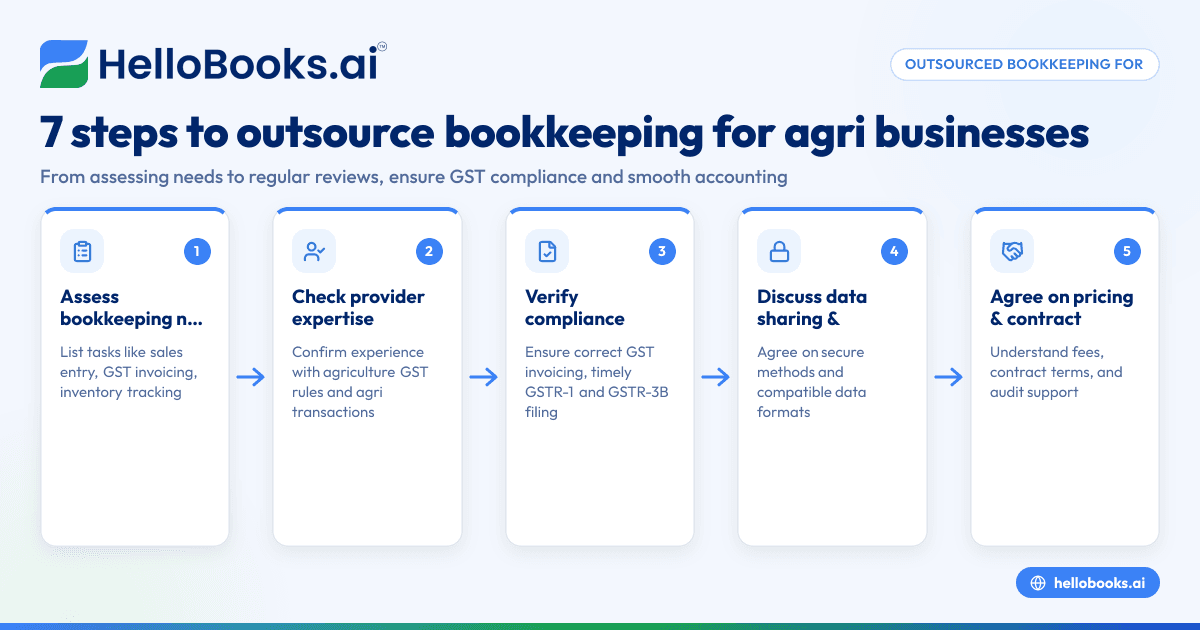
- Assess your bookkeeping needs: List the tasks you want outsourced—such as sales and purchase entry, GST invoicing, GSTR-1 and GSTR-3B filing, bank reconciliation, and inventory tracking. Check if the service can handle agriculture-specific transactions like commission agent fees or agri-input sales.
- Check provider expertise: Ensure the bookkeeping provider understands agriculture business operations and GST rules applicable to your products. Ask if they have experience with agricultural trading and allied businesses. Refer to resources on Agricultural trading and agri businesses for relevant bookkeeping standards.
- Verify compliance capabilities: Confirm the provider can prepare GST invoices with correct HSN/SAC codes, file GSTR-1 and GSTR-3B on time, and reconcile GSTR-2B input tax credits. Ask about their process for handling e-invoicing and e-way bills if applicable.
- Discuss data sharing and security: Decide how you will share bills, invoices, and bank statements securely. Check if the provider supports Excel or Tally data formats. Clarify turnaround times and communication channels.
- Agree on pricing and contract terms: Understand the cost structure—whether fixed monthly fees or per transaction charges. Clarify contract duration, termination clauses, and support for audits or GST assessments.
- Set up a trial period: Start with a trial or pilot period to evaluate accuracy, timeliness, and ease of communication. Adjust processes based on feedback.
- Monitor and review regularly: Schedule monthly reviews of bookkeeping reports, GST filings, and financial statements. Stay involved to catch discrepancies early.
Example (fictional figures)
Consider a seed and fertiliser dealer in Guntur outsourcing bookkeeping for the month of March 2024.
- Total seed sales: ₹3,50,000
- Total fertiliser sales: ₹2,00,000
- Commission paid to agents: ₹30,000
- Purchase of seeds and fertilisers: ₹4,00,000
- Expenses (transport, labour): ₹50,000
The outsourced bookkeeper records:
Sales total = ₹3,50,000 + ₹2,00,000 = ₹5,50,000
Commission expense = ₹30,000
Purchase total = ₹4,00,000
Other expenses = ₹50,000
GST assumed at 5% on seeds and 12% on fertilisers (illustrative rates):
GST on seed sales = ₹3,50,000 × 5% = ₹17,500
GST on fertiliser sales = ₹2,00,000 × 12% = ₹24,000
Total GST collected = ₹17,500 + ₹24,000 = ₹41,500
GST on purchases (assumed average 8%):
₹4,00,000 × 8% = ₹32,000
Net GST payable = GST collected − GST on purchases
₹41,500 − ₹32,000 = ₹9,500
The bookkeeper prepares GSTR-1 and GSTR-3B returns for filing by the 20th of April 2024, ensuring all invoices are entered with correct HSN codes and reconciled against GSTR-2B.
Common mistakes
- Not checking agriculture-specific GST rates and HSN codes: Prevent by verifying GST rates for seeds, fertilisers, and commission services before invoicing.
- Sharing incomplete or unorganised documents: Prevent by maintaining clear records and providing all bills and bank statements promptly.
- Choosing providers without agriculture experience: Prevent by asking for references or case studies from similar agriculture businesses.
- Ignoring reconciliation of GSTR-2B input tax credit: Prevent by insisting on monthly reconciliation to avoid ITC mismatches.
- Not reviewing bookkeeping reports regularly: Prevent by scheduling monthly reviews to catch errors early.
- Assuming cheaper services will handle compliance fully: Prevent by clarifying the scope and ensuring GST filing is included.
For more on bookkeeping automation and compliance, see AI bookkeeping.
Frequently asked questions
What types of agriculture businesses benefit most from outsourced bookkeeping?
Businesses with multiple small transactions, such as commission agents at grain mandis, seed and fertiliser dealers, and allied agri businesses, benefit the most as outsourcing reduces manual errors and saves time.
How does outsourced bookkeeping handle GST compliance for agriculture products?
The service ensures correct GST invoicing with HSN/SAC codes, timely filing of GSTR-1 and GSTR-3B, and reconciliation of input tax credits using GSTR-2B, which is crucial for agriculture businesses dealing with varied GST rates.
Is it safe to share financial data with an external bookkeeping provider?
Yes, provided you use secure data sharing methods and sign confidentiality agreements. Always verify the provider’s data security policies.
Can outsourced bookkeeping help with inventory management in agriculture?
Some providers offer inventory tracking as part of bookkeeping, helping you monitor stock of seeds, fertilisers, and other inputs, but confirm this feature before contracting.
What questions should I ask before hiring a bookkeeping service for my agricultural business?
Ask about their experience with agriculture GST rules, how they handle seasonal transaction spikes, turnaround times, data security, and support during GST audits.
For more details on agriculture business bookkeeping, visit Agricultural trading and agri businesses.
Key takeaways
- Outsourced bookkeeping helps agriculture businesses manage complex transactions and GST compliance efficiently.
- Choose providers with specific experience in agricultural trading and allied businesses.
- Verify the provider’s ability to handle GST invoicing, GSTR-1 and GSTR-3B filing, and GSTR-2B reconciliation.
- Maintain clear communication and share complete documents securely.
- Regularly review bookkeeping reports and GST filings to avoid errors.
- Understand the pricing model and contract terms before signing.
Start managing your agriculture business bookkeeping with confidence. Start on the Free plan (200 transactions a year, GSTR-1 and 3B filing for one GSTIN).