
Key takeaways
What this article covers, in order:
- The check that won't go away
- Why old checks are a problem
- When does a check become "stale"?
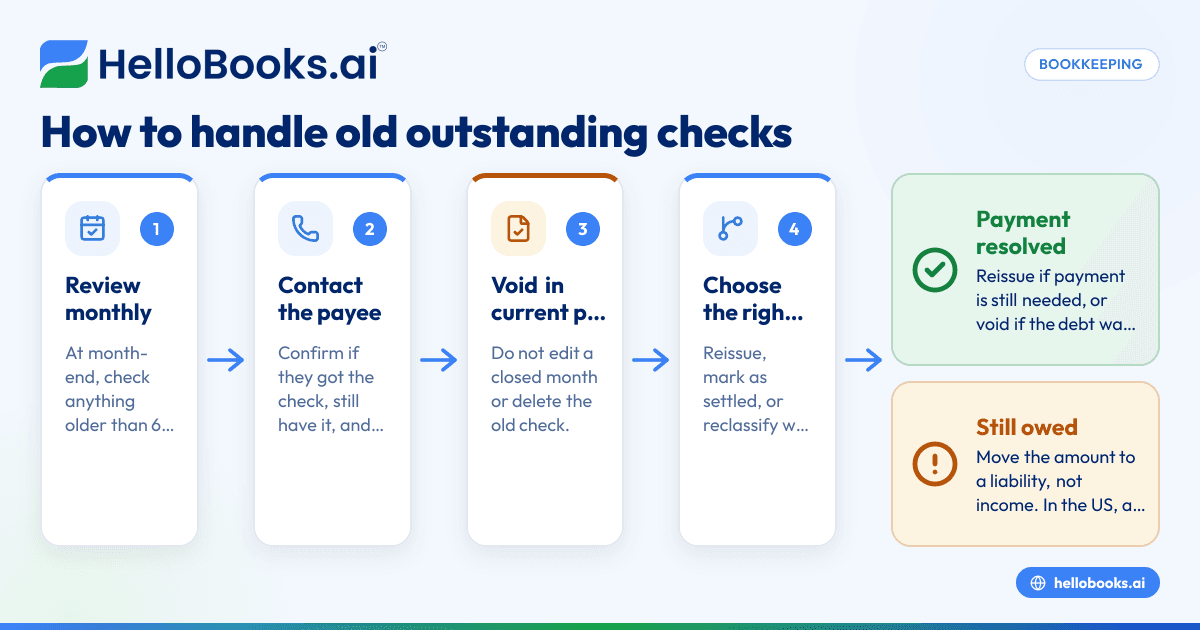
- Step 1: Review the list every month
- Step 2: Contact the payee
- Step 3: Void and reissue (payee still wants payment)
When a check has been outstanding for months, don't just delete it from your books. Contact the payee, find out whether they still have it, and then either let it clear, void it and reissue a replacement, or move the amount to a liability because you still owe the money. The one thing you shouldn't do is treat an uncashed check as if the obligation disappeared, since in many cases it hasn't.
The check that won't go away
Every reconciliation has a little list at the bottom: outstanding checks. Most of them clear within a week or two. But some don't. They sit there month after month, and eventually your list looks like this:
| Check # | Date written | Payee | Amount |
|---|---|---|---|
| 1187 | Feb 12, 2026 | Former contractor | $642.00 |
| 1203 | Mar 30, 2026 | Supply vendor | $118.40 |
| 1241 | Jul 8, 2026 | Customer refund | $75.00 |
| 1266 | Sep 26, 2026 | Landlord | $2,400.00 |
Check #1266 is fine. It's a few days old. The others are a different story. Let's go through what each situation calls for.
Why old checks are a problem
An outstanding check that never clears causes three issues:
- Your cash looks lower than it is. Your books show the $642.00 as already spent. The bank still has it.
- Your reconciliation gets noisy. Every month you re-list the same old items, and real issues get lost in the clutter.
- You might still owe the money. If the contractor never got paid, you have an unpaid bill, not a completed payment.
When does a check become "stale"?
You'll hear the phrase "stale-dated check" a lot. Under the commercial code most US states follow, a bank generally isn't obligated to pay a personal or business check presented more than six months after its date, though it may still choose to pay it in good faith. So a check from Feb 2026 might get rejected if it's presented in Oct 2026, or it might go through.
That uncertainty is the core problem. The check isn't reliably dead, and the debt behind it often isn't either.
Step 1: Review the list every month
Make it a habit. At month-end, look at every outstanding check older than 60 to 90 days. Anything older than six months needs action this month, not next.
Step 2: Contact the payee
This is the step people skip, and it solves most cases. Call or email:
- Did you receive the check? Mail gets lost.
- Do you still have it? Sometimes it's in a drawer.
- Do you still want to be paid? A vendor who already wrote it off still has a right to the money in most cases, so don't assume a "no" means you're off the hook. Get anything important in writing.
Let's look at how this plays out. Sam runs a small HVAC company in Kansas City. (He's a made-up example.)
- Check #1187, $642.00, former contractor. Sam emails. The contractor moved and never got it. Sam needs to stop payment and send a new check.
- Check #1203, $118.40, supply vendor. The vendor says they credited Sam's account and never deposited the check. Sam needs to void it and record the vendor credit properly.
- Check #1241, $75.00, customer refund. No reply after two emails and a phone call. Sam still owes this customer $75.00.
Step 3: Void and reissue (payee still wants payment)
For check #1187:
- Ask the bank to place a stop payment on the original check. Banks usually charge a fee for this.
- Void check #1187 in your books, dated in the current period (Oct 2026), not back in Feb 2026. That keeps your closed months intact.
- Write and record a new check to the contractor for $642.00.
The net effect on your books: the original payment is reversed, the replacement payment is recorded, and the bill stays paid. Your cash only goes down once.
A note on dating the void: if you void the original check by editing its February 2026 entry, you'll break every reconciliation from February 2026 through September 2026. Always reverse it in the current period instead.
Step 4: Void without reissuing (debt is genuinely settled)
For check #1203, the vendor already applied a credit. The obligation is settled another way, so:
- Void check #1203 in the current period.
- Record the vendor credit against the open bill or the original expense account, matching how the vendor resolved it.
Step 5: Reclassify to a liability (you can't reach the payee)
Check #1241 is the trickiest. You still owe the customer $75.00, but you can't get the money to them. The right move is to take it off the outstanding-check list without pretending the debt is gone.
| Entry | Debit | Credit |
|---|---|---|
| Void check #1241 and record the amount still owed | Checking $75.00 | Uncashed checks payable (liability) $75.00 |
Your cash goes back up by $75.00, which matches the bank. The liability shows that you're holding $75.00 that belongs to someone else.
What you shouldn't do is credit "other income." That money isn't yours.
The unclaimed property question
Here's the part most owners don't know about. Every US state has unclaimed property laws (sometimes called escheatment). In broad terms, when money owed to someone sits unclaimed for a set dormancy period, the holder might be required to make a good-faith effort to contact the owner, report it to the state, and turn the funds over. Uncashed vendor checks, customer refunds and payroll checks are common examples.
The details differ a lot from state to state: which property is covered, how long the dormancy period is, what notice you must send, and when reports are due. Some businesses also need to follow the rules of the state where the payee lives, not just their own. We're not going to list state rules here because they vary and change. If you have uncashed checks older than a year, or a pile of small uncashed refunds, check with your CPA about what applies to you.
What about deposits that never arrived?
Occasionally the stuck item is a deposit in transit that never shows up on the statement. That deserves faster attention than an old check. A deposit that's missing for more than a few business days could be a lost deposit, a deposit posted to the wrong account, or a recording error. Call the bank with the date and amount right away.
A simple aging policy
To keep this from becoming a pile, set a rule and stick to it:
| Age of outstanding check | Action |
|---|---|
| Under 30 days | Normal. No action. |
| 30 to 90 days | Note it. Mention it if you talk to the payee. |
| 90 to 180 days | Contact the payee in writing. |
| Over 180 days | Resolve this month: void and reissue, void as settled, or move to a liability. |
| Over 1 year (still owed) | Ask your CPA about unclaimed property obligations. |
How HelloBooks helps
HelloBooks lets you connect most US banks and credit cards, so you can see which payments have actually come through the bank and which are still waiting. If a bank won't connect, CSV statement import works too. The reconciliation report from the reconcile screen lists outstanding items separately from cleared items, between the opening and closing balances, so a check like #1187 that keeps rolling forward is easy to spot month after month; export it as PDF or CSV when you're following up with a payee or your CPA. And because a reconciled, signed-off period can be locked (reopening it later is logged), you're nudged toward voiding old checks in the current period rather than editing a closed one. AP aging reports are on every plan, including Free, so you can see which vendor bills are still open, which helps when you're working out whether an old check means a bill is really unpaid. You can also invite your bookkeeper or CPA into the books to review anything that touches a liability account. More on the bank reconciliation software page. Contractors who write a lot of checks to subs might also find our construction page useful, and nonprofits handling uncashed grant or refund checks can start with our nonprofit accounting page.
FAQs
How long can a check stay outstanding?
There's no fixed limit in your books, but banks generally aren't required to honor checks presented more than six months after their date. Anything older than 90 days is worth following up.
Can I just delete an old outstanding check?
No. Deleting it edits a closed period, breaks past reconciliations, and can hide the fact that you still owe the money. Void or reclassify it in the current period instead.
Should uncashed checks become income?
Generally no. If you still owe the payee, the amount is a liability. Recording it as income overstates your profit and can cause trouble under unclaimed property rules.
What is escheatment?
It's the process where unclaimed money is reported and turned over to a state after a dormancy period. Rules differ by state, so ask your CPA what applies to your business.
Do I need to stop payment before reissuing a check?
It's the safest approach. Otherwise both the original and the replacement could be cashed. Expect a bank fee for the stop payment.
A short monthly look at that list keeps it to a line or two, and keeps your cash number honest.
Start free, no credit card. Try HelloBooks Free