
Key takeaways
What this article covers, in order:
- Key takeaways
- What are electronic invoice requirements in United States?
- Which details should an electronic invoice include?
- Do small businesses have to use a specific invoicing format?
- What makes an electronic invoice legally useful?
- How long should you keep electronic invoices?
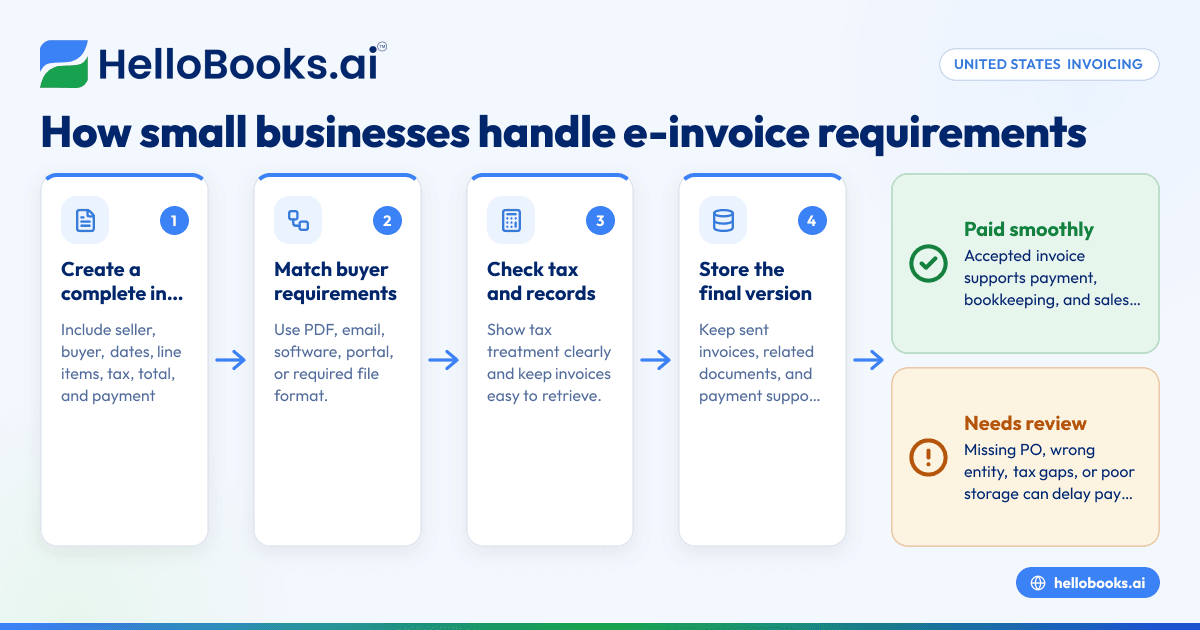
Electronic invoice requirements in the United States are mostly about making invoices accurate, readable, and easy to store and retrieve. For most small businesses, there is no single federal rule that forces one mandatory electronic format, but you still need invoices that support payment, accounting, and sales tax records.
Key takeaways
- In the United States, most small businesses can send electronic invoices as PDFs, emails, or software-generated invoices.
- There is no universal federal invoicing mandate for all small businesses, but buyers may impose their own format rules.
- Your electronic invoices should include basic transaction details, payment terms, tax information, and seller and buyer details.
- Good recordkeeping matters as much as invoice delivery. You need clear records for accounting, sales tax support, and audits.
- Some larger customers, government buyers, and enterprise procurement systems may require specific electronic invoice formats or portals.
- The simplest setup is invoicing software that creates invoices, tracks payments, and ties directly into bookkeeping and reconciliation.
What are electronic invoice requirements in United States?
For most small businesses in the United States, electronic invoice requirements come from practical business needs, customer contracts, and tax recordkeeping rules rather than one nationwide invoice law. An electronic invoice can be a PDF sent by email, a bill created in a billing portal, or a software-generated invoice sent through an online payment link.
That matters because many owners search for electronic invoice requirements united states expecting a single checklist from one federal agency. In practice, the answer is more operational. Your invoice must clearly show what was sold, who bought it, how much is due, when payment is due, and any tax charged. It also needs to be stored in a way you can retrieve later.
For a bakery in Chicago, a machine shop in Detroit, or a home services company in Houston, the day-to-day rules are usually set by:
- your customer agreement
- your accounting process
- your state and local sales tax records
- your payment processor or buyer portal
- your document retention practices
If you work with larger companies, they may ask for invoices in a certain file format or through a procure-to-pay system. If you sell to government entities, they may require submission through a specific system or contract workflow. That is different from saying all businesses in the United States must use one national invoicing standard.
Which details should an electronic invoice include?
An electronic invoice in the United States should include the same core details as a paper invoice. The format can vary, but the content should be complete and easy to understand.
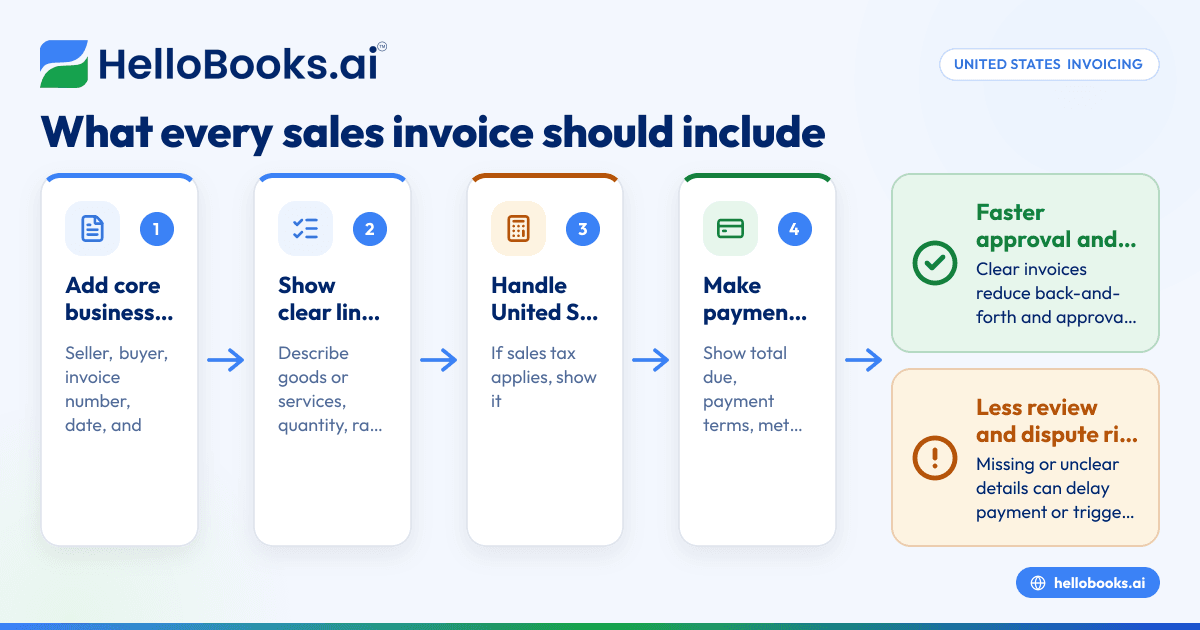
At a minimum, include:
- your business name and contact information
- the customer name and billing information
- a unique invoice number
- invoice date
- due date or payment terms
- description of products or services
- quantity, rate, and line totals
- subtotal
- any discount applied
- any shipping or fees
- taxes charged, if applicable
- total amount due
- payment instructions
For example, a consulting firm in Houston might send an invoice dated 10/06/2026 with Net 15 terms, showing 12 hours of strategy work at $150 per hour, for a total of $1,800. If tax does not apply to that service in the relevant jurisdiction, the invoice should still be clear on the taxable and nontaxable treatment in your records.
Why invoice numbering and dates matter
Invoice numbers help you track open balances, prevent duplicates, and support your accounting records. Dates matter because they affect revenue recognition, collection follow-up, and month-end close.
If you are still creating invoices in spreadsheets, duplicate invoice numbers and missing dates happen often. That creates problems later when reconciling payments from Stripe or matching customer remittances to open invoices in QuickBooks.
What about sales tax on an electronic invoice?
If your sale is taxable, the invoice should show the tax charged clearly. In the United States, sales tax rules vary by state and locality. That means the right tax treatment depends on where you sell, what you sell, and whether your business has a collection obligation there.
This is general information, not tax or legal advice. If your tax treatment is unclear, confirm it with a qualified accountant or tax advisor.
Your invoice should support your sales tax records by showing:
- the taxable item or service
- the location relevant to the sale
- the tax amount charged
- any exemption treatment, if applicable in your records
Do small businesses have to use a specific invoicing format?
Usually no. Most small businesses in the United States can use emailed PDFs or invoices generated in billing software, as long as the invoice is accurate, accepted by the customer, and kept in your records.
That short answer covers most cases, but there are important exceptions.
A local wholesale distributor may accept a PDF invoice by email without any issue. A large retail buyer may require invoices through a supplier portal. A manufacturer using an ERP system may require a structured file or electronic data interchange workflow. A city or state agency may require submission through a procurement platform tied to the contract.
So the real requirement is often buyer-specific. Before you onboard a new major customer, ask:
- How do you want invoices delivered?
- Do you require a purchase order number?
- Do line items need a specific format?
- Do you accept PDF invoices by email?
- Do you require portal upload?
- What documentation must be attached?
If you miss a required PO number or billing code, payment can be delayed even if the invoice amount is correct.
Common electronic invoice formats used by small businesses
Most small businesses use one of these formats:
- PDF attached to email
- invoice link sent from invoicing software
- customer portal invoice
- accounting software generated invoice
- structured files used for large buyers, where required
The simplest path is software that creates standardized invoices and stores them automatically. That reduces back-and-forth and keeps records consistent.
If you are choosing tools, look at invoice software that also supports accounting and payment tracking.
What makes an electronic invoice legally useful?
An electronic invoice is legally useful when it accurately documents the transaction, can be retained, and can be produced later if needed. In other words, the invoice should be complete, authentic, and easy to retrieve.
In day-to-day operations, “legally useful” means it helps you prove the sale happened and supports your bookkeeping. That matters if a customer disputes a bill, your accountant asks for support, or you need records during an audit.
Keep invoices readable and tamper-resistant in practice
Most small businesses do not need advanced legal engineering. They need a dependable process.
A good process includes:
- Generate invoices from one system.
- Use sequential invoice numbers.
- Lock invoice totals after sending.
- Save the final sent version.
- Store related documents like contracts, POs, and payment confirmations.
- Keep backup access to records.
This is where an ai electronic invoice workflow can help. Instead of creating invoices manually, software can pull customer details, line items, and payment terms from your records and reduce data entry mistakes.
Why email alone is not enough
Emailing a PDF is fine for many businesses, but email itself is not a recordkeeping system. If invoices live across inboxes, desktops, and downloads folders, month-end becomes messy.
You need to know:
- which invoice was sent
- when it was sent
- whether the customer viewed it
- whether it was paid
- how it maps to your books
That is why many businesses move from manual email attachments to AI accounting software or accounting software in the USA with invoicing built in.
How long should you keep electronic invoices?
Keep electronic invoices for the full period your accounting, tax, and audit records may be needed. The exact retention period depends on your tax situation, state rules, contracts, and internal policy.
For small businesses, the safest approach is to set a written document retention policy with your accountant. Many owners keep invoices, payment records, and supporting documents together by customer and year so they are easy to retrieve.
A practical retention setup for small businesses
Use one folder or system per fiscal year. Inside it, organize by customer or month. Save:
- final sent invoice
- credit memo, if any
- proof of delivery, if relevant
- payment confirmation
- related contract or PO
- notes on disputes or adjustments
For example, if a contractor in Detroit issues 200 invoices per month, searching Gmail for one PDF from 18 months ago is slow and risky. Searching a proper invoicing and bookkeeping system is much faster.
What if your customer requires a portal or procurement system?
If your customer requires a portal, you usually must follow that process to get paid. Their requirement may cover file type, invoice fields, approval routing, attachment rules, and payment status tracking.
This is common with larger buyers. They may reject invoices that do not match the purchase order, department code, ship-to location, or contract line details.
How to handle customer-specific invoice requirements
Use this checklist before sending the first invoice:
- Confirm the legal billing entity name.
- Confirm billing address and contact.
- Confirm PO number rules.
- Confirm accepted file types.
- Confirm whether backup documents are required.
- Confirm where payment status will appear.
- Confirm who approves invoices internally.
- Confirm whether partial billing is allowed.
A lot of payment delays are not collection problems. They are submission problems.
Build one source of truth internally
Even if a customer requires portal submission, keep your own master invoice record in your accounting system. Your internal record should show the invoice number, date, amount, customer, tax treatment, submission date, and payment date.
That is especially important if you invoice in one system but keep books in QuickBooks or spreadsheets. Disconnected systems create duplicate work and mismatched balances.
Tools with AI bookkeeping features can reduce that manual matching by tying invoices to ledgers and payment records automatically.
What are the most common electronic invoicing mistakes?
The most common mistakes are missing invoice details, wrong customer data, tax errors, duplicate invoices, and poor record storage. Most payment delays come from avoidable process gaps, not complicated regulations.
Those mistakes show up in almost every small finance team. They are easy to miss when invoicing volume rises.
Five mistakes that create payment delays
1. Missing purchase order numbers
Many larger customers will not process an invoice without the right PO number. Always confirm this before billing.
2. Wrong billing entity
A customer may have multiple legal entities or locations. Sending the invoice to the wrong one can stall payment for weeks.
3. Inconsistent tax treatment
Charging tax incorrectly, or failing to document why tax was not charged, creates accounting cleanup later.
4. Duplicate invoice numbers
This happens often with spreadsheets and manual templates. It confuses collections and reconciliation.
5. No link between invoicing and bookkeeping
If your invoice list and your books do not match, month-end close gets harder. You may think receivables are current when some invoices were already paid or written off.
A simple control checklist
Before sending any invoice, check:
- customer name
- billing address
- invoice number
- date and due date
- line items
- amount
- tax treatment
- attachments
- payment instructions
A standard pre-send review takes less than a minute and prevents many disputes.
How can small businesses automate electronic invoicing?
Small businesses can automate electronic invoicing by using software to create invoices, send reminders, track due dates, and sync payments into bookkeeping. The goal is fewer manual touches and cleaner records.
Automation matters most when invoice volume rises. At 10 invoices a month, manual work may feel manageable. At 100, errors start to pile up.
Where automation saves time
Automation helps with:
- recurring invoices
- customer data reuse
- payment reminders
- invoice status tracking
- overdue follow-up
- ledger posting
- reconciliation
For example, a field services company in Houston might bill weekly for maintenance visits. Instead of creating each invoice from scratch, software can pull the customer, service code, and rate automatically.
What should you look for in electronic invoicing software?
Choose software that creates accurate invoices fast, stores records centrally, tracks payment status, and connects invoicing to bookkeeping and reconciliation so month-end is easier.
Then look deeper at workflow. Choose a system that can:
- Create professional invoices quickly.
- Store customer and item details.
- Track sent, viewed, paid, and overdue status.
- Support tax fields where needed.
- Keep invoice records organized.
- Connect invoicing to bookkeeping and bank reconciliation.
That is where accounting software for small business can be more useful than a standalone template. You are not just sending invoices. You are running receivables, matching payments, and closing the books.
If your biggest pain is matching deposits and open invoices, bank reconciliation software can also make collections and month-end more reliable.
Do electronic invoices help with 1099s or compliance?
Not directly. Electronic invoices help you keep cleaner records, but they do not replace your need to handle tax reporting, contractor records, or customer compliance requirements correctly.
For example, if you pay independent contractors, invoice records can support your bookkeeping, but 1099 reporting has its own rules and thresholds. If a customer asks about your data handling practices, your invoicing process should be organized and professional, but that does not by itself satisfy every buyer requirement.
Compliance areas electronic invoices can support
Electronic invoices can make it easier to support:
- revenue records
- sales tax documentation
- customer dispute resolution
- contractor payment records
- audit trails
- month-end close
They are one part of a broader finance system. The cleaner your invoice data, the easier it is to manage expenses, receivables, and reporting across the business.
If you are also trying to control vendor bills and employee spending, expense management software can help keep the payables side as organized as receivables.
When should you move off spreadsheets for invoicing?
Move off spreadsheets when invoice errors, late payments, or month-end cleanup start costing real time. If more than one person touches invoicing, you likely need software.
A spreadsheet can produce an invoice. It cannot reliably manage the full workflow around that invoice.
What are the signs your invoicing process is outgrowing spreadsheets?
If invoices get lost, duplicate numbers appear, payments are hard to match, or month-end cleanup keeps growing, your spreadsheet process is no longer enough.
You should upgrade if:
- you reuse old invoice files and overwrite data
- customers say they never received invoices
- you cannot see overdue balances quickly
- payments are hard to match
- invoice copies are stored in different places
- your accountant asks for cleanup every month
A better invoicing process reduces errors before they hit your books. If you are comparing systems, a QuickBooks alternative may be worth a look if you want invoicing and bookkeeping in one place.