
Key takeaways
What this article covers, in order:
- Key takeaways
- What are sales invoice requirements in United States?
- What should every sales invoice include?
- Why do clear invoice details matter so much?
- Do you have to put sales tax on every invoice?
- What makes an invoice easier for customers to approve?
A sales invoice in the United States should clearly identify the seller and buyer, describe what was sold, show the amount due, and state payment terms. For small businesses, the goal is simple: make the invoice easy to understand, easy to approve, and easy to pay so cash comes in faster and disputes stay low.
Key takeaways
- Sales invoice requirements in United States are mostly practical business requirements, plus tax and recordkeeping rules that vary by state and industry.
- Every invoice should include your business details, customer details, invoice number, date, itemized charges, total due, and payment terms.
- If sales tax applies, show it clearly and keep records that support how you calculated it.
- Clear invoices reduce payment delays, chargebacks, and back-and-forth with customers.
- Using invoice software or AI accounting software can help standardize invoices and reduce manual mistakes.
- This article is general information, not tax or legal advice.
What are sales invoice requirements in United States?
In the United States, there is no single nationwide invoice format that every small business must use. Instead, good invoice practice comes from contract terms, accounting needs, customer requirements, and tax recordkeeping rules, especially around state sales tax.
That means your invoice should do three jobs at once. It should tell the customer what they owe. It should support your bookkeeping. It should also create a clear record in case of audits, disputes, or late-payment follow-up.
For a business in Chicago, Houston, or Detroit, a solid sales invoice usually includes the same core fields. The exact details may vary by industry. A contractor may need job-site details. A manufacturer may need purchase order references. A marketing agency may need billing by project or retainer period.
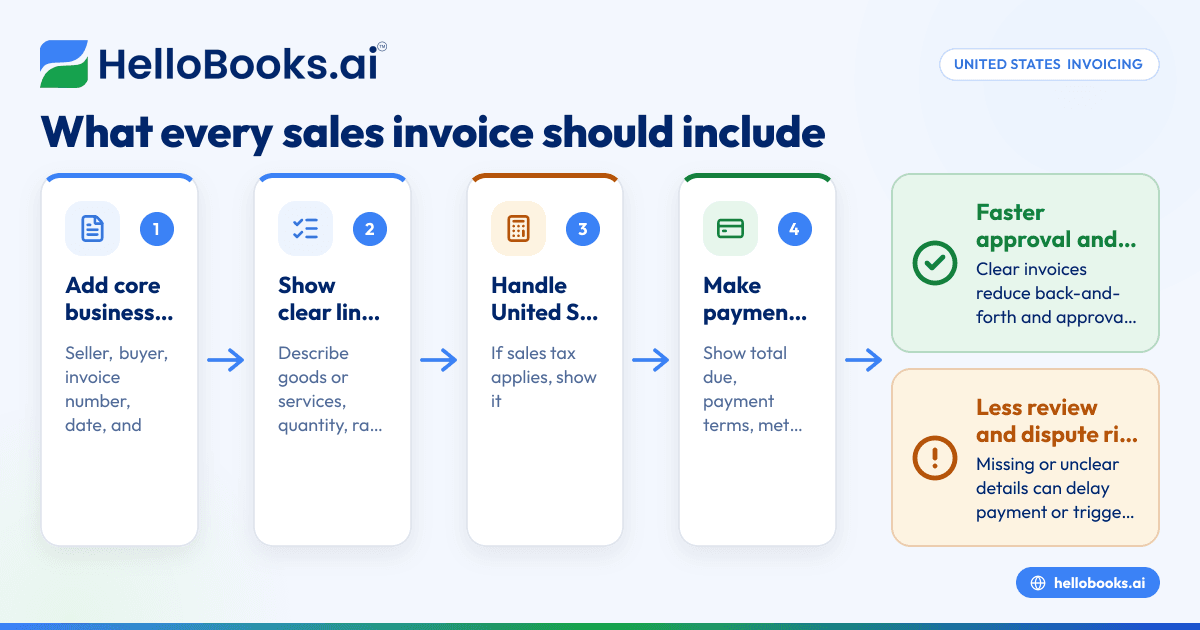
What should every sales invoice include?
Every small business invoice should include enough information for the customer to review and pay it without asking basic questions. If something is missing, approval slows down.
At a minimum, include these fields:
- Your business name Use the legal or operating name your customer recognizes.
- Your business address and contact information Include mailing address, email, and phone number.
- Customer name and billing address Bill the correct legal entity, not just a contact person.
- Invoice number Use a unique number for tracking and audit trails.
- Invoice date Show the date the invoice was issued.
- Due date or payment terms Examples include “Due on receipt,” “Net 15,” or “Net 30.”
- Description of goods or services Be specific. “Consulting services” is weaker than “March 2026 bookkeeping cleanup, 12 hours.”
- Quantity, rate, and line-item amount Show how you got to the subtotal.
- Subtotal The amount before tax, discounts, shipping, or fees.
- Discounts, shipping, or other charges List each item separately if it applies.
- Sales tax, if applicable Show the tax amount clearly.
- Total amount due This should be easy to find.
- Accepted payment methods Include bank transfer, card, ACH, or check details as needed.
- Purchase order number or job reference Many business customers require this before they will pay.
- Notes or remittance instructions Add only what helps payment, not extra clutter.
These are not just nice-to-have fields. They reduce confusion in accounts payable teams and help your own team match payments correctly later.
Why do clear invoice details matter so much?
Clear invoice details help customers pay faster because they reduce approval friction. A good invoice answers the basic questions before someone in accounts payable has to ask them.
This matters even more when your buyer is a larger business. Many companies in the United States process invoices through layered approval. The person who received the product may not be the person who approves payment. The approver may not know your business. Your invoice has to stand on its own.
A clear invoice also improves your records. If a payment comes in short, late, or with no remittance note, your team can trace it faster when invoice numbers and customer names are consistent.
Below the basics, clear invoicing supports:
- Better cash flow forecasting
- Fewer billing disputes
- Easier bank reconciliation
- Cleaner month-end close
- Better support for collections follow-up
- Stronger documentation if sales tax treatment is questioned
If you are still creating invoices by hand in spreadsheets, this is often where errors start. Missing due dates, duplicated invoice numbers, and incorrect tax lines can lead to avoidable delays. That is one reason many teams move to accounting software for small business.
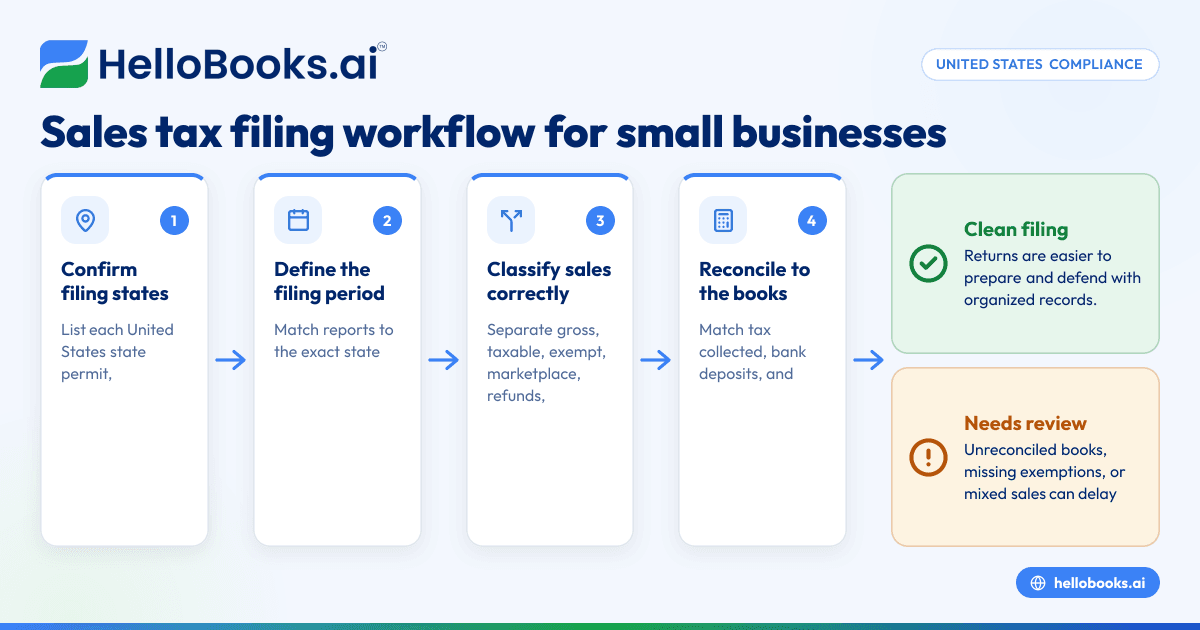
Do you have to put sales tax on every invoice?
No. You only add sales tax when the sale is taxable and you are required to collect it in the relevant state or local jurisdiction.
Sales tax rules in the United States vary by state and sometimes by local area. Some goods and services are taxable in one state and not taxable in another. Your invoice should reflect the tax treatment that applies to that sale.
If sales tax applies, your invoice should usually show:
- The taxable items or services
- The taxable amount
- The sales tax amount charged
- The total due including tax
Do not bury tax inside the line-item price unless your business model or contract specifically requires tax-inclusive pricing. Separate tax lines make records easier to review.
You should also keep support behind each invoice. That includes customer location, product or service details, exemption documentation where relevant, and how the tax amount was calculated. If your customer gives you a valid exemption certificate, store that record with the account.
What if you sell services?
Service taxability depends on the state and the type of service. Some professional services may not be taxable in many states, while certain digital, repair, installation, or mixed service transactions may be treated differently. Review the rules that apply to your state and transaction type before setting up invoice templates.
What makes an invoice easier for customers to approve?
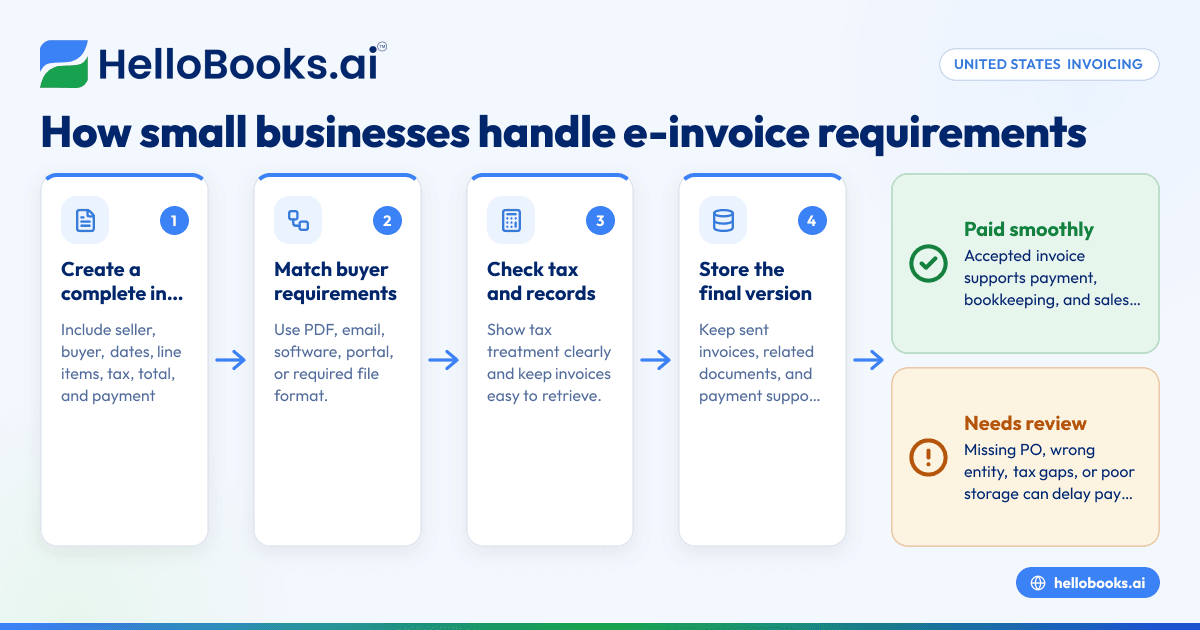
A customer approves your invoice faster when it matches how they buy. That means the invoice should reflect the contract, quote, purchase order, and delivery record as closely as possible.
For business-to-business billing, approval problems usually come from mismatches like these:
- The invoice name does not match the legal buyer name
- The PO number is missing
- The rates do not match the quote
- The billing period is unclear
- The tax line looks wrong
- The work description is too vague
- The invoice was sent to the wrong email address
To reduce delays, build a standard invoicing checklist. Before sending an invoice, confirm the customer’s billing contact, payment terms, PO rules, and any portal submission requirement.
How can you make invoices easier to pay?
Use short, direct language and a clean layout. Put the invoice number, due date, and total due near the top. Add payment instructions that are easy to follow. If you accept electronic payments, include the payment option in the email and on the invoice itself when possible.
If you send recurring invoices, keep formatting consistent each month. Consistency helps your customer’s AP team process the invoice without stopping for review.
What does an invoice need for bookkeeping and audit trails?
For bookkeeping, an invoice is not just a request for payment. It is source documentation for revenue, receivables, tax, and collections.
That means your invoices should be:
- Sequentially numbered
- Dated correctly
- Linked to the right customer record
- Tied to the goods delivered or services performed
- Stored in a way that is easy to retrieve later
Your accounting records should also reflect invoice changes clearly. If you revise an invoice, avoid simply overwriting the original file with no trace. Use version control, a credit memo, or a documented correction process. This matters if a customer disputes the amount later.
Good audit trails also help with cash application. When a customer pays multiple invoices in one ACH transfer, your team needs invoice numbers and remittance details to match the payment correctly. That process becomes much easier with bank reconciliation software and standardized invoice records.
Can you send invoices by email in the United States?
Yes. Email invoicing is common in the United States, especially for small businesses and business-to-business billing. In practice, what matters most is that the customer agrees to receive invoices that way and that your invoices are secure, accurate, and easy to access.
If you use email, follow a few practical rules:
- Send invoices to the right billing address Use the AP or billing email the customer has approved.
- Use a clear subject line Include your business name, invoice number, and due date.
- Attach a readable PDF or use a secure invoice link Avoid unusual file types that trigger security concerns.
- Keep the email short State the amount due and payment deadline.
- Maintain records of delivery Save sent copies and any customer responses.
If you send marketing emails too, keep invoice emails separate from promotions. Transactional billing emails should stay focused on the invoice itself.
What is the difference between a sales invoice, estimate, and receipt?
An estimate is a quote before the sale. A sales invoice is the bill after goods are delivered or services are provided. A receipt shows that payment was actually received.
Small businesses often blur these documents, especially early on. That can create bookkeeping problems.
Here is the clean workflow:
- Estimate or quote Sent before work begins.
- Sales order or agreement Optional, depending on the business.
- Invoice Sent when it is time to bill.
- Receipt or payment confirmation Sent after payment arrives.
Keeping those documents separate helps prevent revenue timing errors and customer confusion. It also makes collection follow-up more professional.
How should small businesses number invoices?
Use a simple, unique, sequential system that your team can follow consistently. Good examples include 1001, 1002, 1003 or a date-based pattern like 2026-0415-001.
The most important rule is consistency. Do not reuse numbers. Do not skip into random formats across departments. A stable invoice numbering system makes it easier to trace unpaid balances, customer questions, and bookkeeping entries.
If you have multiple locations or business lines, you can add a prefix. For example, a Houston warehouse division might use WH-1045. Just keep the logic documented and easy to audit.
How does ai sales invoice automation help?
AI sales invoice automation helps small businesses create consistent invoices, pull customer and item details faster, and reduce manual entry mistakes. It can also help teams spot missing fields before sending invoices, which cuts payment delays.
In practice, automation works best when your invoice process is already standardized. If every customer gets a different format, AI tools have less to work with. Start with a single invoice template. Then automate customer details, line items, recurring billing, and payment reminders.
An AI bookkeeping workflow can also help after the invoice is sent. It can support receivable tracking, payment matching, and cleaner records at month-end. That matters when your team is closing books while still managing day-to-day billing.
What should you avoid putting on an invoice?
Keep invoices complete, but not crowded. Extra text can make the key billing details harder to find.
Avoid these common mistakes:
- Internal notes the customer does not need
- Long legal paragraphs that bury the due date
- Vague service descriptions
- Old payment instructions
- Unclear late fee wording
- Combined tax and shipping in one line
- Different totals in the email and PDF
You should also avoid changing terms after the work is done unless both parties agree. If your quote said Net 30, sending the invoice with “Due on receipt” may create friction and delay payment.
What about late fees?
If you plan to charge late fees or finance charges, those terms should be set clearly in your customer agreement and shown consistently on invoices where appropriate. Rules can vary by contract and state law, so use care and get advice when needed.
What should service businesses include that product sellers may not?
Service businesses often need more context on the invoice because there may be no physical shipment to confirm what was delivered. The invoice should make the work period and scope easy to understand.
Useful service invoice fields include:
- Billing period
- Project name
- Milestone completed
- Hours worked
- Hourly rate
- Team member or role
- Statement of deliverables
For example, a bookkeeping firm in Detroit might invoice “Monthly close and account review for April 2026” rather than “Accounting services.” That level of detail can shorten approval time.
Product sellers, by contrast, may need SKU numbers, shipping details, quantity shipped, unit price, and delivery date. If the customer uses an ERP or procurement system, matching their item references can help speed payment.
What should recurring invoices include?
Recurring invoices should include all the standard fields plus the billing period covered. This is one of the most common missing details in subscription and retainer billing.
For recurring billing, include:
- Start and end date of the service period
- Contract or subscription reference
- Any usage-based charges
- Prior balance, if relevant
- Current charges only, clearly separated
Customers should not have to guess whether they are paying for last month, this month, or the next month. That is how disputes begin.
If you handle many repeating invoices, expense management software, billing templates, and customer-level rules can help keep records clean across cycles.
What if a customer asks for a corrected invoice?
Answer quickly and preserve the record of the original invoice. Do not create confusion by sending multiple different versions with the same file name and no explanation.
A simple correction process looks like this:
- Confirm the issue Check whether the problem is tax, pricing, legal entity, PO number, or description.
- Void or revise according to your system rules Keep the original record where possible.
- Issue the corrected invoice clearly Use a new revision note or a new invoice if needed.
- Tell the customer what changed Keep the explanation short and factual.
- Update your books Make sure receivables and revenue records match the corrected invoice.
This is where standardized accounting software in the USA can help. It reduces the risk of duplicate balances or missing audit trails after invoice edits.
How can small businesses build a strong invoice process?
A good invoicing process is simple, documented, and repeatable. It should not depend on one person remembering every detail.
Use this process:
- Set a standard invoice template Include all required business and payment fields.
- Define customer billing rules Capture PO needs, billing contacts, terms, and tax treatment.
- Create invoices from approved source records Use signed quotes, completed work logs, or shipping confirmations.
- Review before sending Check names, dates, taxes, totals, and payment instructions.
- Send through one consistent channel Usually email or a customer billing portal.