
Key takeaways
What this article covers, in order:
- Key takeaways
- What is the sales tax filing process?
- Why do small businesses struggle with sales tax filing?
- How do you know if you need to file sales tax returns?
- Step-by-step sales tax filing process for small businesses
- What mistakes slow down the sales tax filing process?
Sales tax filing is the process of collecting the right state and local sales tax from customers, tracking taxable and exempt sales, and filing returns with each state where your business is registered. For small businesses in the United States, the challenge is usually not the concept. It is keeping rates, records, filing frequency, and due dates organized across channels and states.
Key takeaways
- The sales tax filing process starts before the return. You need permits, correct tax setup, and clean records.
- Sales tax rules vary by state and locality, so your filing workflow should be state-specific.
- Good records matter. Keep sales reports, exemption certificates, marketplace data, and bank deposits tied together.
- Filing mistakes often come from nexus confusion, wrong taxability settings, and missed due dates.
- Automation can reduce manual work, especially when paired with strong bookkeeping and reconciliation.
- This article is general information, not tax or legal advice.
What is the sales tax filing process?
The sales tax filing process is the recurring workflow a business follows to report taxable sales, exempt sales, tax collected, and tax due to each state where it has a filing obligation. In most cases, you collect sales tax from customers at the point of sale, record it as a liability, and then remit it on a monthly, quarterly, or annual schedule set by the state.
For a small business, the process usually touches several systems. You may sell through a website, invoice customers directly, collect payments through Stripe, and track books in spreadsheets or QuickBooks. That setup works at first. Over time, it creates gaps. Deposits do not match sales reports. Exempt sales are not labeled correctly. Marketplace sales get mixed with direct sales. Then filing day becomes a scramble.
A clean process helps you avoid that scramble. It also helps you answer basic questions with confidence:
- Which states do we need to file in?
- What period does this return cover?
- How much tax did we collect?
- Which sales were exempt or already taxed by a marketplace?
- Do our books match the return?
If you can answer those questions quickly, filing gets much easier.
Why do small businesses struggle with sales tax filing?
Small businesses usually struggle because sales tax sits at the intersection of operations, bookkeeping, and compliance. The tax itself may be simple in one state and more complex in another. But the daily problems are practical.
First, sales tax data often lives in more than one place. A Houston wholesaler may issue invoices from one system, take card payments online, and track deposits in a bank feed. If those systems are not aligned, the reported sales tax can differ from the cash received.
Second, product and customer taxability can be inconsistent. Some sales are taxable. Some are exempt. Some customers provide exemption certificates. If you do not capture that information at the time of sale, you end up fixing it later.
Third, state filing schedules are easy to miss. One state may require monthly returns. Another may require quarterly filings. Even if no tax is due, some states still expect a return from registered sellers.
Finally, manual bookkeeping makes everything harder. If your books are behind, your sales tax return will be behind too. That is one reason many businesses move to AI bookkeeping or AI accounting software to keep transactions categorized and reconciled throughout the month.
How do you know if you need to file sales tax returns?
You generally need to file when you have registered for a sales tax permit in a state and the state assigns you a filing frequency. You may also need to register after you establish sales tax nexus in that state through physical presence or economic activity.
In plain terms, nexus means a sufficient connection to a state. That connection can come from facts such as:
- An office, store, warehouse, or employee in the state
- Inventory stored in the state
- Certain levels of sales or transaction volume in the state
- Events such as trade show activity, depending on state rules
Economic nexus thresholds vary by state. So do the details around marketplace sales, exemptions, and registration triggers. That is why you should check each state's current rules directly before registering or filing.
Once you register, the filing duty usually begins. Even if you had no sales during the period, the state may still expect a zero return. Missing a required return can lead to notices and penalties.
What records do you need before you file?
You need a complete sales report for the filing period, broken down by state, taxable sales, exempt sales, and tax collected. You also need marketplace sales data, exemption certificates, credit memos, refund records, and proof that your books and bank activity support the numbers.
Under that short list is the real work: making sure every source agrees.
Before you prepare a return, gather:
- Sales by state and filing period
- Tax collected by state and local jurisdiction if required
- Exempt sales and supporting exemption certificates
- Marketplace-facilitated sales, if a marketplace handled tax collection
- Refunds, discounts, and credit notes affecting taxable amounts
- Bank deposits for the same period
- General ledger balances for sales tax payable
- Prior notices or carryforwards that affect the return
This is where bookkeeping quality matters. If you do not reconcile your bank deposits and payment processor activity, your sales reports may look correct while your books show something else. Using bank reconciliation software and expense management software can make the close process more reliable before you file.
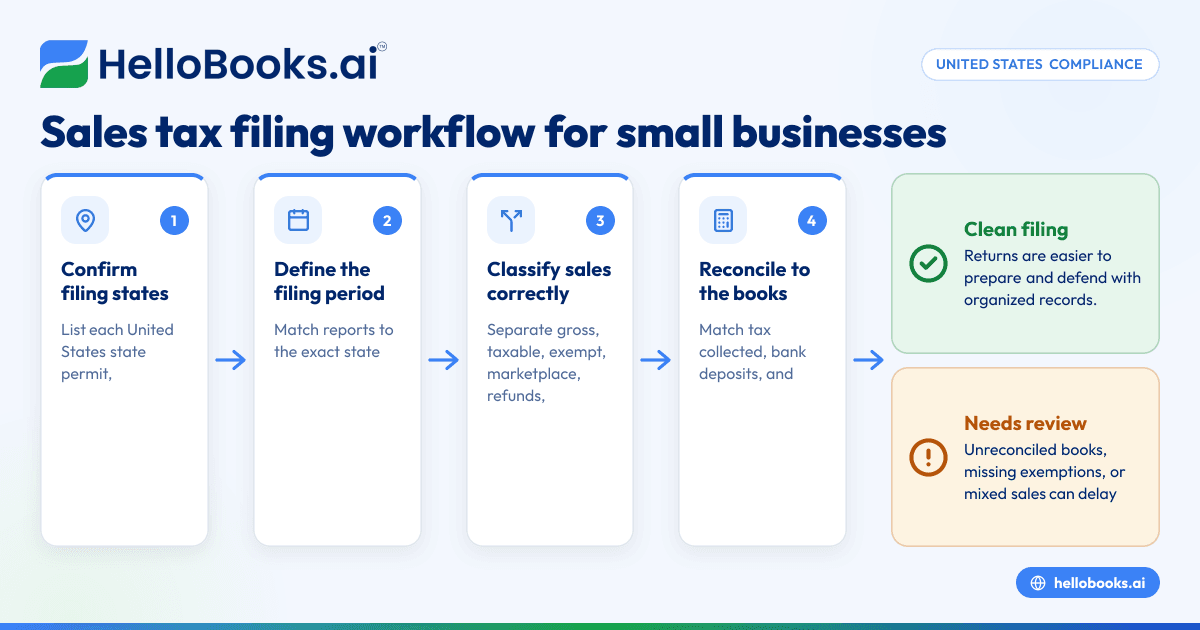
Step-by-step sales tax filing process for small businesses
1. Confirm where you are registered and required to file
Start with a simple filing calendar. List every state where you hold a permit. Add the filing frequency for each state and the due date pattern. Keep this list in one place. Do not rely on memory.
This step sounds basic, but it prevents two common errors: filing in the wrong states and forgetting zero returns.
2. Define the exact filing period
Make sure the date range in your reports matches the state return period. A monthly return usually needs activity for that exact month. A quarterly return needs the exact quarter assigned by the state.
If your accounting close runs late, resist the urge to estimate. It is better to finalize the period correctly than patch mistakes later with amendments.
3. Pull gross sales and separate them by state
Your first number is usually gross sales, not taxable sales. Pull all sales for the period and group them by destination state if your system allows it. This matters because a Chicago seller may have customers in several states, each with different filing obligations.
At this stage, include all channels:
- Direct online sales
- Invoiced sales
- Card-present sales
- Marketplace sales
- Refunds and adjustments
Do not assume your payment processor report alone is enough. Processor totals reflect cash movement, not always tax treatment.
4. Identify taxable, exempt, and non-taxable sales
Next, classify sales properly. This is where returns often go wrong. Some transactions are taxable. Others may be exempt because of the product type, customer status, or documentation.
Review:
- Resale transactions
- Nonprofit or government exemptions where valid
- Sales shipped to states where you are not registered, if applicable
- Marketplace sales where the marketplace collected tax
- Services or products that may be non-taxable in a specific state
If you rely on customer exemptions, make sure you have the exemption certificate on file. Without documentation, a sale may be treated as taxable during an audit.
5. Reconcile tax collected to your books
Once sales are classified, compare the tax collected in your sales system to your accounting records. The liability account should reflect the tax you collected but have not yet remitted.
This comparison catches issues like:
- Sales tax posted to income by mistake
- Refunds not reducing tax liability
- Duplicate entries
- Manual journal entries that changed the balance
- Deposit differences between your sales system and bank account
If your accounting workflow is still spreadsheet-heavy, consider whether accounting software in the USA or accounting software for small business would reduce month-end cleanup.
6. Prepare each state return carefully
Now use your reconciled numbers to complete the return. Some states ask only for a few totals. Others require local breakdowns or separate reporting lines. Follow the state form instructions exactly for that filing period.
As you prepare the return, double-check:
- The permit account number
- The filing period
- Gross sales
- Taxable sales
- Exempt sales
- Tax collected
- Prepayments, credits, or discounts if the state allows them
- Whether a zero return is required
Save a copy of the completed return and supporting workpapers. Do not treat the filing portal as your record system.
7. Submit payment and keep proof
File the return through the state's designated system and schedule payment from the business bank account. Save confirmation numbers, payment receipts, and a PDF or screenshot of the final submission.
This matters later. If a notice arrives, your first defense is clean proof that you filed and paid on time.
8. Post the filing in your books
After filing, reduce the sales tax payable liability in your accounting system for the amount remitted. Match the payment when it clears the bank.
This final step closes the loop. Without it, the liability account may continue to show old balances and confuse the next filing.
What mistakes slow down the sales tax filing process?
The biggest delays come from poor records, not the return itself. Most small businesses lose time because they start gathering data only when the deadline gets close.
The most common mistakes are:
Filing from unreconciled books
If your bank feeds, payment processor totals, and sales records do not match, your return will be harder to defend. Reconcile first. File second.
Mixing marketplace and direct sales
Marketplace-facilitated transactions can be reported differently from direct sales. If you mix them together, you may overstate or understate your tax due.
Missing exemption documentation
If a customer claims exemption, store the certificate in a way you can retrieve quickly. An email inbox is not a system.
Using the wrong taxability settings
Taxability rules differ by state. Review product and customer settings regularly, especially after adding new products or entering a new state.
Waiting until the deadline
A return may take one hour to submit and ten hours to clean up. Start the review early enough to fix issues before the due date.
Can ai sales tax tools help small businesses?
Yes, ai sales tax tools can reduce manual review, especially when they pull clean transaction data from your accounting workflow. They help most when your books are current, your sales channels are connected, and someone still reviews the final return before filing.
The key word is help. Automation is useful, but it does not replace judgment. A tool can speed up classification, flag anomalies, and surface missing details. It can also help standardize recurring tasks across filing periods.
For example, an automated workflow can:
- Pull sales and tax data for the exact filing period
- Flag unusual changes in taxable sales
- Match sales tax collected to the liability account
- Surface missing customer exemption details
- Keep return workpapers organized
For many businesses, the value starts one step earlier, with cleaner bookkeeping. If sales, fees, refunds, and deposits are posted correctly throughout the month, the filing process gets much simpler. That is where software like invoice software and a strong QuickBooks alternative can help create cleaner upstream data.
How can you make sales tax filing easier every month?
Build a repeatable monthly close process that finishes before the filing deadline. Keep sales records, exemption documents, and reconciliations in one place. Then use the same checklist every period so filing becomes a review step, not a rescue project.
That short answer is enough for most businesses. The practical version is to build a simple operating rhythm around it.
Create a monthly compliance checklist
Use one checklist for every filing cycle. Include tasks for sales review, bank reconciliation, exemption review, return preparation, approval, filing, payment, and record retention.
Assign one owner and one reviewer
Even in a small business, someone should own the data and someone should review the filing. This reduces missed steps and creates accountability.
Close books before preparing returns
Do not prepare returns from half-finished books. Reconcile cash, payment processors, and major revenue accounts first. Better bookkeeping leads to faster compliance.
Keep supporting documents organized
Store return copies, confirmations, exemption certificates, and workpapers by state and filing period. If you receive a notice six months later, you will be ready.
Standardize your tools
Too many systems create too many mismatches. If your team still jumps between spreadsheets, email threads, and manual reports, it may be time to simplify with accounting software for small business.
A practical monthly sales tax workflow
Here is a simple workflow a small business can actually follow.
Week 1: Close the month
- Reconcile bank accounts
- Reconcile Stripe or other payment channels
- Review sales summaries
- Check refunds and credits
- Confirm the sales tax liability balance
Week 2: Review state-level sales tax data
- Pull sales by state
- Split taxable and exempt sales
- Review marketplace activity
- Confirm exemption documents are on file
Week 3: Prepare returns
- Complete each return
- Review totals against the general ledger
- Have a second person check the filings
Week 4: File and archive
- Submit returns
- Schedule payments
- Save confirmations
- Post payments to the books
- Update your filing calendar
A workflow like this works well for retailers, distributors, and service businesses that invoice customers across several states. It also reduces last-minute panic when sales volumes rise.
When should you get outside help?
You should get outside help when your business enters new states, your taxability rules get more complex, or you start receiving notices you cannot explain. Complexity increases quickly when you add more products, channels, and locations.
Consider working with a sales tax specialist or accountant if:
- You recently created nexus in new states
- You are unsure whether your products are taxable
- You need help cleaning up prior periods
- You have exemption certificate gaps
- You received state notices or assessment letters
If you need broader support with cleanup and monthly close, you can also find an accountant.
Where software fits into the process
Sales tax filing works best when the books stay current all month. If your team enters invoices late, reconciles only at quarter-end, or tracks sales tax in spreadsheets, the return process will remain manual no matter how good the filing portal is.