


Key takeaways
What this article covers, in order:
- Why this comes up / what goes wrong
- Step-by-step
- Example (fictional figures)
- Common mistakes
- Frequently asked questions
- Key takeaways
An insurance revenue accounting platform helps insurance agents, NBFCs, and financial service businesses accurately record, reconcile, and report their revenue from commissions, fees, and premiums. This article explains why such platforms are essential, the step-by-step process to use one, a detailed example with Indian figures, common mistakes to avoid, and answers to frequently asked questions.
Why this comes up / what goes wrong
Insurance business owners and accountants in India often struggle with managing revenue accounting due to the complex nature of insurance commissions, premium collections, and regulatory compliance. Agents and NBFCs receive payments from multiple sources, including insurers and clients, often with varying payment schedules and commission structures. Without a dedicated platform, they spend excessive time on manual data entry, reconciling payments against invoices, and ensuring GST compliance. Errors in revenue recognition can lead to incorrect tax filings, delayed payments, and compliance risks.
Many still rely on spreadsheets, Tally, or manual bill books, which are prone to errors and inefficiencies. An insurance revenue accounting platform tailored for financial services helps streamline these tasks, saving time and reducing mistakes.
Step-by-step
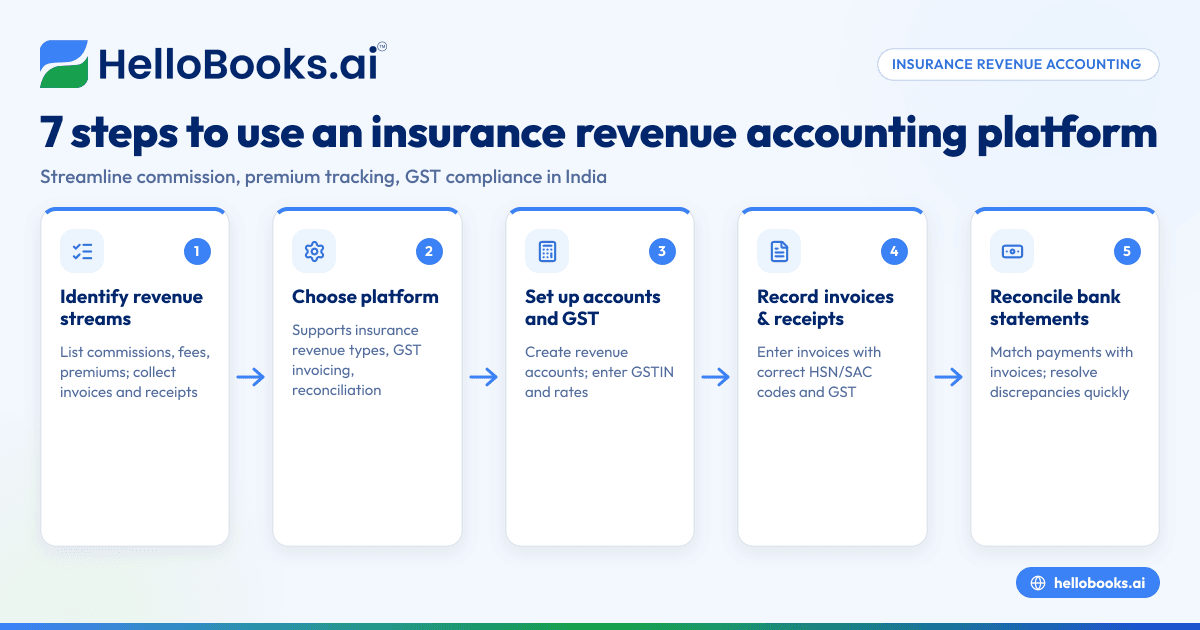
- Identify your revenue streams and documentation
- List all sources of revenue such as commission from insurers, fees from clients, and any other income.
- Collect all invoices, receipts, and payment advices related to these transactions.
- Choose a platform that supports insurance-specific revenue types
- Ensure the platform can handle commission calculations, premium tracking, and GST invoicing.
- Check if it supports reconciliation features for bank statements and insurer payments.
- Set up your chart of accounts and GST details
- Create accounts for each revenue type (e.g., commission income, premium collections).
- Enter your GSTIN and configure GST rates applicable to your services.
- Record invoices and receipts promptly
- Enter all issued invoices with correct HSN/SAC codes and GST rates.
- Upload or link payment receipts to invoices for easy tracking.
- Reconcile bank statements regularly
- Match incoming payments with invoices to identify missing or delayed payments.
- Investigate and resolve discrepancies immediately.
- Generate financial reports and GST returns
- Use the platform to produce profit and loss statements, balance sheets, and GST reports.
- Prepare and review GSTR-1 and GSTR-3B filings using the platform's features.
- Review and audit periodically
- Conduct monthly or quarterly reviews to ensure all revenue is accounted for and reconciled.
- Keep documentation ready for any GST audits or regulatory checks.
For more details on GST invoicing and compliance, see GST invoicing and for specifics on financial services businesses, visit Insurance agents, NBFCs and financial services.
Example (fictional figures)
An insurance agency in Mumbai issues commission invoices and records premium collections as follows:
- Commission invoice dated 01/05/2024 for ₹1,50,000 with 18% GST.
- Premium collection receipt dated 05/05/2024 for ₹3,00,000 with 18% GST.
Calculations:
Commission invoice GST amount:
₹1,50,000 × 18% = ₹27,000
Total invoice value = ₹1,50,000 + ₹27,000 = ₹1,77,000
Premium collection GST amount:
₹3,00,000 × 18% = ₹54,000
Total receipt value = ₹3,00,000 + ₹54,000 = ₹3,54,000
Steps:
- Record the commission invoice with GST correctly.
- Record the premium receipt against the corresponding invoice or client account.
- When payment is received, reconcile bank statement entries against these invoices.
This ensures accurate revenue recognition and GST compliance.
Common mistakes
- Mixing commission and premium revenue accounts
- Prevent by creating separate ledger accounts for each revenue type.
- Incorrect GST rates or codes on invoices
- Prevent by verifying HSN/SAC codes and GST rates for insurance services.
- Delayed reconciliation of payments
- Prevent by scheduling regular bank statement reconciliations.
- Ignoring GST filing deadlines
- Prevent by setting reminders and using platform alerts for GSTR-1 and GSTR-3B.
- Manual data entry errors
- Prevent by using automated data capture or importing bank statements.
- Not maintaining proper audit trails
- Prevent by keeping scanned copies of invoices, receipts, and reconciliation reports.
For more on GST filing and compliance, see HelloBooks for India.
Frequently asked questions
What features should I look for in an insurance revenue accounting platform?
Look for support for commission and premium revenue tracking, GST invoicing with correct HSN/SAC codes, bank statement reconciliation, and GST return preparation like GSTR-1 and GSTR-3B. Integration with your existing accounting tools is also helpful.
Can such platforms handle GST compliance for insurance agents?
Yes, platforms designed for Indian businesses help generate GST-compliant invoices and assist in preparing and filing GSTR-1 and GSTR-3B returns, ensuring you meet statutory requirements.
How often should I reconcile payments?
Ideally, reconcile payments monthly or whenever you receive bank statements to quickly identify missing or delayed payments and maintain accurate books.
Is manual bookkeeping sufficient for insurance revenue accounting?
Manual bookkeeping can lead to errors and delays. Automated platforms reduce data entry, improve accuracy, and save time, especially for businesses handling many transactions.
Can I use the same platform for NBFC and insurance revenue accounting?
Many platforms cater to financial services broadly, including NBFCs and insurance agents. Verify if the platform supports your specific revenue types and compliance needs.
Key takeaways
- Use a platform that supports insurance-specific revenue types like commissions and premiums.
- Maintain separate accounts for each revenue stream and apply correct GST rates.
- Reconcile bank statements regularly to ensure accurate revenue recognition.
- Automate GST invoicing and filing to avoid compliance errors.
- Keep all documentation organized for audits and reviews.
- Regularly review reports to monitor business performance and compliance.
Start managing your insurance revenue accounting efficiently. Start on the Free plan (200 transactions a year, GSTR-1 and 3B filing for one GSTIN).


