


Key takeaways
What this article covers, in order:
- Why this comes up / what goes wrong
- Step-by-step
- Example (fictional figures)
- Common mistakes
- Frequently asked questions
- Key takeaways
An insurance accounting system is essential for insurance agents, NBFCs, and financial services businesses to accurately track premiums received, commissions payable, expenses, and compliance with GST and other regulations. Unlike general accounting, it must handle multiple revenue streams, commission structures, and regulatory reporting specific to insurance.
Why this comes up / what goes wrong
Insurance business owners or accountants often struggle with accounting because their transactions include premium collections, commission payments to agents, brokerage fees, and claim reimbursements. These transactions are frequent and involve multiple parties, making manual bookkeeping prone to errors, delays, and cash flow confusion. GST compliance for insurance-related services can also be complex due to different tax treatments on premiums and commission income. Without a tailored insurance accounting system, businesses risk inaccurate financial reports, delayed GST filings, and cash flow issues.
Step-by-step
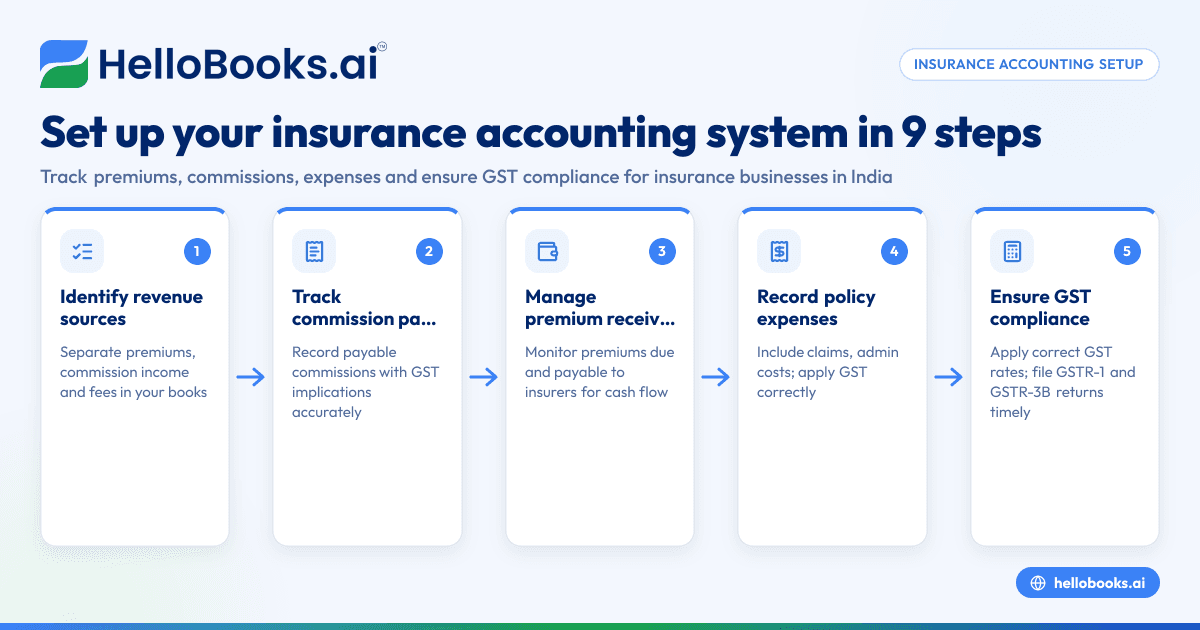
- Identify all revenue sources: List premiums collected from customers, commission income from insurers, and any other fees or charges. Check that each source is separately recorded in your books to avoid mixing income types.
- Track commission payments: Record commissions payable to agents or brokers accurately, including the calculation method, payment dates, and GST implications.
- Maintain premium receivables and payables: Keep track of premiums due from customers and amounts payable to insurers or reinsurers. This helps manage cash flow and ensures timely collections and payments.
- Record expenses related to policies: Include claim payments, administrative costs, and other operational expenses. Ensure GST is applied correctly on these expenses.
- Ensure GST compliance: Apply the correct GST rates on commissions and services. Prepare and file GSTR-1 and GSTR-3B returns timely. Check the input tax credit eligibility on expenses. Insurance agents must file these returns regularly to avoid penalties.
- Reconcile bank statements regularly: Match bank transactions with recorded premiums, commissions, and expenses to identify discrepancies. Monthly reconciliation is recommended to catch errors early.
- Generate financial reports: Prepare profit and loss statements, balance sheets, and cash flow statements reflecting insurance business activities. These reports help with decision-making and compliance.
- Review and update accounting entries monthly: Ensure all transactions are recorded and reconciled before GST filing deadlines to maintain accuracy.
- Keep detailed records for audits: Maintain invoices, receipts, commission statements, and GST returns for compliance verification and audit readiness.
For more on managing GST invoicing specific to insurance and financial services, see GST invoicing. To understand how insurance businesses fit within financial services accounting, visit Insurance agents, NBFCs and financial services.
Example (fictional figures)
Consider an insurance agency in Mumbai that collected premiums and paid commissions in March 2024.
- Premiums collected from customers: ₹5,00,000
- Commission income from insurers: ₹50,000
- Commissions paid to agents: ₹40,000
- Administrative expenses: ₹10,000
- GST rate assumed on commission income and expenses: 18% (illustrative)
Calculate GST on commission income:
₹50,000 × 18% = ₹9,000
Calculate GST on administrative expenses:
₹10,000 × 18% = ₹1,800
Net commission income including GST:
₹50,000 + ₹9,000 = ₹59,000
Total expenses including GST:
₹40,000 (commissions paid) + ₹10,000 (admin) + ₹1,800 (GST on admin) = ₹51,800
Prepare entries:
- Debit bank ₹5,00,000 for premiums collected
- Credit revenue ₹5,00,000
- Debit commission receivable ₹59,000
- Credit commission income ₹50,000 and GST liability ₹9,000
- Debit commission expense ₹40,000
- Debit administrative expenses ₹10,000
- Credit bank ₹51,800
This example shows how to separate premiums, commissions, expenses, and GST for clear accounting.
Common mistakes
- Mixing premium and commission income: Prevent by recording premiums and commissions in separate ledger accounts to maintain clarity.
- Ignoring GST on commission income: Prevent by verifying GST applicability and rates on insurance services before filing returns.
- Delayed bank reconciliation: Prevent by scheduling monthly reconciliation to catch errors and discrepancies early.
- Not maintaining commission payment schedules: Prevent by documenting commission agreements and payment timelines clearly.
- Overlooking input tax credit eligibility: Prevent by reviewing GST rules for expenses related to insurance business regularly.
- Using generic accounting software without insurance features: Prevent by choosing systems that allow customised ledgers for insurance transactions or support insurance accounting.
For more on avoiding errors in insurance accounting and GST compliance, see Insurance agents, NBFCs and financial services.
Frequently asked questions
What is an insurance accounting system?
An insurance accounting system is a specialised method of bookkeeping that tracks premiums, commissions, claims, and expenses unique to insurance businesses. It ensures accurate financial reporting and regulatory compliance.
How is insurance accounting different from regular accounting?
Insurance accounting involves managing multiple revenue types like premiums and commissions, handling complex commission structures, and applying specific GST rules, which differ from standard business accounting.
What GST compliance is needed for insurance businesses?
Insurance agents must file GSTR-1 and GSTR-3B returns, correctly apply GST rates on commissions and services, and reconcile input tax credits. Timely filing avoids penalties.
Can I use generic accounting software for insurance accounting?
Generic software may not handle insurance-specific transactions well, leading to errors. It's better to use systems that support insurance accounting needs or customise ledgers accordingly.
How often should I reconcile accounts in insurance accounting?
Monthly reconciliation is recommended to ensure all premiums, commissions, and expenses are recorded correctly and to prepare for GST filing deadlines.
For further guidance on GST invoicing and filing for insurance businesses, visit GST invoicing.
Key takeaways
- Separate premiums, commissions, and expenses in your accounts for clarity.
- Track commission payments and schedules precisely.
- Apply correct GST rates on commissions and services and file returns timely.
- Reconcile bank statements monthly to avoid discrepancies.
- Maintain detailed records for audits and compliance.
- Use accounting systems that support insurance-specific transactions or allow customisation.
To start managing your insurance accounting efficiently, consider starting on the Free plan (200 transactions a year, GSTR-1 and 3B filing for one GSTIN) at HelloBooks pricing.


