
Key takeaways
What this article covers, in order:
- Key takeaways
- Why is tracking payments made important for small businesses?
- What information should I include when recording payments made?
- How do I track payments made manually vs with software?
- How does AI help with payments made tracking?
- How to reconcile payments made with your bank statements?
Tracking and recording payments made is essential for small businesses in the United States to maintain clear financial records, manage cash flow, and stay compliant with tax regulations. Proper bookkeeping ensures your business expenses and income are accurately documented and simplifies tax filing and audits.
Key takeaways
- Accurately tracking payments made helps manage cash flow and financial health.
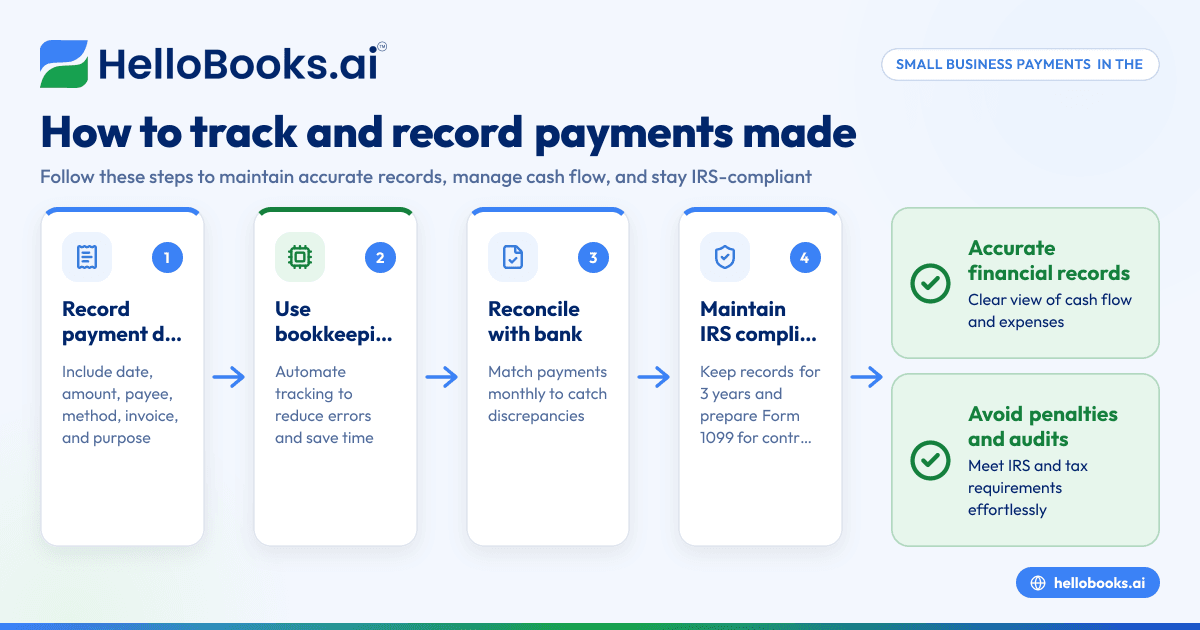
- Record payment details including date, amount, payee, payment method, and purpose.
- Use accounting software or AI bookkeeping tools to automate payment tracking.
- Reconcile payments with bank statements regularly to avoid errors.
- Maintain compliance with IRS rules by keeping detailed payment records.
- Digital invoicing and e-payment methods streamline payment recording processes.
Why is tracking payments made important for small businesses?
Tracking payments made allows you to know exactly how much money is leaving your business, for what purpose, and whether any payments need follow-up. It helps you avoid missed payments, prevent fraud, and prepare accurate financial statements. For tax purposes, the IRS requires detailed records of business expenses, so your bookkeeping must be precise.
Without proper tracking, you risk penalties, audit complications, and difficulties managing budgets. Regularly recording and reviewing payments maintains transparency and supports better business decisions.
What information should I include when recording payments made?
When you record a payment, note the:
- Date of payment
- Amount paid in USD ($)
- Name of the payee (vendor or service provider)
- Payment method (check, credit card, ACH transfer, cash)
- Invoice or reference number, if applicable
- Purpose or category of the expense (supplies, rent, services)
- Any terms or notes related to the payment
This level of detail makes future bookkeeping and tax filing easier. It also allows you to generate detailed financial reports showing how money was spent.
How do I track payments made manually vs with software?
Tracking payments manually means entering payment details into spreadsheet software like Microsoft Excel or Google Sheets. You’ll create columns for each data point and update the sheet regularly. This method works for very small businesses but is time-consuming and prone to errors.
Software options like accounting software for small business automate many of these steps. They connect to your bank accounts, import transactions, and let you categorize payments quickly. Such systems reduce data entry and improve accuracy.
How does AI help with payments made tracking?
AI can save time and reduce errors by automatically categorizing and reconciling payments made.
AI payments made technologies analyze transaction data, detect inconsistencies, and ensure your records are accurate and up-to-date without manual input.
At HelloBooks.ai, AI bookkeeping software automates reconciliation, invoicing, and expense management. This lets you focus on running your business instead of manual bookkeeping tasks. The AI learns your preferences and patterns, speeding up payment recording and reporting.
How to reconcile payments made with your bank statements?
Reconciliation compares your recorded payments against bank statements to confirm all transactions match. This process catches missing, duplicate, or erroneous entries.
- Download or print your bank statement.
- Review each recorded payment to see if it matches a statement entry.
- Mark matching payments as reconciled.
- Investigate any discrepancies and correct your records.
- Repeat monthly or more frequently for accuracy.
Reconciliation ensures your books reflect true cash flow and prevents surprises during tax season.
What are common payment methods for small businesses in the U.S.?
Small businesses commonly use multiple payment methods:
- Checks remain popular for vendors and contractors.
- ACH bank transfers speed up payments with low fees.
- Credit or debit cards offer convenience and rewards.
- Online payment platforms such as Stripe or PayPal enable electronic payments.
- Cash is still used in some retail or service settings but requires careful tracking.
Knowing your typical payment methods helps tailor your bookkeeping approach to capture all transactions efficiently.
How do 1099 forms relate to payment tracking?
If you pay independent contractors $600 or more during the year, you must report these payments using Form 1099-NEC to the IRS and the contractor. To prepare this form accurately, maintain detailed records of all payments made to contractors.
Payment tracking software can flag vendor payments approaching this threshold and help generate 1099 forms. Staying on top of these requirements avoids IRS penalties.
How do state sales taxes and business expenses affect payment tracking?
Unlike sales collected from customers, payments made for business expenses often include state and local sales tax that may be recoverable depending on filing and exemption status. Keep track of the tax portion separately, as this impacts your tax filings and deductions.
For example, purchases made in Illinois or Texas might have varying state and local sales taxes which require clear documentation to claim deductions or credits properly.
Best practices for bookkeeping and payment management
- Record payments as soon as possible after they happen.
- Attach digital copies of receipts and invoices for each payment.
- Use integrated invoice software to connect invoicing with payments.
- Schedule regular reviews and reconciliations.
- Choose software that supports your payment methods and tax needs.
- Train team members responsible for payments on consistent recordkeeping.
How do I switch from manual spreadsheets or QuickBooks to automated bookkeeping?
Switching saves time and reduces errors. Start by selecting an accounting software in the USA or a QuickBooks alternative that matches your business size and industry.
Then:
- Export your existing financial data or transactions.
- Import them into the new system.
- Set up bank feeds and payment integrations.
- Train staff or accountants on the new workflow.
- Gradually transition all payment recording to the software.
HelloBooks.ai offers a user-friendly platform wrapped in AI. You can automate bank reconciliation software and expense management software functions, improving your workflow within days.
How to maintain compliance with IRS and regulatory requirements?
Always keep complete and accurate payment records for at least three years, as required by the IRS. Ensure invoices, receipts, and contracts are stored securely and are accessible.
Reconcile payments regularly to detect and correct errors early. Use compliant software that meets security standards expected by your buyers and auditors.
This is general information and not tax or legal advice. For specific questions, consult a professional accountant or tax advisor.
Ready to simplify your payment tracking?
Explore how HelloBooks.ai can automate your payment tracking, reconciliation, and reporting. Book a demo today at /book-a-demo or see our plans at /pricing.
Frequently asked questions
What details are essential when recording payments made?
Always record the payment date, amount, payee, payment method, invoice number, and expense category. This helps you match payments with invoices and prepare taxes correctly.
How often should I reconcile payments with my bank statements?
Monthly reconciliation is standard and keeps your books accurate. If you handle many transactions, consider weekly reconciliations to catch issues sooner.
Can AI actually reduce errors in payment tracking?
Yes. AI-powered tools like those in HelloBooks.ai automate data entry, categorize payments consistently, and alert you to discrepancies, reducing manual errors.
Is digital invoicing necessary to track payments effectively?
While not mandatory, digital invoicing greatly improves accuracy and speed. It links invoices to payments automatically, simplifying your bookkeeping.
How do I handle payments made to contractors for tax reporting?
Track all payments made to contractors, especially those over $600 annually. Use your software to generate 1099 forms and comply with IRS deadlines.
What is the best way to switch from manual bookkeeping to automated software?
Start by selecting software suited for your business size and needs. Import existing data, set up integrations, and train users. Transition gradually to avoid disruptions.
Read next
This article covers one part of a bigger topic. For the complete picture, read our guide to payments made.