
Key takeaways
What this article covers, in order:
- Why this comes up / what goes wrong
- Step-by-step
- Example (fictional figures)
- Common mistakes
- Doing this in HelloBooks
- Frequently asked questions
A payroll system for manufacturing businesses must handle diverse wage types, attendance tracking, overtime calculations, and statutory compliance specific to the industry. This article explains the step-by-step process to select and implement such a system, highlights common mistakes, provides a detailed example, and describes how HelloBooks can help reduce manual data entry.
Why this comes up / what goes wrong
Manufacturing business owners or accountants often face challenges managing payroll due to the varied workforce composition. They may employ permanent staff, contractual workers, and daily wage labourers, each with different wage structures and attendance patterns. Tracking shifts, calculating overtime, and applying statutory deductions such as Provident Fund (PF), Employee State Insurance (ESI), and Professional Tax can be complex and time-consuming. Many businesses still use manual spreadsheets or Tally, which increases errors and wastes time. Inaccurate payroll can lead to employee dissatisfaction, compliance issues, and penalties.
Step-by-step
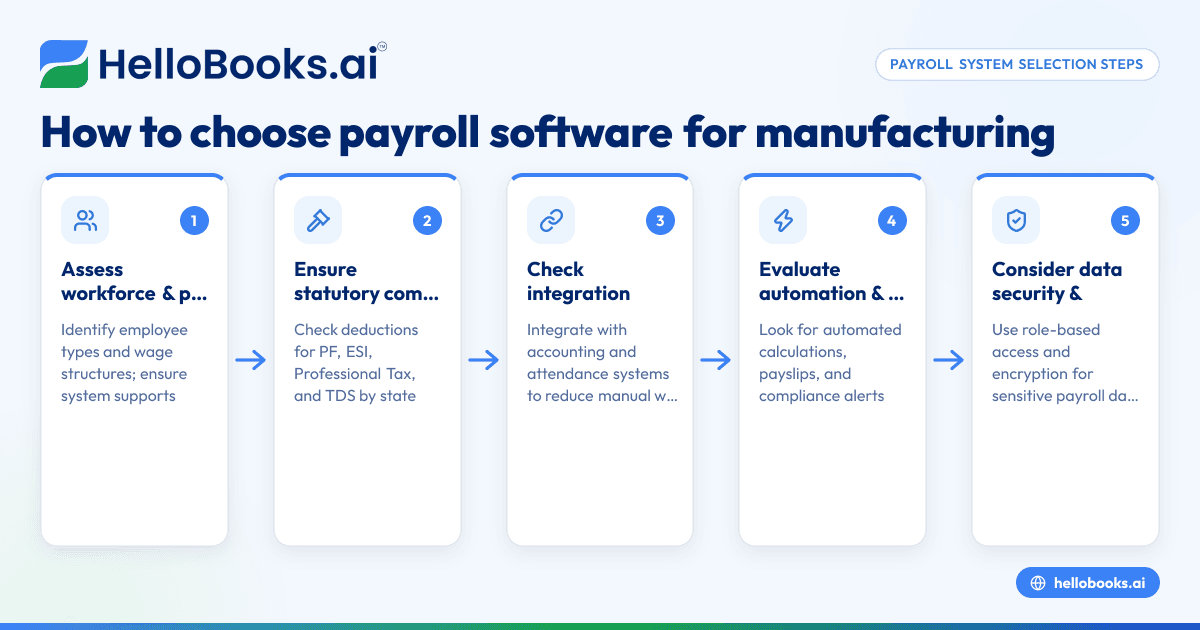
- Assess your workforce and payroll needs: List all employee categories (permanent, contractual, daily wage) and their pay structures. Check if your payroll system supports multiple wage types, shift differentials, and overtime calculations.
- Ensure statutory compliance: Confirm that the system can handle deductions like Provident Fund, ESI, Professional Tax, and TDS as applicable in your state. It should generate reports and forms needed for government filings.
- Check integration capabilities: The payroll system should integrate with your accounting software and, if possible, with your attendance or production systems to reduce manual data entry and errors.
- Evaluate automation and ease of use: Look for features such as automated salary calculations, attendance data import, payslip generation, and compliance alerts to reduce manual work.
- Consider data security and access controls: Payroll data is sensitive; ensure your system offers role-based access and data encryption.
- Test the system with sample data: Run a trial payroll cycle using sample employee data to verify calculations, deductions, and report accuracy.
- Train your staff: Provide training for payroll and HR teams on using the system effectively.
- Review and update regularly: Payroll rules and employee details change over time; keep the system updated accordingly.
For more on manufacturing business processes, see Manufacturing.
Example (fictional figures)
Consider an auto-components MSME in Pune processing payroll for a permanent worker in March 2024.
- Basic Salary = ₹30,000
- House Rent Allowance (HRA) = ₹12,000
- Overtime = 10 hours at an assumed ₹150/hour
- Provident Fund (PF) deduction calculated on Basic Salary
- Professional Tax = ₹200
Calculations:
Overtime pay = 10 hours × ₹150 = ₹1,500
Gross Salary = Basic + HRA + Overtime
= ₹30,000 + ₹12,000 + ₹1,500 = ₹43,500
PF deduction = (Assumed statutory percentage) × ₹30,000 = NEEDS EXPERT REVIEW
Professional Tax = ₹200
Total Deductions = PF deduction + ₹200 = NEEDS EXPERT REVIEW
Net Salary = Gross Salary - Total Deductions = NEEDS EXPERT REVIEW
This example highlights the need for the payroll system to accurately calculate overtime and statutory deductions. Exact PF rates vary and must be applied as per the latest government rules.
Common mistakes
- Ignoring different wage types: Not accounting separately for contractual or daily wage workers leads to incorrect payroll. Choose systems that support multiple pay structures.
- Manual data entry errors: Entering payroll data manually in spreadsheets causes mistakes. Prevent this by automating data capture and calculations.
- Missing statutory deadlines: Late submission of PF, ESI, or tax payments results in penalties. Use software with compliance reminders.
- Not reconciling attendance: Payroll without verifying attendance records can cause overpayments. Integrate with attendance systems or check records before processing payroll.
- Poor data security: Payroll data breaches harm employee trust. Use systems with role-based access and encryption.
For more on GST and invoicing related to manufacturing, visit GST invoicing.
Doing this in HelloBooks
HelloBooks offers OCR for purchase bills, allowing manufacturing businesses to capture supplier bills from photos or PDFs instead of manual entry. This reduces data entry time and errors, freeing resources to focus on payroll and compliance tasks. Learn more at HelloBooks for India.
Frequently asked questions
What payroll solutions are best for manufacturing businesses?
Look for payroll systems that handle multiple wage types, overtime, statutory deductions, and integrate with attendance and accounting software. Ease of use and compliance support are important.
Can payroll software integrate with Tally or Excel?
Many payroll systems provide import/export features for Tally or Excel to reduce duplicate data entry. Confirm integration capabilities before selecting a system.
How do I manage payroll compliance for manufacturing workers?
Ensure your payroll system correctly calculates and deducts Provident Fund, ESI, Professional Tax, and TDS. Keep the software updated with the latest statutory changes.
Is automation helpful for payroll in manufacturing?
Yes, automation reduces errors, saves time, and ensures timely salary payments and statutory filings.
How can I avoid payroll errors?
Use a tested payroll system, reconcile attendance data, automate calculations, and review payroll reports before finalising.
For more details on manufacturing business processes, see Manufacturing.
Key takeaways
- Manufacturing payroll systems must handle diverse wage types, overtime, and statutory deductions.
- Automate payroll calculations and integrate attendance data to reduce errors and save time.
- Test the payroll system with sample data and train staff before full implementation.
- Regularly update payroll software to stay compliant with changing laws.
- HelloBooks helps reduce data entry by capturing supplier bills via OCR.
For a practical walkthrough of payroll and accounting for your manufacturing business, Book a 30-minute demo at Book a 30-minute demo.