
Key takeaways
What this article covers, in order:
- Why this comes up / what goes wrong
- Step-by-step
- Example (fictional figures)
- Common mistakes
- Doing this in HelloBooks
- Frequently asked questions
NYC sales tax combines New York State and New York City sales taxes plus a Metropolitan Commuter Transportation District surcharge, applied to most taxable sales within the city. Businesses selling taxable goods or services in NYC must register with the state tax department, collect the correct tax, keep records, file returns, and remit the tax on time. This article explains the practical steps for compliance, common mistakes to avoid, a worked example in Indian rupees for clarity, and how HelloBooks helps Indian businesses with related GST reconciliation and tax accuracy features.
Why this comes up / what goes wrong
Small business owners search "nyc sales tax" because they need to know how much tax to charge customers in New York City and how to comply with filing and payment requirements. The combined tax structure and varying rates by product or service cause confusion. Errors in calculating or reporting sales tax can lead to penalties and cash flow problems. Indian small businesses face similar challenges with GST invoicing, reconciliation, and filing, making this a useful comparison for understanding tax compliance complexities.
Step-by-step
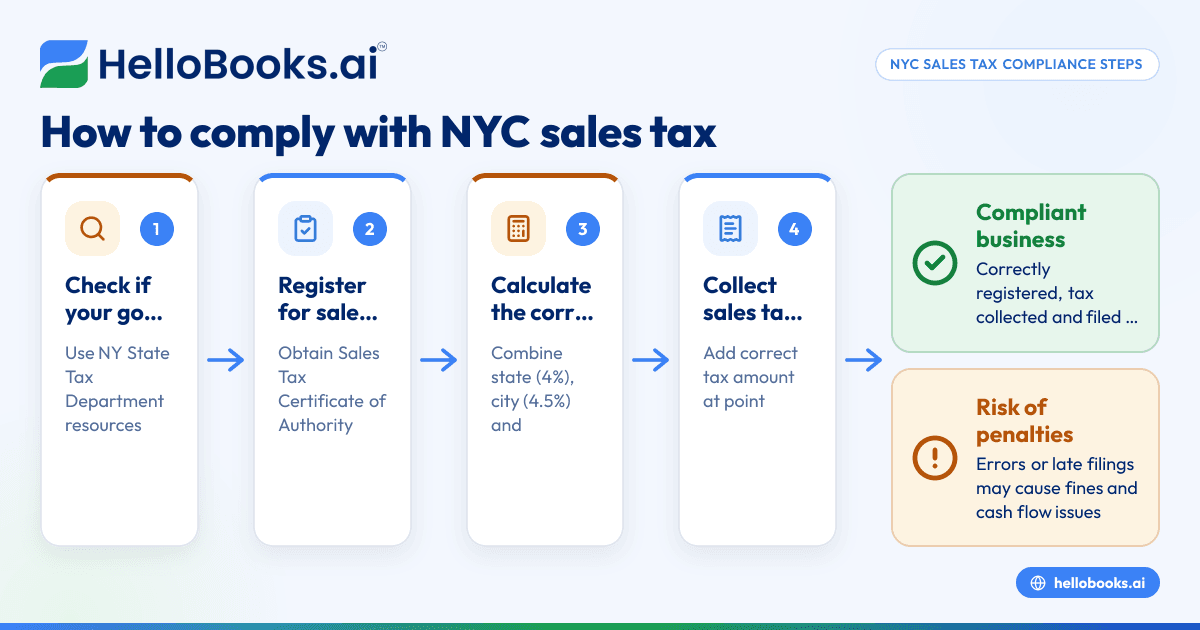
- Determine if your goods or services are taxable in NYC. Use New York State Department of Taxation and Finance resources to confirm taxability. NEEDS EXPERT REVIEW.
- Register for a sales tax permit. If you make taxable sales in NYC, register with the New York State Tax Department to obtain a Sales Tax Certificate of Authority.
- Calculate the correct sales tax rate. The combined NYC sales tax rate generally includes the state rate (4%), city rate (4.5%), and a 0.375% Metropolitan Commuter Transportation District surcharge, totaling about 8.875%. Rates may vary by product or service. NEEDS EXPERT REVIEW.
- Collect sales tax on each taxable sale. Add the correct tax amount to the sale price at the point of sale.
- Maintain accurate sales records. Keep detailed invoices and receipts showing taxable sales and collected tax.
- File sales tax returns and remit collected tax on time. New York requires periodic filing (monthly, quarterly, or annually depending on volume). Use official forms and follow deadlines carefully.
- Stay updated on rate changes and exemptions. Tax rules can change; regularly check official sources.
Example (fictional figures)
An Indian business exports goods to a New York City client on 15/05/2024. The invoice value is ₹1,00,000. Assume an illustrative NYC sales tax rate of 8.875% for calculation.
Tax calculation:
₹1,00,000 × 8.875% = ₹8,875
Total invoice amount including tax:
₹1,00,000 + ₹8,875 = ₹1,08,875
The business must collect ₹8,875 as sales tax, report it correctly in tax filings, and remit this amount to the New York tax authorities.
Common mistakes
- Charging incorrect tax rates: Prevent by regularly verifying current rates from official New York State resources.
- Failing to register for sales tax: Prevent by confirming registration requirements early.
- Mixing up tax jurisdictions: Prevent by understanding the combined state and city tax structure.
- Late filing or payment: Prevent by setting reminders and tracking deadlines carefully.
- Poor record-keeping: Prevent by maintaining detailed invoices and using digital tools for sales and tax tracking like HelloBooks.
- Confusing inter-state and intra-state tax rules: Prevent by learning specific rules for your business location and sales destinations.
Doing this in HelloBooks
HelloBooks offers GSTR-2A/2B reconciliation and ITC tracking that flags missing or mismatched supplier invoices before ITC is claimed in GSTR-3B. It also automates place-of-supply and tax head split, ensuring CGST+SGST are charged on intra-state sales and IGST on inter-state sales correctly, reducing invoice errors. These features help Indian businesses manage tax accuracy and reconciliation efficiently. Learn more at HelloBooks for India and about GST invoicing.
Frequently asked questions
How much is NYC sales tax?
NYC sales tax is approximately 8.875%, combining New York State and New York City taxes plus a transportation surcharge. Rates vary by product or service; check official sources for exact rates. NEEDS EXPERT REVIEW.
What is the process for NYC sales tax compliance?
Register for a sales tax permit, collect the correct tax on sales, maintain records, file returns periodically, and remit the collected tax on time. Using professional help or software can simplify this process.
How do I avoid mistakes in NYC sales tax filing?
Keep updated on tax rates, register properly, maintain accurate records, and meet filing deadlines. Tools like HelloBooks assist with reconciliation and tax accuracy.
Is NYC sales tax similar to GST in India?
Both are consumption taxes but differ in structure and administration. Indian businesses can use HelloBooks for GST invoicing, reconciliation, and filing, which shares some compliance challenges with NYC sales tax.
Can HelloBooks help with US sales tax?
HelloBooks focuses on Indian GST compliance. However, its reconciliation and invoicing features provide useful insights into managing complex tax environments.
Key takeaways
- NYC sales tax combines state and city taxes totaling about 8.875% on taxable sales.
- Small businesses must register, collect, file, and remit sales tax correctly and on time.
- Common errors include wrong rates, missed registration, and late filing; prevention requires diligence and good record-keeping.
- HelloBooks supports Indian businesses with GST reconciliation and tax head split features to reduce errors.
- Regularly check official resources for updates and compliance requirements.
Understanding NYC sales tax is important if you sell taxable goods or services there. Indian businesses can draw parallels with GST compliance challenges. To see how HelloBooks can simplify your tax and invoicing needs, Book a 30-minute demo.
This article is general information, not tax or legal advice. Rules change; confirm the current position on gst.gov.in or with your chartered accountant before acting.