
Key takeaways
What this article covers, in order:
- Why this comes up / what goes wrong
- Step-by-step
- Example (fictional figures)
- Common mistakes
- Frequently asked questions
- Key takeaways
Automated due diligence software in Singapore helps small businesses automate the process of verifying identities, screening sanction lists, monitoring adverse media, and checking company registrations. This reduces manual effort, speeds up compliance, and lowers the risk of missing critical red flags. The software supports compliance with anti-money laundering (AML) and Know Your Customer (KYC) regulations by providing consistent data and audit trails. This article explains why small businesses seek this software, how to evaluate options step-by-step, a practical example with Indian figures, common mistakes, and frequently asked questions.
Why this comes up / what goes wrong
Small business owners in Singapore face strict AML and KYC regulations requiring thorough due diligence on clients, suppliers, and partners. Manual due diligence using spreadsheets, paper records, or ad hoc checks is slow and prone to errors. It can lead to missed risks, compliance failures, and potential penalties. Automated due diligence software promises faster, more reliable checks by pulling data from trusted sources and generating reports automatically. However, choosing the right software is challenging due to variations in data coverage, automation levels, integration capabilities, compliance features, and costs.
Step-by-step
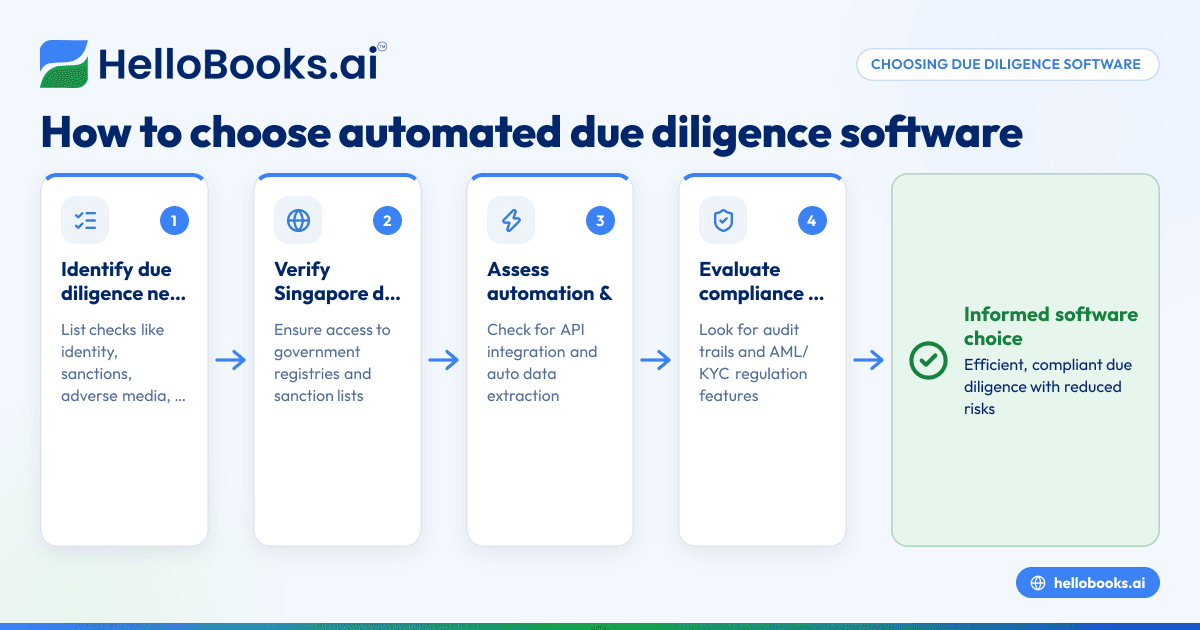
- Identify Your Due Diligence Requirements: List the specific checks you need, such as identity verification, sanction list screening, adverse media monitoring, and company registration verification. Ensure the software covers these checks relevant to your business sector.
- Verify Data Sources and Geographic Coverage: Confirm the software accesses reliable, up-to-date data sources specific to Singapore, including government registries, international sanction lists, and credible news databases. This ensures accuracy and compliance.
- Assess Automation and Integration Features: Check how much manual data entry the software requires. Look for features like automatic extraction of information from documents, API integration with your accounting or CRM systems, and automated report generation. Integration reduces duplicate data entry and streamlines workflows.
- Evaluate Compliance Support: Confirm the software supports Singapore’s AML and KYC regulations by providing audit trails, documentation, and reports suitable for regulatory inspections. This helps demonstrate compliance during audits.
- Check User Interface and Reporting Formats: The software should be easy to use and produce clear, actionable reports. Verify if reports can be exported in common formats like PDF or Excel, which are widely used in financial processes such as GST invoicing and e-invoicing (IRN and QR).
- Review Pricing Models and Customer Support: Understand the pricing structure—whether subscription-based, per-check fees, or tiered plans. Also, check the availability of customer support and training resources to help your team get started.
- Trial the Software and Collect Feedback: Use free trials or demos with your actual business data. Gather feedback from your finance or compliance team about usability, accuracy, and effectiveness before making a decision.
Example (fictional figures)
An Indian small business importing electronics wants to automate supplier due diligence. Currently, it spends 12 hours monthly on manual checks, with staff costing ₹350 per hour.
- Manual cost per month = 12 hours × ₹350 = ₹4,200
- Automated software subscription = ₹2,500 per month (assumed illustrative rate)
Savings per month = ₹4,200 - ₹2,500 = ₹1,700
If the software also reduces the risk of penalties worth ₹60,000 annually, the monthly benefit increases:
- Annual penalty risk = ₹60,000
- Monthly equivalent = ₹60,000 ÷ 12 = ₹5,000
- Total monthly benefit = ₹1,700 + ₹5,000 = ₹6,700
This example shows automating due diligence saves time, cuts costs, and lowers compliance risks.
Common mistakes
- Choosing software without Singapore-specific data: Prevent this by verifying the software covers Singapore government and regulatory databases.
- Ignoring integration needs: Prevent by checking if the software can connect with your existing accounting or CRM tools to avoid duplicate data entry.
- Overlooking compliance documentation: Prevent by ensuring the software provides audit trails and reports compliant with Singapore’s AML/KYC regulations.
- Neglecting user training: Prevent by allocating time for staff training and using vendor support resources.
- Focusing only on price: Prevent by balancing cost with features, data accuracy, and support.
- Not updating due diligence regularly: Prevent by scheduling periodic reviews, especially after significant changes in business relationships.
Frequently asked questions
What is automated due diligence software?
Automated due diligence software automates verifying identities, screening sanctions and watchlists, and assessing risks related to clients or vendors. It reduces manual work and errors, making compliance easier.
Is automated due diligence mandatory in Singapore?
Certain sectors must perform due diligence under Singapore’s AML and KYC laws. While software is not mandatory, it helps meet compliance efficiently and consistently.
Can automated due diligence software integrate with accounting tools?
Many solutions offer API integration with accounting and CRM systems to streamline workflows and reduce duplicate data entry. Evaluating integration capabilities is important before purchase.
How often should due diligence be updated?
Due diligence should be updated regularly, typically annually or when there is a significant change in the business relationship.
What formats do due diligence reports come in?
Reports usually come in PDF and Excel formats for easy sharing and record-keeping. These formats are similar to those used in GST invoicing and e-invoicing (IRN and QR).
Key takeaways
- Automated due diligence software saves time and reduces errors in compliance checks.
- Verify the software covers Singapore-specific registers and sanctions.
- Integration with existing finance and CRM systems streamlines processes.
- Ensure software provides compliance documentation and audit trails.
- Balance cost with features and support when choosing software.
- Use trials and team feedback to assess usability before purchase.
- Schedule regular updates to due diligence to maintain compliance.
Choosing the right automated due diligence software in Singapore helps small businesses comply efficiently while saving time and reducing risks. For Indian businesses managing GST compliance alongside due diligence, explore HelloBooks for India and its features for GST invoicing and e-invoicing (IRN and QR).
Compare plans for India at Compare plans for India.