
Key takeaways
What this article covers, in order:
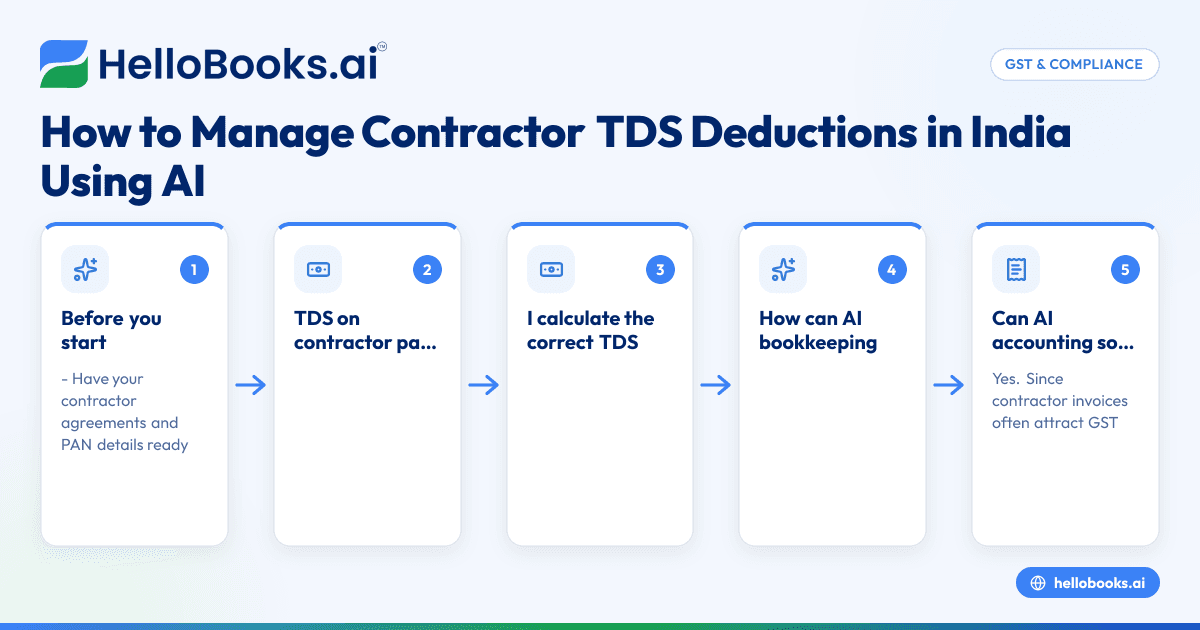
- Before you start
- Step 1: What is TDS on contractor payments in India and why must you deduct it?
- Step 2: How do I calculate the correct TDS on contractor payments?
- Step 3: How can AI bookkeeping software simplify TDS deduction and bookkeeping?
- Step 4: Can AI accounting software also help with GST and e-invoicing compliance for contractor payments?
- Step 5: What records must I maintain after deducting TDS on contractor payments?
How to Manage Contractor TDS Deductions in India Using AI Bookkeeping Software
This guide is for Indian business owners, finance leads, and accountants who want to handle TDS on contractor payments efficiently. By the end, you'll know how to accurately deduct, record, and report TDS on contractor payments using AI bookkeeping software, speeding up compliance and avoiding costly mistakes.
Before you start
- Have your contractor agreements and PAN details ready.
- Know the applicable TDS rates under the Income Tax Act for contractor payments (usually 1% or 2% for businesses).
- Maintain GST registration and proper books for invoice recording.
- Access to reliable AI bookkeeping software that supports TDS deductions and reporting.
Step 1: What is TDS on contractor payments in India and why must you deduct it?
Under Indian tax law, Tax Deducted at Source (TDS) applies when a business makes payments to contractors for services. This means your business must deduct a portion (usually 1% for individual/HUF contractors, 2% for others) before paying the contractor. The deducted TDS is then deposited with the Indian government and credited to the contractor’s tax account.
Why is it important? Because failing to deduct or deposit TDS can attract penalties and interest. Also, it helps the government track income and prevent tax evasion.
Common mistake: Treating contractor payments like vendor purchases without deducting TDS or applying GST tax rules on the wrong component.
Step 2: How do I calculate the correct TDS on contractor payments?
Calculate TDS on the gross payment amount for the contractor's services, excluding GST. For instance, if you pay ₹1,00,000 to a contractor and the TDS rate is 1%, deduct ₹1,000 as TDS and pay the contractor ₹99,000.
Important: Confirm the contractor’s PAN is valid; otherwise, higher TDS rates apply. Also, check whether the contract classifies as 'contract for services' to attract TDS.
Common mistake: Deducting TDS on invoice value including GST or missing PAN validation leading to wrong TDS rates.
Step 3: How can AI bookkeeping software simplify TDS deduction and bookkeeping?
AI TDS features in modern bookkeeping software automate deduction and record-keeping. The software can extract contractor invoices, recognise payment details, deduct TDS automatically at applicable rates, and generate payment vouchers. It can also prepare TDS challans for deposit and generate Form 26Q for filing quarterly TDS returns.
This saves time, reduces manual errors from spreadsheets or Tally entries, and ensures compliance deadlines are met.
Common mistake: Relying solely on manual bookkeeping tools which cause missed deadlines and reconciliation errors.
Step 4: Can AI accounting software also help with GST and e-invoicing compliance for contractor payments?
Yes. Since contractor invoices often attract GST, AI accounting software can automatically apply GST rates, generate e-invoices (if turnover exceeds ₹20 crore or applicable threshold), and track e-way bills if goods are involved.
This integration ensures your contractor payments and TDS records are consistent with your GST filings, preventing mismatches and audits.
Common mistake: Managing TDS and GST separately leading to data discrepancies.
Step 5: What records must I maintain after deducting TDS on contractor payments?
Maintain these digitally, ideally within your AI bookkeeping software:
- Contractor invoices with GST and service details.
- Payment vouchers reflecting TDS deduction amounts.
- TDS challan receipts for deposits to the government.
- Form 26Q and TDS return acknowledgements.
- Contractor PAN and contract agreements.
Proper record-keeping simplifies audits and GST return filing.
Common mistake: Keeping fragmented paper or spreadsheet files with missing TDS details.
Worked Example: Using AI Bookkeeping Software for Contractor TDS
Shivani runs a web design agency in Pune with multiple freelance contractors. In March 2024, she receives an invoice of ₹1,20,000 (plus ₹21,600 GST at 18%) from a freelance contractor without which she will not deliver client projects on time.
- Step 1: Confirm contractor’s PAN is valid. Shivani uses AI bookkeeping software that verifies PAN.
- Step 2: Software calculates TDS at 1% on ₹1,20,000 = ₹1,200.
- Step 3: Software generates payment voucher showing ₹1,20,000 invoice amount, ₹1,200 TDS deducted, and ₹1,40,000 GST separately.
- Step 4: Shivani pays the contractor ₹1,18,800 (₹1,20,000 - ₹1,200) plus the ₹21,600 GST.
- Step 5: Software prepares TDS challan with TAN and generates Form 26Q data for quarterly filing.
- Step 6: Contractor uses Form 26AS credits TDS during tax filings.
- Step 7: The GST e-invoice is filed, with seamless integration of sales data and TDS details.
Shivani’s manual data entry is reduced to nearly zero, and compliance risks are minimised.
What errors should I watch for when managing TDS on contractor payments?
Automating with AI bookkeeping helps but stay alert to:
- Wrong TDS rates due to incorrect classification of contractor.
- Missing PAN leading to 20% TDS deduction, which can strain cash flows.
- Delays in depositing TDS causing penalty.
- Improper invoices without breakdown of service and GST.
- Not reconciling TDS deducted with Form 26AS or contractor’s tax returns.
Double-check these regularly with your software’s audit features.
How does ai tds improve my overall accounting workflow?
AI TDS streamlines tax deduction by auto-identifying contractor payments, calculating precise TDS amounts, and updating your books in real-time. This reduces manual reconciliation and reporting errors, helping your finance team focus on strategic activities. Integration with GST and bank feeds further smoothens monthly compliance and vendor payments.
This digital accuracy is especially helpful when managing multiple contractors across cities like Mumbai, Bengaluru, and Pune, reducing compliance headaches and audit risks.
To see how AI bookkeeping software like HelloBooks can handle your contractor TDS deductions, streamline GST invoicing, and simplify bank reconciliation, book a demo or compare plans today.
Managing TDS on contractor payments in India need not be a complex, time-consuming task. With clear steps and AI-powered tools, your business can stay compliant and save hours of manual bookkeeping each month. Get started by choosing the right software that supports TDS automation and GST integration for your small or growing business.
Related reading
- AI bookkeeping
- How to Perform Accurate GST Return Filing in India Using AI Bookkeeping Software, Supported with Caveats
- How AI Bookkeeping Software Fully Supports Small Businesses in India to Reduce Manual Accounting Errors
Read next
This article covers one part of a bigger topic. For the complete picture, read our guide to supported with caveat.