
Key takeaways
What this article covers, in order:
- Where manual errors usually start in Indian bookkeeping
- How AI bookkeeping cuts errors before GST filing
- Purchase bills, OCR and ITC tracking reduce rework
- Bank statement upload matters more in India than many articles admit
- Inventory, purchases and sales should not live in separate worlds
- AI bookkeeping also lowers the compliance risk around transport and tax handling
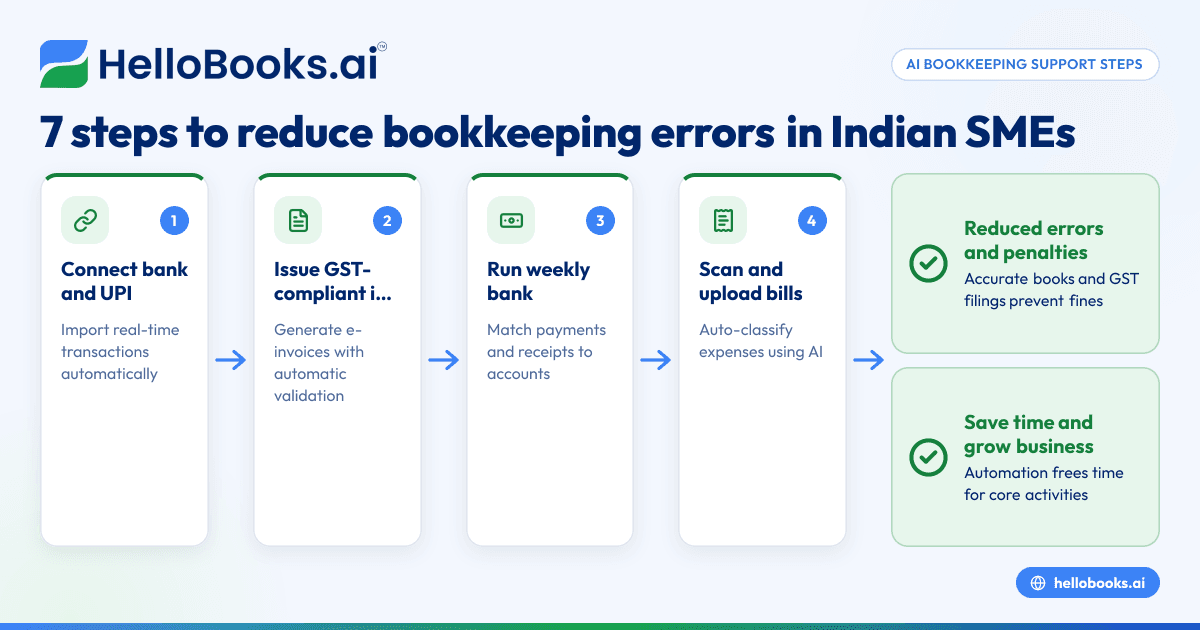
India’s small businesses reduce manual accounting errors when bookkeeping software captures a transaction once and reuses it across invoices, GST records, bank reconciliation, inventory and reports. In practice, that means fewer typing mistakes, fewer CGST/SGST versus IGST mix-ups, faster matching of UPI and NEFT receipts from uploaded bank statements, and cleaner data for filing GSTR-1 and GSTR-3B on the GST Portal operated by GSTN under the CGST Act, 2017 and related GST law.
Where manual errors usually start in Indian bookkeeping
For many Indian businesses, errors do not begin at year-end. They begin at the first entry point.
A sale is written in a notebook, then copied into Excel, then typed again into an invoice, then totalled for GST, then re-entered for return filing, then matched against a bank statement. Every re-typing step creates another chance to get the amount, GSTIN, place of supply, tax head, HSN/SAC, or customer name wrong.
That is especially common when a business handles a mix of:
- local and inter-state sales needing the right CGST/SGST or IGST split
- inventory items and service lines in the same month
- receipts coming through UPI, IMPS, NEFT or RTGS
- purchase bills arriving as paper slips, WhatsApp photos, PDFs, or email attachments
- multiple branches or GSTINs across states
In India, these are not just bookkeeping problems. They can become compliance problems under the GST framework administered by the Central Board of Indirect Taxes and Customs (CBIC) and implemented through GSTN on the GST Portal. Invoice particulars are governed by GST law, including the CGST Act, 2017 and the CGST Rules, 2017; the current legal requirements are published on cbic.gov.in and gst.gov.in.
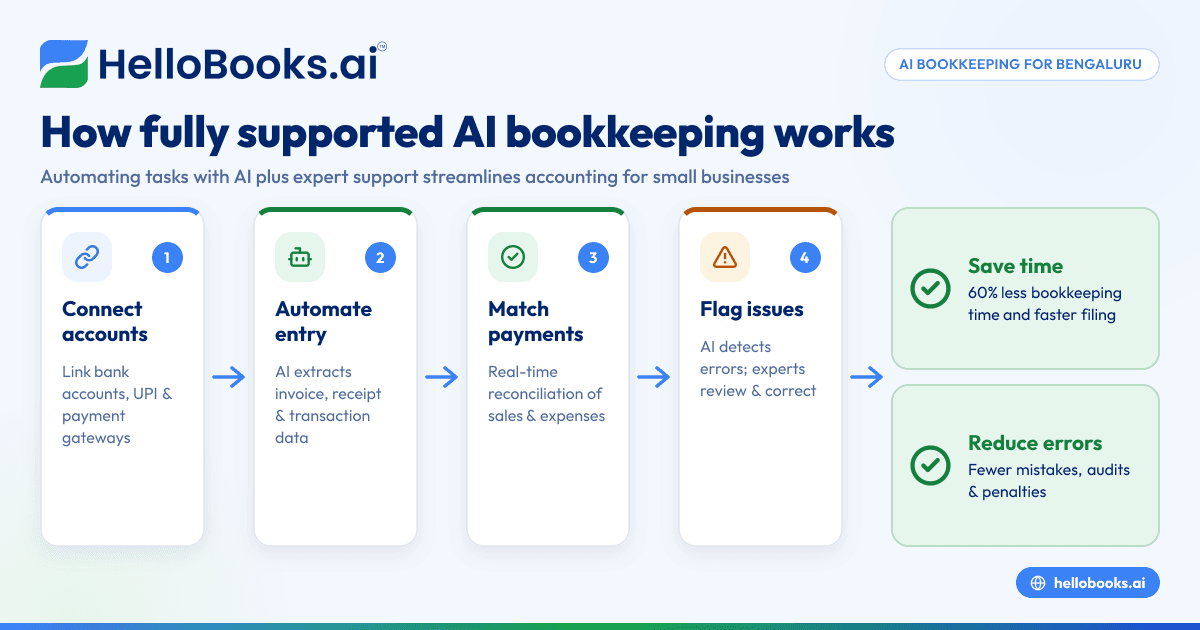
AI bookkeeping helps by shrinking the number of times the same data must be entered. If the original invoice, expense or receipt is captured correctly, the rest of the workflow becomes much less fragile.
How AI bookkeeping cuts errors before GST filing
The biggest win is not “AI” in the abstract. It is structured data.
When bookkeeping software creates GST invoices with customer GSTIN details, place-of-supply logic and the right tax-head split built in, it reduces one of the most expensive manual mistakes in India: charging the wrong tax type for a sale. A local sale may need CGST and SGST, while an inter-state sale may need IGST, depending on the facts and the GST law. The legal framework sits under the Integrated Goods and Services Tax Act, 2017 and the CGST Act, 2017, with official guidance and current rules published by CBIC and on the GST Portal.
That same bookkeeping record can then feed smart invoicing and, where applicable under current e-invoicing rules, generate an IRN and signed QR through e-invoicing software. The present applicability criteria are set under GST law and notified by CBIC; businesses should check the latest notifications and advisory material on cbic.gov.in and gst.gov.in because thresholds can change.
This matters because many GST filing errors are invoice-origin errors. If the invoice itself has the wrong GSTIN, tax head, taxable value, or place of supply, the mistake can flow straight into returns.
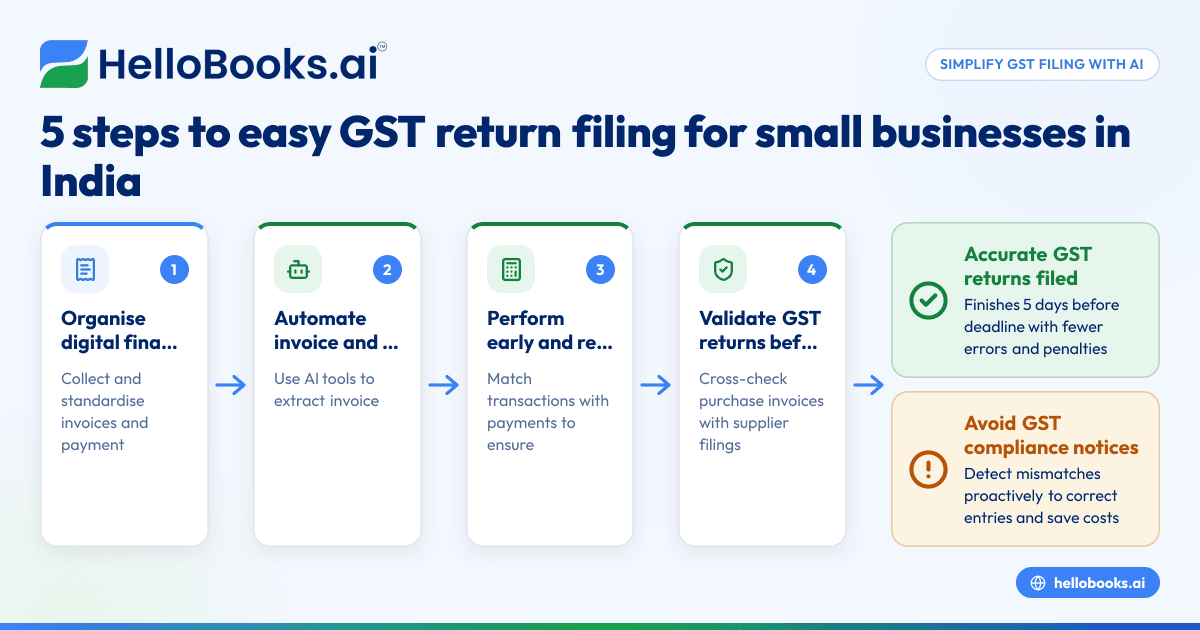
With properly connected books, GSTR-1 and GSTR-3B are prepared from the same underlying entries instead of from separate spreadsheets. That reduces the classic mismatch where sales shown to customers and sales declared to GSTN differ because someone edited one file but not the other. HelloBooks is relevant here because it directly files GST return filing software data for GSTR-1 and GSTR-3B from the books already maintained in the system.
Purchase bills, OCR and ITC tracking reduce rework
On the purchase side, manual entry creates a different cluster of errors: duplicate bills, wrong vendor names, missed tax amounts, and ITC claimed on invoices that are not reflected properly.
Indian businesses often receive supplier documents in inconsistent formats. One vendor sends a PDF, another sends a photo on WhatsApp, another hands over a printed tax invoice, and another sends a bill with incomplete item descriptions. Entering all of this by hand is slow and error-prone.
OCR for purchase bills helps by pulling data from the document into the books rather than making a staff member type every line. The value is not just speed. It is consistency across vendor name, invoice number, taxable amount and GST fields.
Then comes the GST-specific part: reconciliation. A bookkeeping system that checks purchase records against GSTR-2A and GSTR-2B helps the business see where supplier invoices are missing or mismatched before figures are used in GSTR-3B. The entitlement conditions for input tax credit arise under the CGST Act, 2017 and associated rules, and the current return data and matching environment are published on gst.gov.in. Any claim decision in a live case should be reviewed with a qualified tax professional because facts matter.
For small businesses, this is often the difference between controlled month-end work and last-minute chaos. Instead of hunting across email, Tally exports, PDFs and paper files, the owner or accountant can work from one purchase ledger and one reconciliation view.
Bank statement upload matters more in India than many articles admit
A generic bookkeeping article often treats reconciliation as a back-office nicety. In India, it is central.
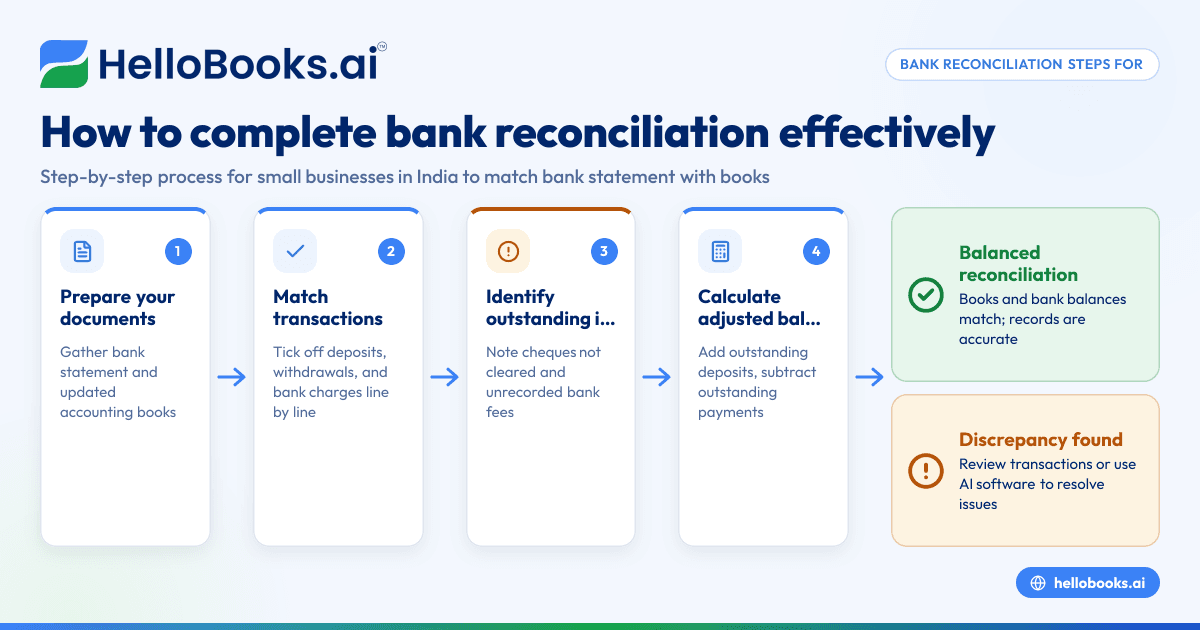
A small business may collect rupees through UPI, receive a customer transfer by NEFT, pay a supplier by RTGS, settle petty expenses in cash, and see fees or reversals hit the bank later. If books are maintained separately from the actual bank statement, the business can easily overstate receivables, miss bounced receipts, or fail to spot duplicate entries.
Uploading a bank statement and using AI reconciliation reduces that drag. Instead of keying every transaction manually, the business imports the statement and matches receipts and payments to recorded invoices and expenses. That is especially helpful when narration formats differ across banks and when a proprietor wants month-end books without spending evenings clearing unmatched lines.
This is where bank reconciliation software is useful in a specifically Indian sense: it helps map real bank movement to GST invoices, credit sales and vendor payments even when references come through messy UPI descriptions or mixed banking channels.
An illustrative and invented scenario makes the point. Suppose a Jaipur trader issues three invoices in a week for ₹18,000, ₹42,000 and ₹1,10,000, all invented numbers purely to show the workflow. Two customers pay by UPI in split instalments, and one pays by NEFT with an abbreviated narration. The calculation below leaves out bank charges, returns, credit notes and timing differences. If those receipts are matched by hand, a staff member may mark the ₹42,000 invoice as unpaid because the bank shows two separate credits of invented amounts adding up to the total. With uploaded statements and AI-assisted matching, the software can suggest that both credits belong to the same invoice, reducing a receivables ageing error before it reaches the P&L. These figures are illustrative and invented, not compliance guidance.
Inventory, purchases and sales should not live in separate worlds
A common Indian SME setup is to bill in one tool, track stock in another, and finalise accounts in Tally or spreadsheets. That fragmentation is one reason accounting errors survive for months.
If the sale happens but stock is not reduced, gross margin becomes unreliable. If a purchase bill is entered but the item is not added to inventory, reorder decisions become guesswork. If returns are tracked on paper, the closing stock in the books can drift away from physical reality.
When bookkeeping and inventory are connected, each sale and purchase updates the same data model. That gives the owner a more reliable closing stock figure and reduces manual journal adjustments later. It also helps when the business needs financial reports that tie back to GST and purchase data instead of being assembled from multiple files.
For Indian traders and distributors who still keep a Tally-based history, transition matters. A business does not always want to abandon old records overnight. A Tally connector or migration path is useful because it lets the business move toward cleaner bookkeeping without losing continuity. Readers comparing systems may also find tally-alternative relevant where the problem is not familiarity but duplicated work across GST, invoices and reporting.
AI bookkeeping also lowers the compliance risk around transport and tax handling
Not every error is a ledger error. Some are process errors.
If goods move and the invoice, transporter details and document references are retyped into a separate transport workflow, mistakes can creep in. Creating the e-way bill from the invoice record lowers duplicate entry and helps keep consignment details aligned. Current e-way bill rules arise under GST law and are administered through the GST system; businesses should rely on the latest official material published on gst.gov.in and the e-way bill system.
Similarly, bookkeeping mistakes increase when tax adjustments are tracked outside the main books. If reverse charge or TDS/TCS positions are kept in side spreadsheets, month-end figures can diverge from the real liability or expense view. Recording them inside the accounting workflow is cleaner and easier to audit. The statutory basis for TDS generally sits under the Income-tax Act, 1961 administered by the Income Tax Department, while GST reverse charge rules arise under GST law administered by CBIC and GSTN. The current rates, thresholds and filing requirements are published by the relevant authorities and should be checked there rather than taken from a blog summary.
What “fully supports” a small business actually means
No software removes the need for judgment. But it can remove avoidable repetition.
For a small business in India, “fully supports” should mean the system helps at the points where errors are most likely:
- creating a GST invoice once with the right place-of-supply logic
- generating e-invoice data, including IRN and signed QR, where applicable under current CBIC rules
- capturing purchase bills from photos and PDFs instead of retyping them
- reconciling books with uploaded bank statements for Indian banking patterns
- tracking GSTR-2A/2B and ITC issues before return filing
- filing GSTR-1 and GSTR-3B from the same records used for day-to-day accounting
- keeping inventory, receivables and financial reports aligned
- supporting multiple GSTINs when the business operates in more than one state
That is a more realistic definition than promising “error-free accounts.” Businesses still need review controls, especially for unusual transactions, complex place-of-supply cases, related-party entries, Companies Act or MCA reporting obligations, and data-governance responsibilities that may sit under laws such as the Digital Personal Data Protection Act, 2023 depending on the business context. Compliance remains a management responsibility.
How a small Indian business can choose the right system
The right question is not “does it use AI?” It is “which manual errors will this remove from my current workflow?”
If your business mainly struggles with invoice mistakes, start with GST-compliant invoicing and e-invoicing support. If month-end is painful because receipts do not match books, focus on uploaded statement reconciliation. If your CA spends time chasing vendor bills and GST mismatches, purchase OCR and GSTR-2A/2B tracking matter more.
A retailer, consultant, trader and manufacturer will not need the exact same setup. But they usually need one common thing: the books should become the source of truth, not a summary typed after the fact.
HelloBooks is most relevant when that is the goal. It combines accounting software for small business workflows with GST invoicing, e-invoicing where applicable, direct GSTR-1 and GSTR-3B filing, purchase-bill OCR, uploaded bank-statement reconciliation, inventory tracking, financial reports, multi-GSTIN support, and mobile access on iOS and Android so the owner is not waiting to reach a desktop to capture a transaction. If a proprietor prefers quick queries in Hindi, English or Hinglish, Noor on WhatsApp can help them ask bookkeeping questions in a format many Indian businesses already use daily.
If you want to evaluate fit before changing your process, see the India product pages at /in, explore the current plans at /in/pricing, or try free checks like the GSTIN validator when the immediate problem is bad source data rather than software itself.