
Key takeaways
What this article covers, in order:
- Before you start
- Why should I automate my GST return filing process?
- How does AI GST return automation work?
- Step 1: Why automate your GST return filing process?
- Step 2: How do I choose the right software for my business?
- Step 3: How to set up automation without errors?
This guide is for small business owners, finance leads, and accountants in India who want to reduce time spent on GST return filing. By the end, you will know how to set up and use automation tools, including AI-powered software, to simplify your GST return filing process while avoiding common pitfalls.
Before you start
- Your business must be registered under GST and have a valid GSTIN.
- Gather all your sales and purchase invoices, including e-invoices if applicable.
- Have access to your bank statements and payment records.
- Choose a reliable GST return filing software or an AI accounting software that supports GST compliance.
Why should I automate my GST return filing process?
Automating GST return filing saves you hours of manual data entry and reduces costly errors. It pulls invoice and payment data directly from your systems, ensuring accuracy and timely filing. This helps avoid penalties and delayed refunds, especially for small businesses in Mumbai, Bengaluru, or Pune.
Manual filing often leads to mistakes, missed deadlines, and frustration. Automation streamlines your workflow and improves compliance.
Automation saves time by pulling data directly from your invoicing and bank records. It reduces human error by cross-checking invoices against payments and GST rules. Automated tools also help you meet deadlines by sending reminders and preparing returns in the correct formats.
A common mistake is relying solely on spreadsheets or Tally without automation. This causes repetitive data entry, missed adjustments, and frustration during reconciliation.
How does AI GST return automation work?
AI GST return automation uses machine learning to identify key invoice details like GSTINs, invoice numbers, taxable values, and GST amounts—even from scanned or emailed documents. It matches these invoices with bank payments to spot discrepancies and incorrect GST rates.
This early detection helps you correct errors before filing, reducing the risk of GST scrutiny or fines. AI tools also update quickly to reflect changes in GST rules and e-invoicing requirements.
For example, if a supplier’s invoice does not match the payment amount in your bank statement, the AI flags this for review. This early detection prevents errors that could trigger GST scrutiny or fines.
Step 1: Why automate your GST return filing process?
GST return filing manually involves collecting invoice data, reconciling payments, and entering details on the GST portal. For small businesses in cities like Mumbai, Bengaluru, or Pune, this task often takes hours every month. Mistakes in data entry can lead to penalties or delayed refunds.
Automation saves time by pulling data directly from your invoicing and bank records. It reduces human error by cross-checking invoices against payments and GST rules. Automated tools also help you meet deadlines by sending reminders and preparing returns in the correct formats.
A common mistake is relying solely on spreadsheets or Tally without automation. This causes repetitive data entry, missed adjustments, and frustration during reconciliation.
Step 2: How do I choose the right software for my business?
Choosing the right software depends on your business needs:
- Ensure it supports all GST return types you file regularly (GSTR-1, GSTR-3B, GSTR-9, etc.).
- Confirm integration with your invoicing system, whether it’s Tally, spreadsheets, or e-invoicing platforms.
- Look for automated bank reconciliation features that link directly with your bank accounts or UPI payment data.
- Check if the software supports e-invoicing, which is mandatory for businesses with turnover above ₹20 crore since 2023.
- Verify compliance with the latest GST rules and data privacy regulations such as the DPDP Act 2023.
- Choose a user-friendly interface that your finance team can easily navigate without extensive training.
Avoid software that requires uploading invoices manually or lacks integration with your payment systems. This defeats the purpose of automation and can increase errors.
Step 3: How to set up automation without errors?
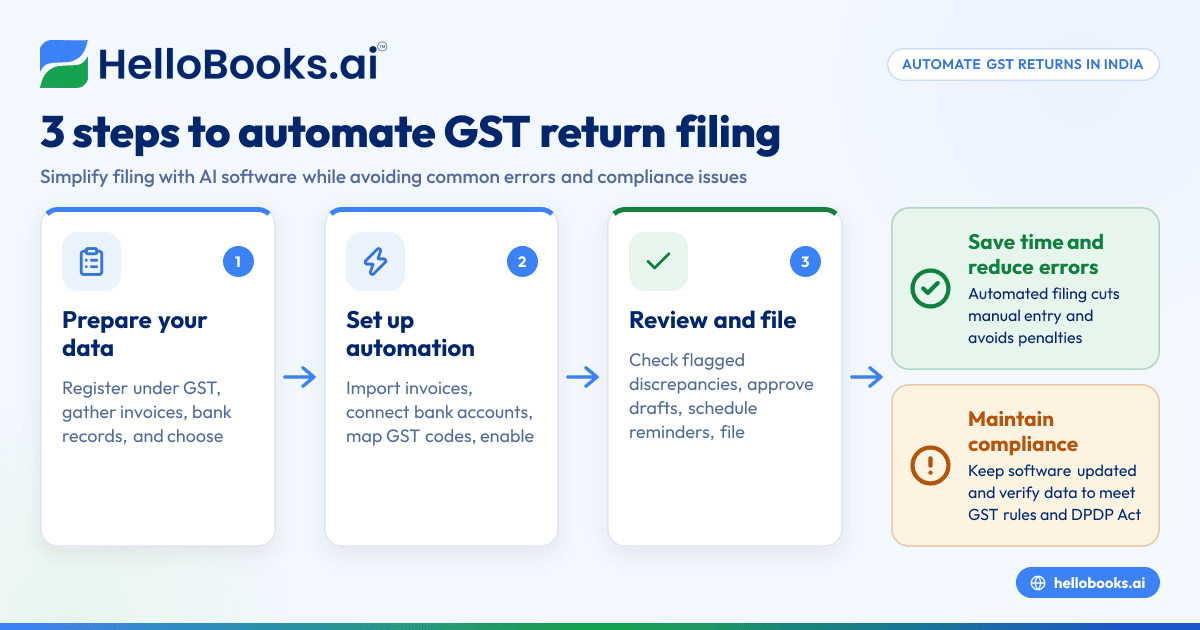
Setting up automation correctly is key to avoid problems:
- Import your existing sales and purchase invoices into the software. Many tools support bulk import via Excel or direct integration with billing systems.
- Upload your bank statements or connect your bank account using secure APIs to enable automatic reconciliation.
- Map your chart of accounts and GST tax codes accurately in the software. Incorrect GST codes can cause wrong tax calculations.
- Enable auto-matching of invoices with payments. The software will then link purchase invoices with outgoing payments and sales invoices with incoming receipts.
- Configure the software to generate GST returns based on reconciled data. Set it to prepare draft GSTR-1 and GSTR-3B returns automatically.
- Review any discrepancies flagged by the software promptly. For example, if a purchase invoice GST amount doesn’t match the payment, investigate and correct the data.
- Schedule reminders and alerts for GST return filing deadlines to avoid penalties.
- Train your team to verify the auto-filled data before filing. Automation reduces errors but does not eliminate the need for human oversight.
A common mistake is ignoring flagged discrepancies or blindly trusting all auto-filled information. Always cross-check reports with your source documents.
What caveats should I be aware of when using AI GST return software?
AI GST return automation depends on the quality of the input data. Errors in invoices or bank feeds will lead to inaccurate returns. Also, GST rules change often, so your software must update regularly. Some transactions, like cash sales without invoices, need manual entry.
Data privacy under the DPDP Act 2023 is crucial—check your software’s compliance. Automation helps but does not replace the need for professional audits or tax advice.
While automation is powerful, keep these caveats in mind:
- The accuracy of automated GST returns depends on the quality of input data. Errors in invoices or bank feeds will lead to incorrect returns.
- GST rules and compliance requirements can change. Ensure your software provider updates the system promptly to reflect new regulations.
- Not all transactions may be captured automatically. For example, cash sales without invoices or manual credit notes may require manual entry.
- Some adjustments like advances received or credit notes issued often need manual intervention.
- The software must comply with data protection norms under the DPDP Act 2023. Verify data security and privacy policies.
- Automation reduces workload but does not replace the need for periodic audits and professional review.
- Filing GST returns using software is subject to GST law; consult your tax advisor if unsure about specific transactions.
Worked example: Automating GST return filing for a Pune-based SME
ABC Traders, a Pune-based SME with an annual turnover of ₹12 crore (illustrative), decided to automate their GST return filing using HelloBooks AI accounting software.
- Importing invoices: ABC Traders imported all sales and purchase invoices from their billing system into HelloBooks. The software recognized GSTINs, invoice numbers, taxable values, and GST amounts automatically.
- Bank reconciliation: They connected their bank account with HelloBooks, which auto-imported bank statements and matched payments against invoices.
- Discrepancy flagging: HelloBooks flagged a few purchase invoices where the GST amount did not match the payment made. The finance lead reviewed these and found some supplier invoices had incorrect GST rates. The suppliers were contacted to issue corrected invoices.
- Generating returns: Based on reconciled data, HelloBooks prepared draft GSTR-1 and GSTR-3B returns. The system automatically aggregated taxable supplies, input tax credits, and GST payable.
- Review and approval: The finance lead reviewed the auto-prepared returns inside HelloBooks and made minor manual adjustments for advances received.
- Filing: HelloBooks generated the JSON files ready for upload on the GST portal. ABC Traders’ accountant filed the returns without manual data entry.
Outcome: ABC Traders reduced manual data entry by approximately 70%, avoided penalties by timely filing, and saved hours previously spent reconciling invoices and payments.
If you want to streamline your GST return filing process, consider trying HelloBooks. You can book a demo or compare plans to see what suits your business needs.
Automating your GST return filing saves time, reduces errors, and helps you focus on growing your business. Start by selecting the right software, setting up your data correctly, and reviewing outputs regularly. With careful use, AI GST return filing tools can be a valuable addition to your finance workflow.
Related reading
- How to Perform Accurate GST Return Filing in India Using AI Bookkeeping Software, Supported with Caveats
- How AI Bookkeeping Can Help Indian SMEs Manage GST Return Filing Efficiently, Supported with Caveats
Read next
This article covers one part of a bigger topic. For the complete picture, read our guide to supported with caveat.