Key takeaways
What this article covers, in order:
- Before you start
- What is AI AIS reconciliation, and how does it help SMEs?
- Step 1: Why reconcile your bank statements regularly?
- Step 2: How can AI software simplify this process?
- Step 3: Which features should you look for in AI reconciliation software?
- Step 4: How to implement AI automated reconciliation in your SME?
How AI Software Can Streamline Automated Bank Reconciliation for SMEs in India
This guide is for SME owners, finance leads, and accountants in India who want to cut down the time spent on bank reconciliation. By the end, you will know how to use AI software to automate your bank reconciliation and avoid common pitfalls that waste time and cause errors.
Before you start
- Have your bank statements and accounting ledger data (Tally, spreadsheets, or existing software) ready.
- Ensure your business bank accounts support electronic statement downloads in formats like CSV or OFX.
- Understand the basics of your accounting workflow and GST compliance.
- Choose AI-powered accounting or bank reconciliation software that supports AIS reconciliation and integrates well with your existing tools.
What is AI AIS reconciliation, and how does it help SMEs?
AI AIS reconciliation stands for Artificial Intelligence Automated Intelligent System reconciliation. It automates matching bank transactions to your accounting records, spotting discrepancies, and suggesting corrections. This reduces manual data entry, speeds up the monthly closing process, and improves accuracy.
Unlike manual reconciliation, AI can handle large volumes of transactions daily, learn typical payment patterns, and propose matches even when details don’t perfectly align, which frees up your finance team for higher-value tasks.
Step 1: Why reconcile your bank statements regularly?
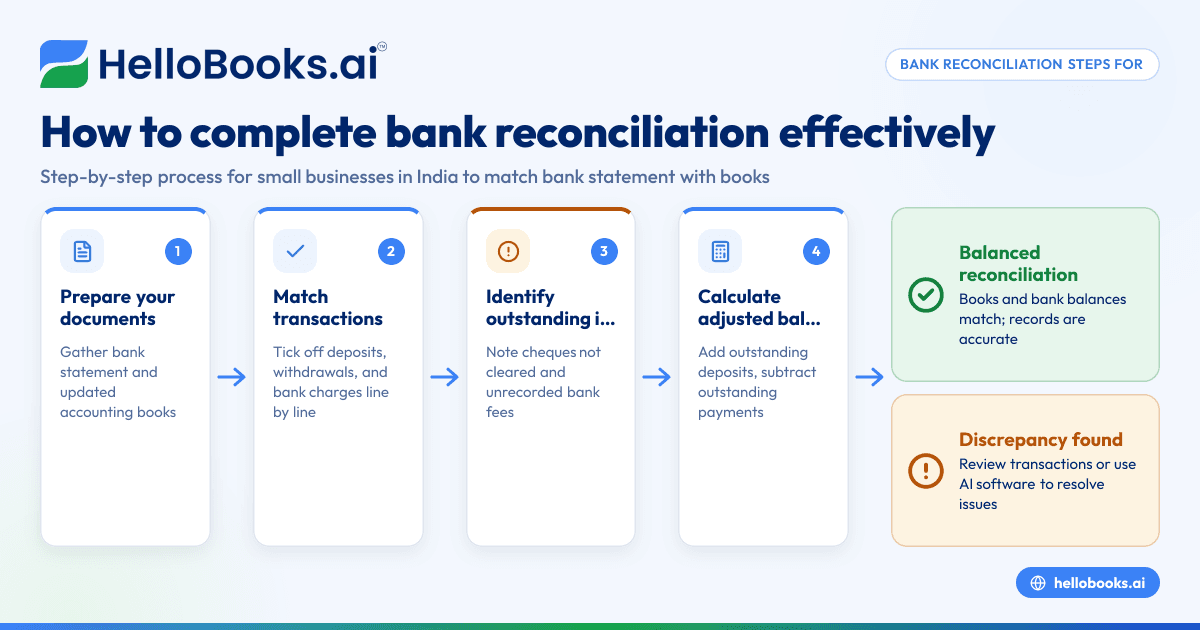
Reconciliation confirms that the money shown in your ledger matches what your bank reports. This keeps your financial records accurate, prevents fraud or errors, and is essential for GST compliance and timely return filing.
Many SMEs miss regular reconciliation because it is time-consuming. Delays can cause problems such as missed payments or mismatched GST claims, affecting cash flow and compliance.
A common mistake is leaving reconciliation until the month-end rush, which leads to last-minute errors and stressful corrections.
Step 2: How can AI software simplify this process?
AI software automatically fetches your bank statements and matches each transaction against invoices, expenses, and payment records kept in your books. It flags unmatched items for review, suggests likely matches, and learns from your feedback to improve accuracy over time.
The AI can even detect duplicate payments or incorrect entries, saving you from costly mistakes. This process is much faster than manual reconciliation and reduces the risk of oversight.
Many SMEs still do partial reconciliation manually, which wastes time and leaves errors hidden.
Step 3: Which features should you look for in AI reconciliation software?
Choose a solution that offers:
- Seamless bank feeds for Indian banks like SBI, HDFC Bank, ICICI, and Axis Bank.
- Support for multiple account reconciliation within one dashboard.
- Automatic categorisation of payments and receipts linked to invoices or bills.
- Alerts for discrepancies, fraud detection, and unusual transactions.
- Export options for GST reporting and audit trails.
- User-friendly interface accessible to non-accountants.
Beware of software that requires excessive manual uploads or does not support Indian banking formats, as it will reduce the benefits of automation.
Step 4: How to implement AI automated reconciliation in your SME?
- Connect your bank accounts via secure APIs or upload statements regularly in supported formats.
- Import your current accounting data or connect existing tools like Tally.
- Train the AI by confirming matches or correcting exceptions during the initial cycles.
- Set reconciliation frequency (daily, weekly, or monthly) according to your business needs.
- Regularly review flagged exceptions and integrate with your GST filing process to ensure error-free returns.
Do not skip the training phase; AI improves with your input, so allocating time for initial review speeds long-term automation.
Worked example: Automating reconciliation for a Pune-based SME
Consider “ABC Fabrics,” a textiles SME in Pune. Each month, ABC receives ₹10 lakh in payments from various retailers, mostly via UPI and bank transfers.
Before AI, their accountant spent 20 hours monthly matching payments against sales invoices in spreadsheets and Tally, often struggling with missing or mismatched details.
After implementing AI-powered bank reconciliation software with AIS reconciliation capabilities and linking three bank accounts:
- The software automatically fetched bank statements daily.
- It matched transactions against over 300 invoices and expense entries.
- AI flagged 15 unmatched entries for quick manual review.
- Reconciliation time reduced from 20 to 4 hours per month.
- Errors in invoice matching dropped by over 90%, easing GST filing.
This resulted in smoother cash flow visibility and increased confidence in financial reporting.
Can I use AI reconciliation software if I’m currently using Tally or spreadsheets?
Yes, many AI reconciliation tools integrate directly with Tally or allow spreadsheet imports. This lets you continue using familiar accounting methods while automating bank matching.
Start by exporting current transaction data into supported formats. Connect your bank feeds to the AI software and allow it to cross-check entries. The AI will learn from your existing data structure and gradually reduce manual intervention.
A mistake is assuming you must fully switch systems; incremental adoption saves time and avoids disruption.
How much time will AI AIS reconciliation software save me?
AI reconciliation software can cut your reconciliation time by 60-80%, depending on your transaction volume and prior manual effort.
Most SMEs report that with automation, tasks that took days reduce to hours, helping close monthly books faster and freeing staff for strategic activities like budgeting.
Efficiency gains also reduce late payment risks and improve cash management.
Next steps to implement AI bank reconciliation
Start by evaluating your current reconciliation workflow and transaction data formats. Choose AI-powered accounting software in India that supports AIS reconciliation, offers bank connectivity, and suits your business size.
You can book a demo to see how AI reconciliation features work and explore plans tailored to your needs at pricing. Automating reconciliation is an investment in accuracy and efficiency that grows with your SME.
By adopting AI, you will spend less time on tedious matching and more on growing your business.
Related reading
- How AI Bookkeeping Software Can Simplify Bank Reconciliation for Small Businesses in the United States
- How Delaware Small-Business Owners Can Choose AI Accounting Software to Simplify Sales Tax and Bank Reconciliation
Read next
This article covers one part of a bigger topic. For the complete picture, read our guide to ais reconciliation.