
Key takeaways
What this article covers, in order:
- Mistake 1: Manual Data Entry Errors — Why Do They Happen and How Can AI Help?
- Mistake 2: Relying Solely on Tally or Traditional Software for Complex Reconciliation?
- Mistake 3: Is Your GST Filing at Risk Because of Missing or Misclassified Transactions?
- Mistake 4: Does AI Bookkeeping Solve All Data Accuracy Problems?
- Mistake 5: Overestimating AI Automation — Can It Replace Your Accountant?
- How does AI bookkeeping make invoice management easier?
How AI Bookkeeping Helps Small Businesses in India Reduce Errors and What Its Limits Are
==========================================================================================
Getting bookkeeping wrong can cost your small business more than just money. Errors in your accounts increase audit risk, delay GST compliance, lead to wrong tax payments or missed input credit, and eat into your valuable time. Fixing these mistakes often means frustrating manual checks, rework, and stress. For small business owners and finance leads in India juggling multiple roles, the right tools become crucial for accuracy and efficiency.
Mistake 1: Manual Data Entry Errors — Why Do They Happen and How Can AI Help?
Manual entry errors happen when you type data into spreadsheets, Tally, or QuickBooks, or copy details from invoices, bank statements, or bills by hand. In Mumbai’s busy wholesale markets or Pune’s bustling retail stores, poor handwriting or unclear print on invoices, missing digits, or transposed numbers add to errors. Even a small mistake like ₹1,000 wrongly entered as ₹10,000 can distort your cash flow projections and GST calculations.
For example, consider a Pune-based garment wholesaler recording daily cash sales and purchases manually. A clerk typing invoice amounts might accidentally transpose digits — say, ₹12,340 becomes ₹13,240. Repeated errors compound, leading to mismatched ledger balances and frustrations at reconciliation time every month.
An AI-powered bookkeeping system automates data capture for invoices and bank transactions with Optical Character Recognition (OCR) and machine learning. The AI recognises text on scanned invoices and PDFs, extracts key values like invoice number, date, GSTIN and amounts, then intelligently matches these entries against purchase or sales ledgers. It flags exceptions such as mismatches, missing data, or duplicate entries for quick review.
This reduces human error by thousands of clicks and keystrokes, speeding up overall data entry and improving accuracy. Your Pune wholesaler can spend more time growing the business, not chasing invoice corrections or reconciliations.
Mistake 2: Relying Solely on Tally or Traditional Software for Complex Reconciliation?
Tally is a favourite for Indian SMEs for basic accounting, but many businesses struggle when handling hundreds of small expenses, GST invoices, and digital payments manually. For example, a Bengaluru startup using Tally might receive dozens of UPI transactions daily, multiple purchase bills with input tax credit implications, and GST e-invoices to manage. Reconciling these bank transactions with ledger entries by hand can lead to overlooked mismatches and delays, especially when month-end nears.
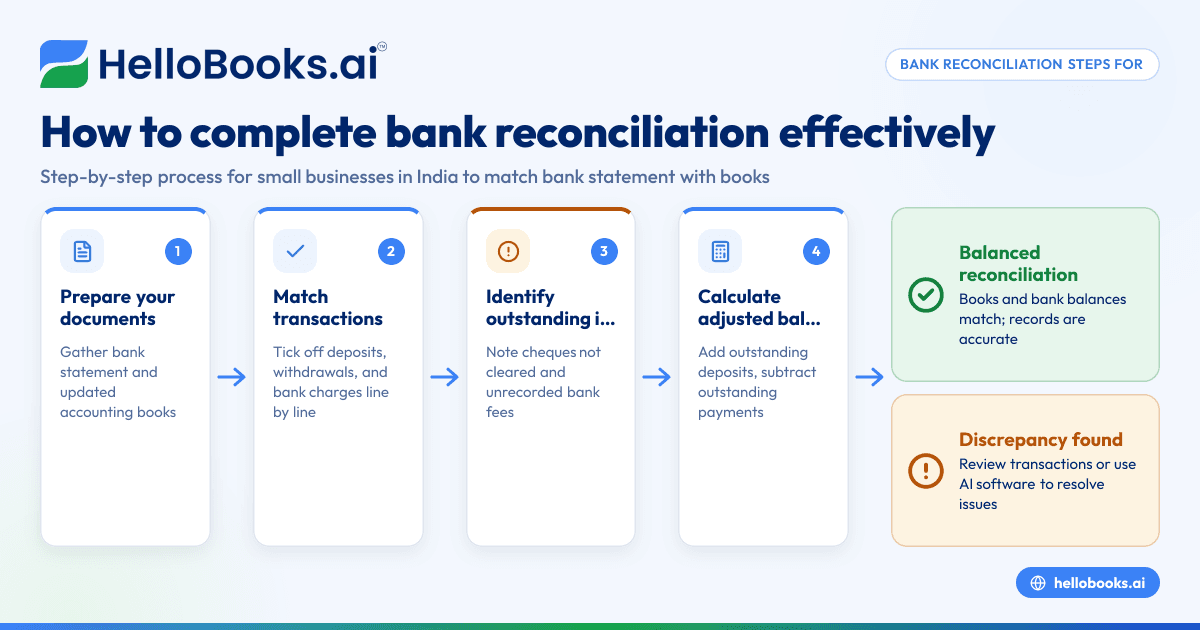
An automated AI approach to bank reconciliation software can compare thousands of transactions instantly. The AI learns your usual payment and invoice patterns — such as recurring vendor payments or salary transfers — and automatically matches bank entries to invoices or expense claims. It detects anomalies like a vendor payment without a matching invoice or duplicate reimbursements.
This cutback on manual checking means faster, more reliable reconciliation and compliance updates. For example, a Pune-based logistics company automating reconciliation saves days of accounting work monthly and instantly spots GST credit claims that don’t match supplier invoices, preventing compliance issues.
Mistake 3: Is Your GST Filing at Risk Because of Missing or Misclassified Transactions?
GST compliance is non-negotiable. Many small businesses miss or wrongly classify expenses, impacting input tax credit and taxable turnover calculations. Typically, some last-minute valid purchases or e-invoices may be overlooked just before filing, causing higher tax payments or penalties from inaccurate returns. Misclassification between IGST, CGST, and SGST on interstate and intrastate transactions is another common pitfall.
For instance, a Mumbai-based electronics parts manufacturer might manually enter purchase bills from multiple suppliers and fail to note the correct GST rate or reverse charge applicability. This leads to underclaimed input credit or GST mismatch notices from the tax department.
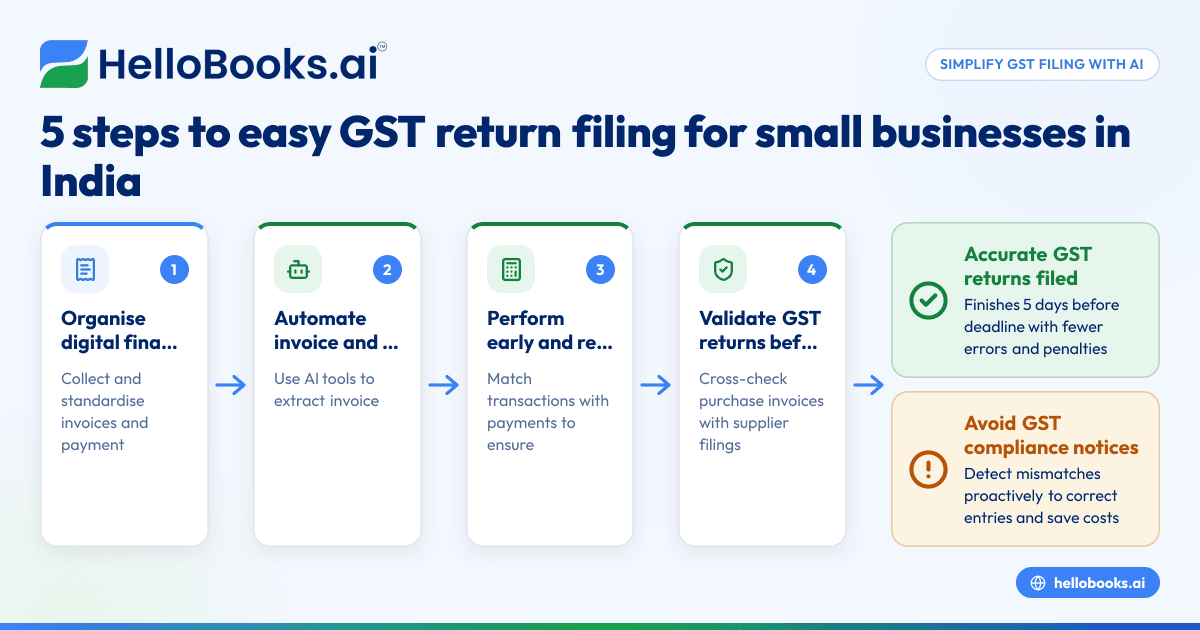
AI bookkeeping software that integrates with GST return filing software can automatically classify transactions by GST rate, reconcile them with suppliers' e-invoices, verify HSN codes, and flag incomplete or incorrect data. This ensures your books are current and compliant — easing e-invoicing and return filing by reducing last-minute surprises.
However, periodic manual review remains critical because updates in GST rules or new expense categories require human oversight. AI’s pattern recognition aids compliance but cannot fully replace expert judgment on complex tax matters.
Mistake 4: Does AI Bookkeeping Solve All Data Accuracy Problems?
AI software assists with speed and accuracy but won't replace the need for good internal controls and proper bookkeeping habits.
It requires clean data inputs — scanned documents should be legible, and original invoices must be complete. Automated systems learn from existing data patterns, so new, unusual transactions or one-off events can confuse AI or cause misclassifications.
For example, sudden purchases for a new product line or one-time vendor payments may not conform to historical norms. AI will flag these as exceptions, but manual follow-up is necessary for correct categorisation.
Human judgment remains essential to catch fraud attempts, identify anomalies such as inflated expenses, and validate automated suggestions. AI tools reduce routine errors but cannot fully fix incomplete or deliberately incorrect records. Incorrect data at the start still leads to problems downstream, including inaccurate financial reports and tax filings.
Mistake 5: Overestimating AI Automation — Can It Replace Your Accountant?
AI automation reduces repetitive tasks, freeing finance teams from tedious data entry and enabling faster reconciliations. But it does not replace the need for accountants or finance professionals.
Accountants provide strategic value: interpreting complex transactions, planning tax-saving strategies, managing audits, and advising on regulatory changes like the DPDP Act 2023 on personal data protection or GST notifications.
Think of AI as a force multiplier for your accountant or finance team. Small business owners need both: automation to fix data entry and reconciliation errors at scale, plus expert advice on compliance, tax benefits, and regulatory updates.
Without qualified professionals, AI’s benefits are limited — it won't help optimise your tax liabilities or negotiate with tax authorities.
How does AI bookkeeping make invoice management easier?
Invoice management involves timely recording, validation, payment follow-up, and auditing. Manual processes lead to delays and errors, hurting cash flow and supplier relationships.
AI bookkeeping software can automatically extract details from sales and purchase invoices using OCR, validate GST elements such as invoice number format and GSTIN, verify HSN codes, and check invoice duplication. It can even trigger reminders or alerts for overdue payments via WhatsApp or email, crucial in India’s business context where informal communication prevails.
For example, a retailer in Pune using an AI tool connected with invoice software can minimise delays in recording sales invoices and speed up cash flow management. The system detects mismatches immediately, reducing disputes and simplifying audit trails. This cuts down manual effort while keeping supplier and customer relationships smooth.
What is the best simple weekly routine to keep books accurate and benefits flowing?
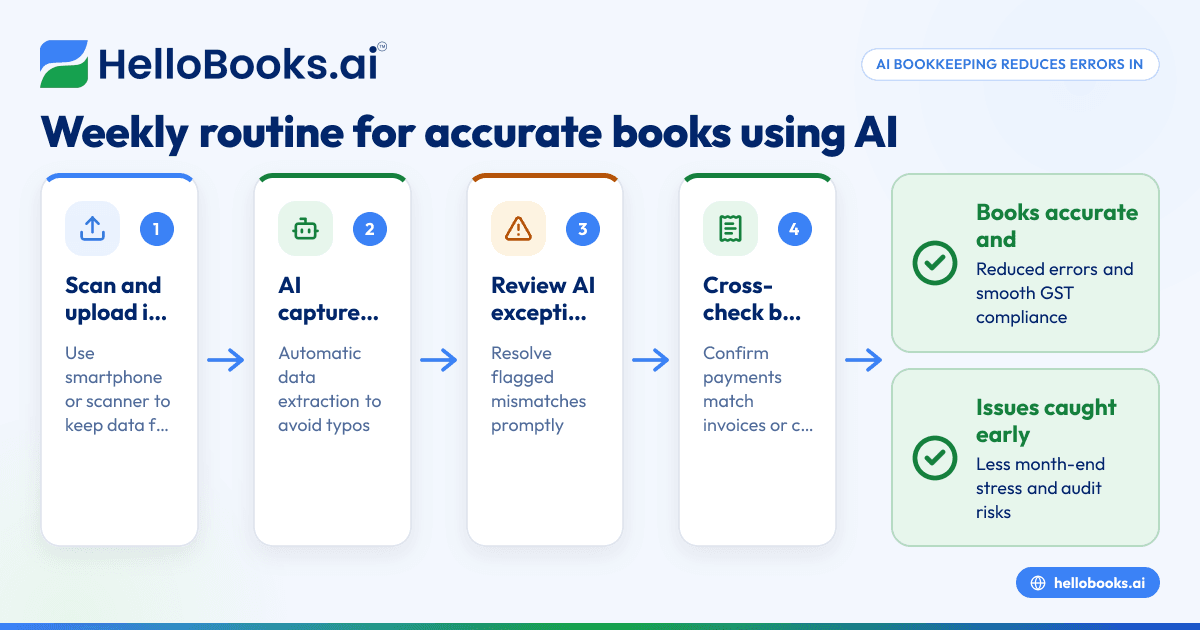
Establishing a routine helps catch errors early and maintain up-to-date accounts. Here is a simple weekly checklist for small businesses in Mumbai, Bengaluru, or tier-2 cities:
- Scan and upload all invoices and bills immediately: Use your smartphone or scanner. Prompt uploads keep data fresh.
- Let AI automatically capture and categorise entries: Avoid manual entry where possible to reduce typos.
- Review AI-flagged exceptions or mismatches: Spend 20-30 minutes resolving flagged items rather than waiting for month-end crisis.
- Cross-check bank reconciliation with AI suggestions: Confirm payments link to invoices or expense claims.
- Verify GST-related transactions for accuracy: Ensure rates, codes, and reverse charges are correctly applied.
- Download reports and flag unusual trends: Look for sudden spikes in expenses or missing revenue items.
- Schedule follow-up with your accountant for flagged items: Especially for complex or unusual entries that need professional review.
Keeping to this routine reduces GST filing headaches and keeps your books audit-ready throughout the year.
Small business owners in Mumbai or Hyderabad can greatly reduce accounting overhead using AI bookkeeping, making financial management more accurate and less stressful. But remember, it is a tool to assist you — not a magic wand. Combine technology with routine reviews and professional advice for best results.
If you want to see the difference AI bookkeeping brings to your daily finance workflows and compliance, you can book a demo or compare plans. Reducing errors and saving time is well within reach when your books are smart and automated.
Related reading
- How AI Bookkeeping Supports Small Businesses While Highlighting Limitations in India
- What to Know Before Using AI Bookkeeping for Your Small Business in India
Read next
This article covers one part of a bigger topic. For the complete picture, read our guide to supported with caveat.