


Key takeaways
What this article covers, in order:
- Why this comes up / what goes wrong
- Step-by-step
- Example (fictional figures)
- Common mistakes
- Doing this in HelloBooks
- Frequently asked questions
A hotel GST bill format is a tax invoice that complies with GST rules and includes details such as supplier and recipient names and GSTINs, invoice number and date, HSN or SAC codes, taxable value, CGST/SGST/IGST rates and amounts, place of supply, and signatures. Hotels must issue such bills for their services and goods to customers, ensuring proper GST compliance and smooth input tax credit claims.
Why this comes up / what goes wrong
Hotel business owners or accountants often struggle with creating GST bills that meet the statutory requirements under GST law. Many hotels, especially small and mid-sized ones, still rely on manual bill books or spreadsheets, leading to errors or missing details. Incorrect GST bills can cause delays in GST filing, rejection of input tax credit (ITC) claims by customers, or penalties. A ready-to-use, clear hotel GST bill format helps avoid these issues by standardising invoice creation and ensuring all mandatory particulars are included.
Step-by-step
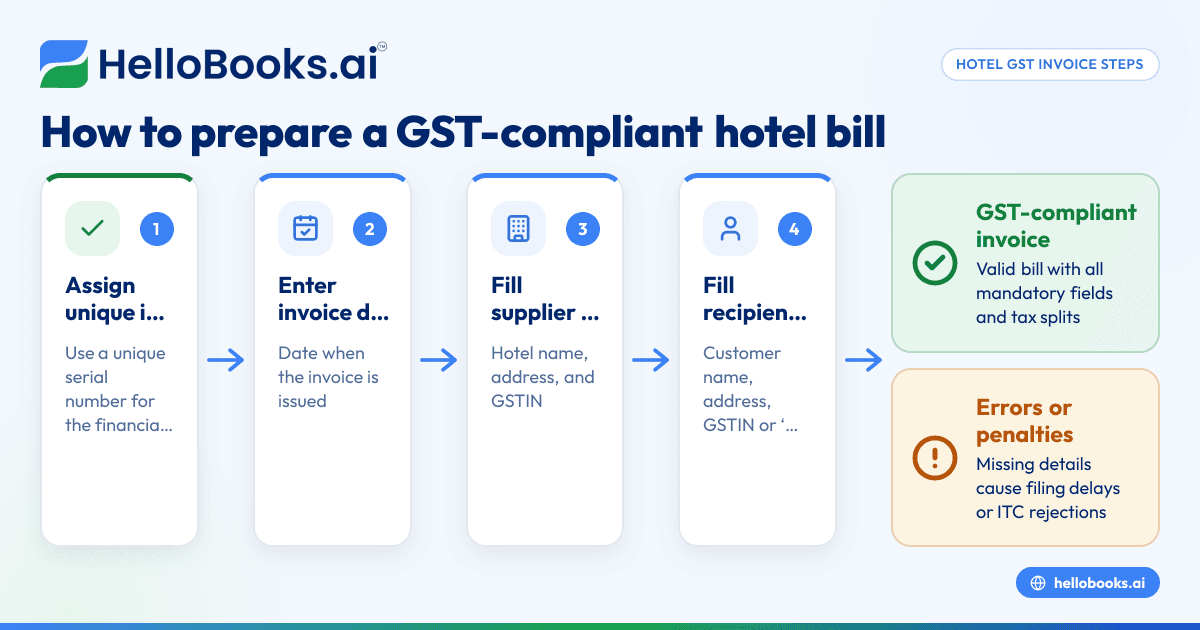
- Assign a unique invoice number: Use a consecutive serial number (up to 16 characters) unique for the financial year, containing letters, numbers, ‘-’ or ‘/’. Check that this number has not been used before.
- Enter the invoice date: This is the date on which the invoice is issued.
- Fill in supplier details: Include the hotel’s name, address, and GSTIN.
- Fill in recipient details: Add the customer’s name, address, and GSTIN or UIN if registered. For walk-in customers without GSTIN, mention ‘Unregistered’.
- Mention place of supply: State the place where supply is made along with the state name, especially important for inter-state supplies.
- List goods or services with HSN/SAC codes: Use the correct HSN code for goods or SAC code for services provided by the hotel, such as room rent, food, or beverages.
- Describe quantity and unit: For goods, mention quantity and unit (e.g., 2 bottles). For services, quantity can be ‘1’ or as applicable.
- Calculate taxable value: Show the total value before tax, minus any discounts.
- Apply GST rates and calculate tax amounts: Split tax into CGST and SGST for intra-state or IGST for inter-state supplies. Show each tax amount separately.
- Mention if reverse charge applies: Usually not applicable for hotel services but check your transactions.
- Include delivery address if different: If goods or services are delivered elsewhere, mention that address.
- Sign or digitally sign the invoice: The supplier or authorised representative must sign.
Check all fields carefully for accuracy before issuing the invoice.
Example (fictional figures)
Date: 15/05/2024
Hotel: The Pune Stay, Pune, GSTIN 27ABCDE1234F1Z5
Customer: Mr. Rajesh Kumar, Mumbai, GSTIN 27XYZDE5678L1Z2
Invoice No: INV/2024/0001
Place of Supply: Maharashtra
| Description | HSN/SAC Code | Quantity | Unit | Rate (₹) | Amount (₹) |
|---|---|---|---|---|---|
| Room Rent (1 night) | 996311 | 1 | Night | 3,000 | 3,000 |
| Food & Beverages | 996321 | 1 | Set | 1,500 | 1,500 |
Taxable Value = ₹3,000 + ₹1,500 = ₹4,500
Assumed GST rate: 18%
CGST = ₹4,500 × 9% = ₹405
SGST = ₹4,500 × 9% = ₹405
Total GST = ₹405 + ₹405 = ₹810
Total Invoice Value = ₹4,500 + ₹810 = ₹5,310
The invoice must clearly show these calculations and tax splits.
Common mistakes
- Missing GSTIN or incorrect GSTIN: Always verify the GSTIN of both supplier and recipient to avoid ITC rejection.
- Incorrect or missing HSN/SAC codes: Use the correct codes for hotel services to ensure compliance.
- No unique invoice number or duplicate numbers: Maintain a proper serial numbering system.
- Wrong tax rates or tax splits: Confirm if supply is intra-state (CGST+SGST) or inter-state (IGST) and apply rates accordingly.
- Omitting place of supply or delivery address: This can cause confusion in tax jurisdiction.
- Not signing the invoice: Digital or physical signature is mandatory.
Using a GST invoice validator can help spot errors before issuing bills.
Doing this in HelloBooks
HelloBooks offers GST invoicing that creates GST-ready invoice formats with the correct CGST/SGST or IGST split and HSN/SAC codes from the customer's GSTIN, ensuring all fields Rule 46 requires are filled consistently. For businesses exceeding the ₹5 crore turnover threshold, HelloBooks supports e-invoicing with IRN and signed QR codes generated at save time. It also enables direct filing of GSTR-1 and GSTR-3B returns built from your recorded invoices, ensuring your returns match your issued bills. Learn more about GST invoicing and how HelloBooks supports restaurants, cafes and cloud kitchens here.
Frequently asked questions
What details are mandatory on a hotel GST bill?
A hotel GST bill must contain the supplier's and recipient's names and GSTINs, invoice number and date, HSN/SAC codes, taxable value, CGST/SGST or IGST rates and amounts, place of supply, delivery address if different, and the supplier’s signature as per Rule 46 [cgst-rule-46/rule46-particulars].
Do hotels need to issue e-invoices?
Hotels with aggregate turnover exceeding ₹5 crore must issue e-invoices for B2B supplies from 1 August 2023, obtaining an IRN and signed QR code [einvoice-threshold-5cr/einv-5cr-from-2023-08-01].
Can I use a simple Excel sheet for hotel GST bills?
Yes, but you must ensure all mandatory fields are included and calculations are accurate. Using dedicated software or validated templates reduces errors.
When are GSTR-1 and GSTR-3B returns due?
Monthly GSTR-1 is due by the 11th day of the following month, and GSTR-3B by the 20th day [gstr1-due-date/gstr1-monthly-11th] [gstr3b-due-date/gstr3b-monthly-20th]. Under QRMP, quarterly dates differ [qrmp-scheme/qrmp-dates].
What is the difference between HSN and SAC codes?
HSN codes classify goods, while SAC codes classify services. Hotels use SAC codes for services like room rent and food.
Key takeaways
- A hotel GST bill format must comply with Rule 46, including GSTINs, invoice number, date, HSN/SAC codes, taxable value, tax rates, and signatures.
- Use a unique invoice number and verify GSTINs to avoid errors.
- Correct tax rate application and clear tax splits (CGST/SGST or IGST) are essential.
- HelloBooks automates GST invoicing with compliant formats, e-invoicing, and direct GST return filing.
- Regularly check deadlines for GSTR-1 and GSTR-3B filing to stay compliant.
Start creating GST-compliant hotel bills easily with HelloBooks. Start on the Free plan (200 transactions a year, GSTR-1 and 3B filing for one GSTIN).
This article is general information, not tax or legal advice. Rules change; confirm the current position on gst.gov.in or with your chartered accountant before acting.


