


Key takeaways
What this article covers, in order:
- Why this comes up / what goes wrong
- Step-by-step
- Example (fictional figures)
- Common mistakes
- Frequently asked questions
- Key takeaways
Food truck accounting software is designed to simplify bookkeeping, GST invoicing, expense tracking, and reconciliation for mobile food vendors. It helps avoid manual errors, saves time on compliance, and provides clearer insights into profitability.
Why this comes up / what goes wrong
Food truck owners often start by managing accounts with spreadsheets, bill books, or basic Tally setups. However, these methods become cumbersome as daily transactions, GST invoicing, and inventory management grow. The mobile nature of the business adds complexity: sales happen at different locations, cash and digital payments mix, and stock levels fluctuate rapidly. Without specialised software, owners spend excessive time on data entry and risk errors in GST filing or stock tracking.
Owners also struggle to keep track of GST compliance deadlines and reconcile input tax credit claims, which can lead to penalties or lost tax benefits. Managing perishable inventory and multiple payment modes manually increases the chance of mistakes. Choosing the right food truck accounting software is crucial for efficient financial management and compliance.
Step-by-step
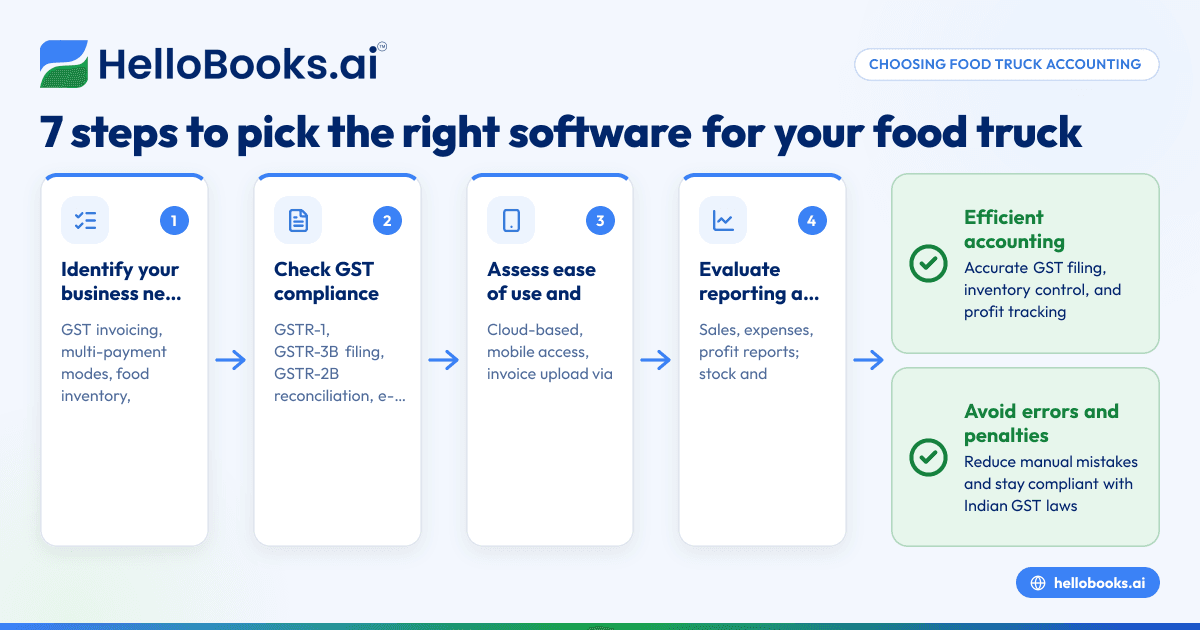
- Identify Your Business Needs:
- Check if the software supports GST invoicing and e-invoicing, essential for compliance.
- Ensure it handles multiple payment modes common in food trucks, like cash, UPI, and card payments.
- Look for inventory tracking tailored to food items, including expiry management.
- Confirm it can reconcile bank statements and expenses easily to save time.
- Check GST Compliance Features:
- Verify if the software can prepare and file GSTR-1 and GSTR-3B returns.
- Look for GSTR-2B reconciliation features to claim correct ITC.
- Ensure it supports e-way bill generation if your goods movement requires it.
- Assess Ease of Use and Accessibility:
- Prefer cloud-based software accessible on mobile devices for on-the-go updates.
- Check if it allows uploading bills and invoices via mobile camera to reduce manual entry.
- Evaluate Reporting and Insights:
- The software should provide detailed sales, expense, and profit reports.
- Inventory reports should alert you about low stock or expiry to avoid wastage.
- Compare Pricing and Scalability:
- Choose a plan that fits your transaction volume and GSTIN requirements.
- Ensure the software can scale as your food truck business grows or adds more trucks.
- Trial and Support:
- Use free trials to test features before committing.
- Check for customer support availability to assist with issues or queries.
- Integration Possibilities:
- See if the software integrates with your existing tools like Tally or Excel for smoother data migration and reporting.
For more on choosing software, see accounting software for small business and accounting software in India.
Example (fictional figures)
A food truck owner in Mumbai records daily sales and expenses for April 2024:
- Total sales (taxable): ₹1,50,000
- GST rate assumed: 5%
- Expenses (ingredients, fuel): ₹60,000
Calculate GST collected:
₹1,50,000 × 5% = ₹7,500
Total amount including GST:
₹1,50,000 + ₹7,500 = ₹1,57,500
Calculate net profit before tax:
Sales (₹1,50,000) - Expenses (₹60,000) = ₹90,000
This example shows how software can automate these calculations, generate GST invoices with correct tax, and prepare GSTR-1 and 3B returns accurately. It also helps reconcile bank statements and track expenses to maintain accurate books.
Common mistakes
- Ignoring GST compliance features:
- Prevent by choosing software that supports GSTR-1 and 3B filing to avoid penalties and interest.
- Not tracking inventory properly:
- Prevent by using software with inventory modules tailored for perishable food items to reduce wastage.
- Manual data entry errors:
- Prevent by selecting software that allows invoice scanning or bank statement uploads to reduce mistakes.
- Overlooking multi-location sales tracking:
- Prevent by ensuring the software can record sales by location or event to understand performance.
- Choosing software without mobile access:
- Prevent by opting for cloud-based solutions accessible on smartphones for real-time updates.
- Ignoring customer support and training:
- Prevent by verifying support availability and training resources before purchase.
See more about software suitability in HelloBooks for India.
Frequently asked questions
What features should food truck accounting software have?
It should support GST invoicing, e-invoicing, expense and inventory tracking, bank reconciliation, and provide clear financial reports. Mobile access and ease of use are also important for on-the-go management.
Can food truck accounting software handle GST filing?
Yes, good software prepares and files GSTR-1 and GSTR-3B returns, helps reconcile GSTR-2B to claim ITC, and supports e-way bill generation if needed.
Is Tally enough for a food truck business?
Tally can manage basic accounting but may lack mobile access, easy GST filing, and inventory tracking suited for food trucks. Dedicated software often reduces manual work and errors.
How to manage inventory in food truck accounting?
Use software that tracks stock levels, expiry dates, and alerts for reorder. This prevents wastage and stockouts common in food businesses.
Are there free options for food truck accounting software?
Some software offers free plans with limited transactions and GST filing for one GSTIN, suitable for small-scale food trucks starting out.
Key takeaways
- Food truck accounting software streamlines GST compliance, invoicing, and inventory management.
- Choose software with mobile access and features tailored to food and beverage businesses.
- Avoid manual errors by using software that supports invoice scanning and bank reconciliation.
- Ensure GST filing capabilities like GSTR-1 and 3B are included.
- Test software with free trials and check customer support before buying.
- Integration with existing tools like Tally or Excel can ease transition.
To start managing your food truck accounts efficiently, start on the Free plan (200 transactions a year, GSTR-1 and 3B filing for one GSTIN).


